
Lobbyists ‘Deploy’ to Stop Sovereign Debt Reform Bill

Four lobbying groups representing Wall Street firms are trying to block the bill from passing in the final days of the legislative session.

Julia Rock and Chris Bragg   ·   June 12, 2025
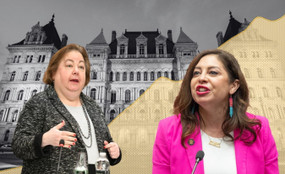
Lobbying groups representing Wall Street firms are mounting an eleventh-hour push to stop proposed legislation that would limit creditor lawsuits against countries that default on their debt payments. | Photo: kevinjeon00 / Getty Images | Illustration: Leor Stylar

Sign up for Staying Focused, our newsletter keeping readers up to speed on New York politics.

Lobbying groups representing Wall Street firms are mounting an eleventh-hour push to stop proposed legislation that would limit creditor lawsuits against countries that default on their debt payments. Those lawsuits are often brought by hedge funds that are not satisfied with the debt repayment terms that other creditors, like governments, accept in restructuring negotiations.

The bill was developed by community groups after Puerto Rico defaulted on its debt and New Yorkers watched as friends and family in the territory faced school and hospital closures and lost their pensions.

The legislation passed the state Senate last week, and the bill’s Assembly sponsor, Jessica González-Rojas from Queens, was optimistic that it would pass her chamber as well.

One prominent business group has remained on the sidelines: the Partnership for New York City, which represents companies, big law firms, and banks.

“In general, we don’t think New York State should be attempting to regulate industry at a global or national level, since it puts a strain on state resources and tends to reinforce the perception that New York is over-regulated and not a great place to do business,” said Kathryn Wylde, CEO of the Partnership. But, she said, the bill sponsors “worked with representatives of industry to make the language in this bill quite narrow and less objectionable than original drafts so we have not engaged in opposition to this version.”

But now, four groups are pressing the Assembly to stop the bill in its tracks. One is the Business Council, which represents a broad swath of companies, ranging from National Fuel Gas to Northrop Grumman, and is the most prominent voice for business interests in Albany.

The other three are national organizations that represent the finance sector: the Securities Industry and Financial Markets Association, the Creditor Rights Coalition, and the Loan Syndications and Trading Association.

González-Rojas said the lobbying groups seem to have “deployed” to influence Assembly lawmakers after their Senate counterparts passed the bill on June 4.

Opposition memos circulated to assemblymembers and obtained by New York Focus detail the lobbyists’ arguments. The groups say the legislation would raise borrowing costs for countries and could lead firms to move operations outside of New York.

About half of sovereign bonds — tens of trillions of dollars’ worth of debt held by countries around the world — are issued under New York state law. Countries issue the bonds to raise money for infrastructure or other public expenses, promising to repay the buyers later with added interest. In recent decades, some hedge funds have adopted strategies of buying distressed sovereign debt and then aggressively suing for repayment when countries default, often in New York courts.

The bill currently before the Assembly, backed by progressive groups, seeks to rein in those investors — sometimes called “vulture funds” — by reviving an old defense against the lawsuits. It would also lower the interest rate on defaulted debt, lessening the incentive to drag out litigation. Bloomberg estimates that the legislation would impact about $800 billion in debt from developing countries.


A June 4 memo from the Loan Syndications and Trading Association and Creditor Rights Coalition said that more than $700 billion in sovereign bonds governed by New York law were likely traded in 2024, earning traders, law firms, and financial firms “substantial revenue.”

Sovereign debt issuance, trading, and litigation might move to other states if New York passed the legislation, the groups warned: “This business is lucrative and other states know it.”

The Business Council echoed concerns about “the ramifications this legislation will have for New York’s economy, budget, and its stature as the financial capital of the world” in its memo, which is publicly available.

Gregory Makoff, an expert on sovereign debt at the Harvard Kennedy School who has advised legislators on the bill, said that concern is “absurd.”

“No country would choose to move the governing law of their new funding from New York to Texas just to make it easier for vultures to sue them,” Makoff said.

The Loan Syndications and Trading Association and Creditor Rights Coalition also warned that the bill would undermine the sanctity of contracts, creating uncertainty that would increase borrowing costs for countries.

Also on June 4, the Securities Industry and Financial Markets Association, or SIFMA, circulated a memo making similar arguments. During floor debates before the Senate passed the legislation, two Republican senators, Jack Martins and Mark Walczyk, gave long speeches slamming the proposal. Walczyk read from SIFMA’s 2024 statement on the bill.

According to Michael Kink, executive director of a coalition that supports the bill, the two senators huddled after their speeches with William Crowell, a lobbyist from the firm Dickinson & Avella PLLC. The firm recently signed a $4,286-a-month contract to lobby for the Loan Syndications and Trading Association, state lobbying records show.

The legislative session is expected to end next week, and it’s unclear if the bill will be brought to a vote in the Assembly before then.

“We haven’t gotten confirmation of any Assembly vote — but we don’t have confirmation of Assembly votes on any issues,” said González-Rojas. “We’re all on pins and needles, and there’s a lot of competition to have debate on bills, and only limited time left.”

This article has been updated with a statement from Kathryn Wylde, CEO of the Partnership for New York City, received after initial publication.

At New York Focus, our central mission is to help readers better understand how New York really works. If you think this article succeeded, please consider supporting our mission and making more stories like this one possible.

New York is an incongruous state. We’re home to fabulous wealth — if the state were a country, it would have the tenth largest economy in the world — but also the highest rate of wealth inequality. We’re among the most diverse – but also the most segregated. We passed the nation’s most ambitious climate law — but haven’t been meeting its deadlines and continue to subsidize industries hastening the climate crisis.

As New York’s only statewide nonprofit news publication, our journalism exists to help you make sense of these contradictions. Our work scrutinizes how power works in the state, unpacks who’s really calling the shots, and reveals how obscure decisions shape ordinary New Yorkers’ lives.

In the last two decades, the number of local news outlets in New York has been nearly slashed in half, allowing elected officials and powerful individuals to increasingly operate in the dark — with the average New Yorker none the wiser.

We’re on a mission to change that. Our work has already shown what can happen when those with power know that someone is watching, with stories that have prompted policy changes and spurred legislation. We have ambitious plans for the rest of the year and beyond, including tackling new beats and more hard-hitting stories — but we need your help to make them a reality.

If you’re able, please consider supporting our journalism with a one-time gift or a monthly gift. We can't do this work without you.

Thank you,


Julia Rock is a reporter for the Financial Times. She was previously an investigative reporter at New York Focus and The Lever.
A photo of Chris Bragg.
Chris Bragg is the Albany bureau chief at New York Focus. He has done investigative reporting on New York government and politics since 2009, most recently at The Buffalo News and Albany Times Union.
Also filed in New York State

In May, state lawmakers passed a $269 billion budget after haggling for months over thousands of line items and policies affecting New Yorkers.

Millions in outside spending was a boon to Gov. Kathy Hochul’s 2022 opponent, Lee Zeldin, and influenced down-ballot races.

The legislation would make it easier for currently and formerly incarcerated people and child victims to sue the state over allegations of past abuse.