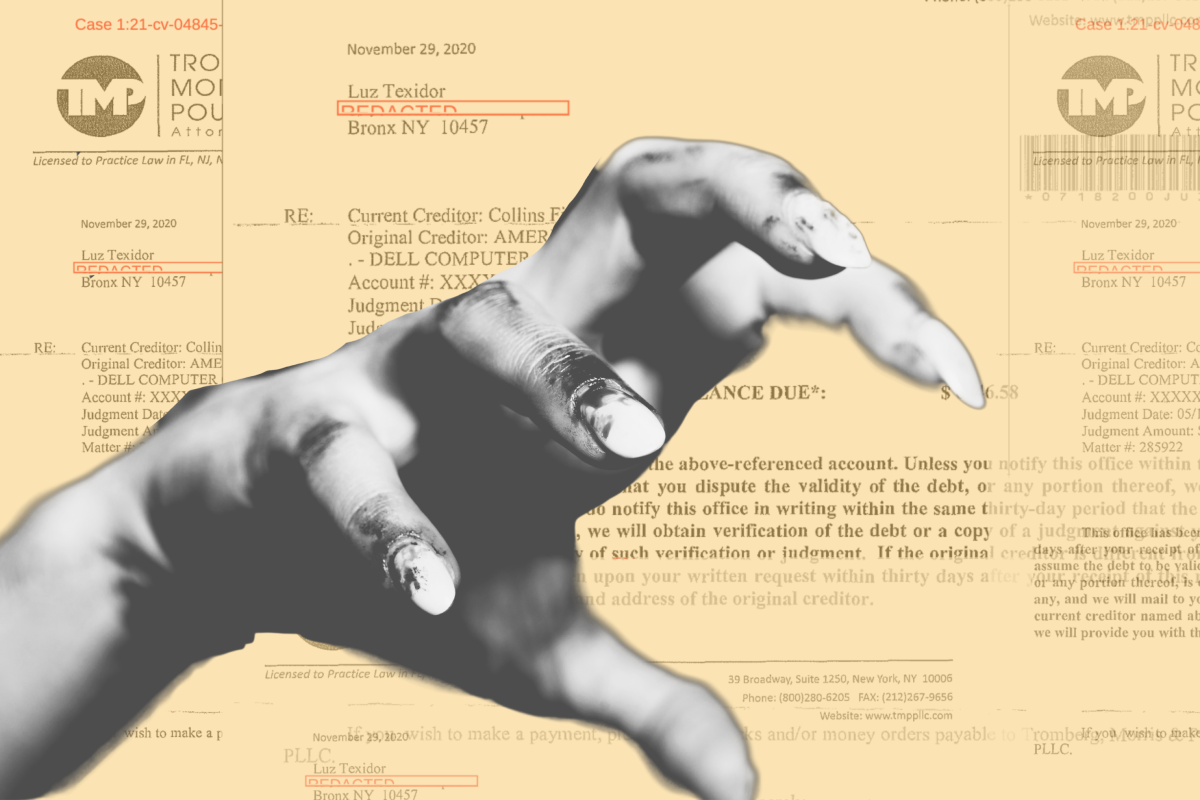
Fraud and falsehoods often don’t stop debt collectors from pursuing their targets for years.
Fraud and falsehoods often don’t stop debt collectors from pursuing their targets for years. ·  View in browser
NEWSLETTER

Funding local news is more important than ever, and it will take a village to succeed. Join us in our work to rebuild local journalism as a pillar of democracy in New York.

Industry experts refer to delayed debt-collection attempts as “zombie debt.” Photo: neoblues/Getty Images | Illustration: Leor Stylar
Fraud and falsehoods often don’t stop debt collectors from pursuing their targets for years.
By Sam Mellins

In recent months, New York Focus has been reporting on “sewer service,” the term for when plaintiffs in a lawsuit fail to properly inform defendants that they’re being sued.

Sewer service is particularly widespread in the debt collection industry, where it frequently results in creditors winning cases and garnishing a defendant’s paycheck before those defendants even realize they’ve been sued.

It’s often the result of dishonest process servers — people hired by plaintiffs to hand-deliver lawsuits to defendants — who lie about having done their job.

High-profile lawsuits over sewer service in the early 2000s prompted government crackdowns and reforms designed to rein in lawless servers. Since then, some of the most notorious actors have been banned from the industry.

Yet the fraud can still haunt New Yorkers years later. That’s because a plaintiff can collect a debt up to 20 years after winning a judgment in New York, even if serious doubts arise about the process server’s integrity. Industry experts refer to these delayed debt-collection attempts as “zombie debt.”

New York Focus found several examples of zombie debt persisting for years after a server was credibly accused of widespread fraud. In most cases, the defendants never fight back. Here are three stories of defendants who did.

Related: Have You Been Sued for Credit Card Debt? Your Fake Relative Might Know.

Shoplifting remains fully prosecutable in New York state. Photos: Photos: Vectorportal.com, lorozco3D/Getty | Illustration: Leor Stylar
First-time offenders might receive community service, but penalties may be severe.
By Ferdi Ferhat Özsoy

NO.

Shoplifting remains a criminal offense under New York state law, prosecuted as larceny.

Theft of property valued at $1,000 or less is classified as petit larceny, a Class A misdemeanor, carrying penalties of up to one year in jail and a fine of $1,000. If the stolen property exceeds $1,000 in value, the crime is charged as grand larceny, a felony that carries multi-year prison sentences and fines ranging from $5,000 to $30,000, depending on the value and circumstances.

The 2019 bail reform law eliminated cash bail for most misdemeanors and non-violent felonies, meaning most accused shoplifters receive desk appearance tickets instead of pretrial detention.

The crime remains fully prosecutable and convictions can lead to substantial penalties. Judges have discretion; first-time offenders might receive community service, but penalties may be severe, particularly in cases of organized retail theft, which now face stronger enforcement and harsher sentences. Shoplifting is not permitted or “decriminalized” anywhere in New York.

New York Focus partners with Gigafact to produce fact briefs, or quick-response fact checks, about trending claims relating to New York state.

This fact brief is responsive to conversations such as this one.

Got a claim you want us to check? Submit it here.

Recent Stories

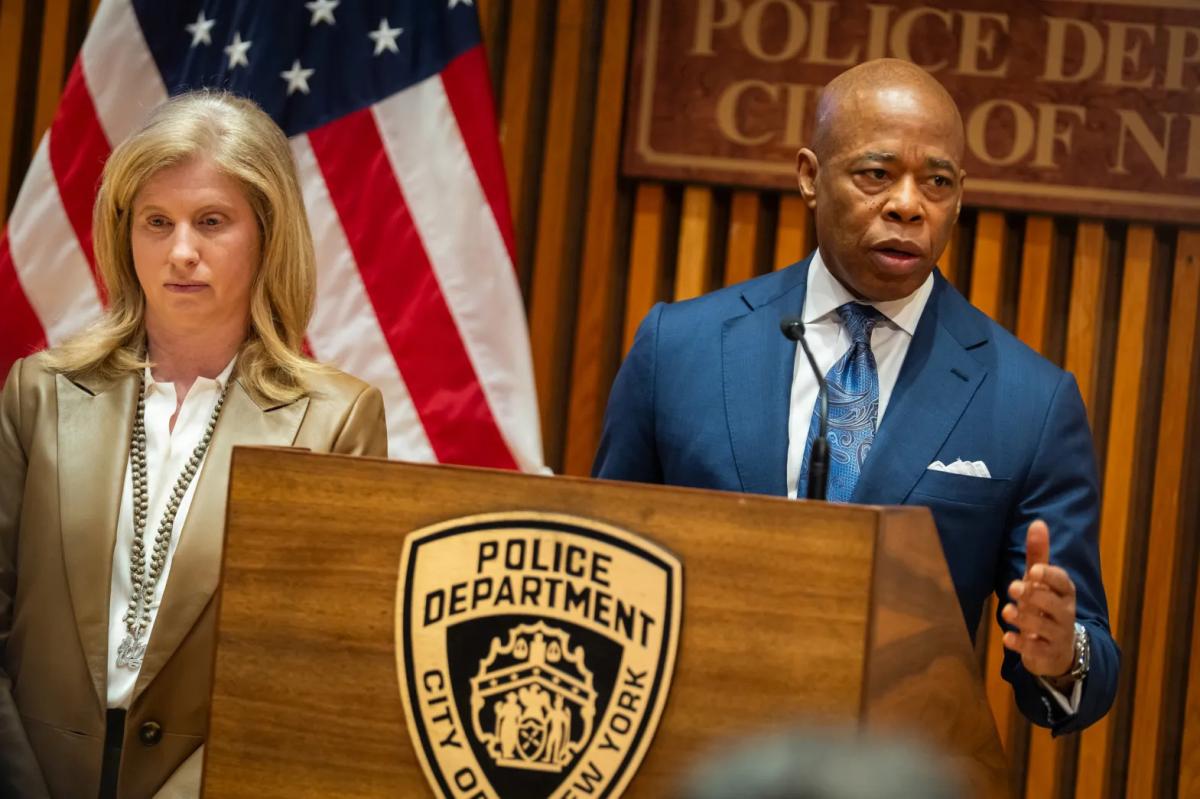
Mayor Eric Adams and NYPD Commissioner Jessica Tisch at 1 Police Plaza, April 3, 2025. Ed Reed/Mayoral Photography Office
Big Apple Connect, the mayor’s flagship free internet service for public housing residents, is quietly being used to expand the NYPD’s real-time, remote surveillance. Here’s what we still don’t know about the clandestine program.
By Zachary Groz

On Monday, New York Focus revealed that one of New York City Mayor Eric Adams’s signature technology projects is also a backdoor for police surveillance.

The NYPD has been using Big Apple Connect, the mayor’s free broadband program for public housing residents, to connect CCTV cameras at New York City Housing Authority (NYCHA) developments to the department’s city-wide surveillance software, called the Domain Awareness System. The connections enable the police department to stream footage in real-time, without needing to ask for NYCHA’s permission.

The video surveillance component of the project was never publicly disclosed. New York Focus learned about it after reviewing Office of Technology and Innovation documents that laid out the agency’s intention to link the housing authority’s cameras to the NYPD three years ago. Only recently did the NYPD confirm to New York Focus that the program is being used to implement real-time, remotely viewable video surveillance at at least 20 NYCHA developments.

There’s still a lot that the Adams administration hasn’t told us. Here’s what we still don’t know about Big Apple Connect ...

The NYPD is gaining live access to CCTV footage in public housing, without having to ask NYCHA for permission. Photos: Phonlamai Photo/Getty Images; Johnramos1978/Wikimedia Commons; Badge: Wikimedia Commons | Illustration: Leor Stylar
The Adams administration is using its flagship broadband program to give police real-time access to NYCHA camera feeds — without telling anyone.
By Zachary Groz

New York City Mayor Eric Adams’s administration is quietly using a flagship free internet program for public housing residents for another purpose: expanding NYPD surveillance.

The New York City Police Department is working to use network connections established under the three-year-old Big Apple Connect program to link cameras at New York City Housing Authority (NYCHA) developments directly to the NYPD’s central digital surveillance system, a police department spokesperson confirmed to New York Focus.

Cameras at one development were linked last Wednesday, the spokesperson said, and 19 more are set to follow.

The Northeast Supply Enhancement project, or NESE, could mark a turning point for New York’s approach to energy. Photos: Gage Skidmore / Office of Governor Kathy Hochul | Map: Williams application documents | Illustration: New York Focus
Public comments are closing soon for an underwater pipeline project that sprang back to life this spring after talks between Hochul and Trump.
By Colin Kinniburgh

Next week, New York could move a step closer to approving its biggest gas pipeline in at least a decade. August 16 marks the end of the public comment period for a 37-mile pipeline that would carry gas from New Jersey, underwater, to an existing pipe just south of the Rockaways, adding a new link in a network that spans from Texas to Long Island.

The Northeast Supply Enhancement project, or NESE, could mark a turning point for New York’s approach to energy. For years after passing its flagship climate law in 2019, the state rejected one large fossil fuel project after another, arguing that they would violate the state’s legal mandate to cut greenhouse gas emissions and other environmental protections.

The state Department of Environmental Conservation has previously rejected NESE three times — in 2018, 2019, and 2020 — on the grounds that it would harm water quality in the New York Bay. The pipeline was left for dead.

Then Donald Trump returned to the presidency in January, promising a new age of fossil fuel dominance. NESE’s sudden revival comes after talks between Trump and New York Governor Kathy Hochul in May, when the White House lifted a stop-work order on a major offshore wind project off Long Island while Hochul committed to, in her words, “work with the Administration and private entities on new energy projects.” Just 10 days later, the energy company Williams revealed it was reapplying for approval from New York regulators for NESE and the even larger Constitution Pipeline project.

Copyright © New York Focus 2024, All rights reserved.
Staying Focused is compiled and written by Alex Arriaga
Contact Alex at alex@nysfocus.com

Feedback? Tips? Pitches? Contact us at: editor@nysfocus.com

Support our work!

Interested in sponsoring these emails? Get in touch! Email editor@nysfocus.com.

This email was sent to *|EMAIL|*

unsubscribe from this list  ·  update subscription preferences

New York Focus · *|HTML:LIST_ADDRESS_HTML|* · USA