Medicaid Cutbacks Could Trigger Healthcare Crisis for Millions in New York

From preventive screenings to addiction treatment, critical care hangs in the balance for millions of New Yorkers relying on Medicaid.

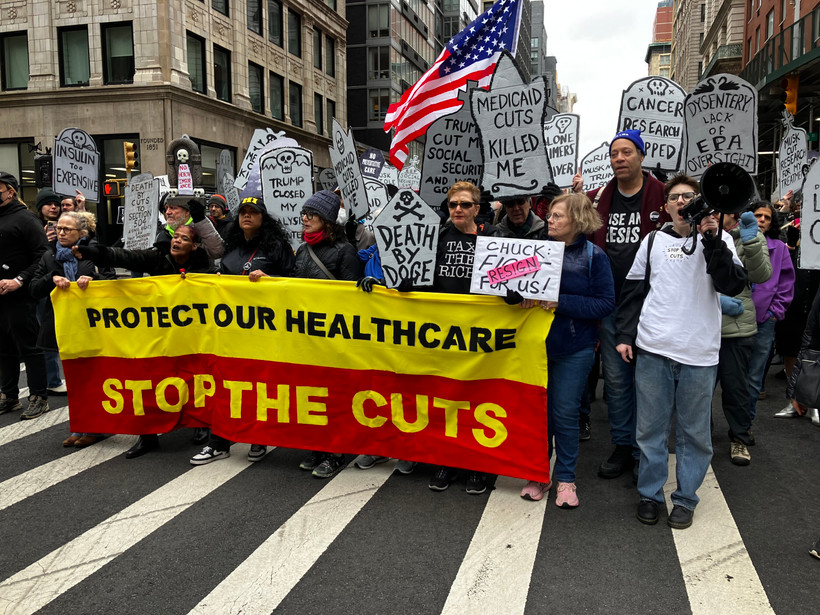
Marchers in lower Manhattan stage a "die-in" on March 15 to protest proposed cuts to Medicaid.
Marchers in lower Manhattan stage a "die-in" on March 15 to protest proposed cuts to Medicaid. | Clara Hemphill
Clara Hemphill   ·   May 1, 2025

Sign up for Staying Focused, our newsletter keeping readers up to speed on New York politics.

Jonathan VanScoy, 54, who lives in a small town in the Finger Lakes, relies on Medicaid for drug and alcohol treatment. Phil, 58, a carpenter in the Adirondacks, uses his health insurance for preventive care, such as a skin screening for cancer or a colonoscopy. Jorge, 32, a construction worker in White Plains, has regular doctor visits and uses an inhaler to keep his asthma under control.

Jon, Phil, and Jorge are among the millions of New Yorkers who receive free or low-cost health insurance subsidized by the federal government. Now, they fear they will lose their coverage if Republicans in Congress follow through with their plan to cut hundreds of billions of dollars from Medicaid, the federal-state health insurance that covers 6.9 million New Yorkers.

That’s more than one-third of the state’s residents, including 42 percent of all births and 63 percent of nursing home residents.

A House plan to shave $880 billion from Medicaid over the next decade could force New York to make gut-wrenching choices: end health care coverage for some 2 million residents, trim benefits such as home care for the disabled and elderly, cut other parts of the budget such as education, or find more than $7 billion a year in new taxes.

The debate over Medicaid costs has put New York’s seven Republican members of Congress in a tight spot: They are pressured by their leadership to impose budget cuts, but they are aware that a large proportion of their constituents rely on Medicaid. At the same time, the debate gives them significant power: With a tiny majority in the House, Republicans can afford only a handful of defections to pass the budget — so New York Republicans’ votes can be decisive.

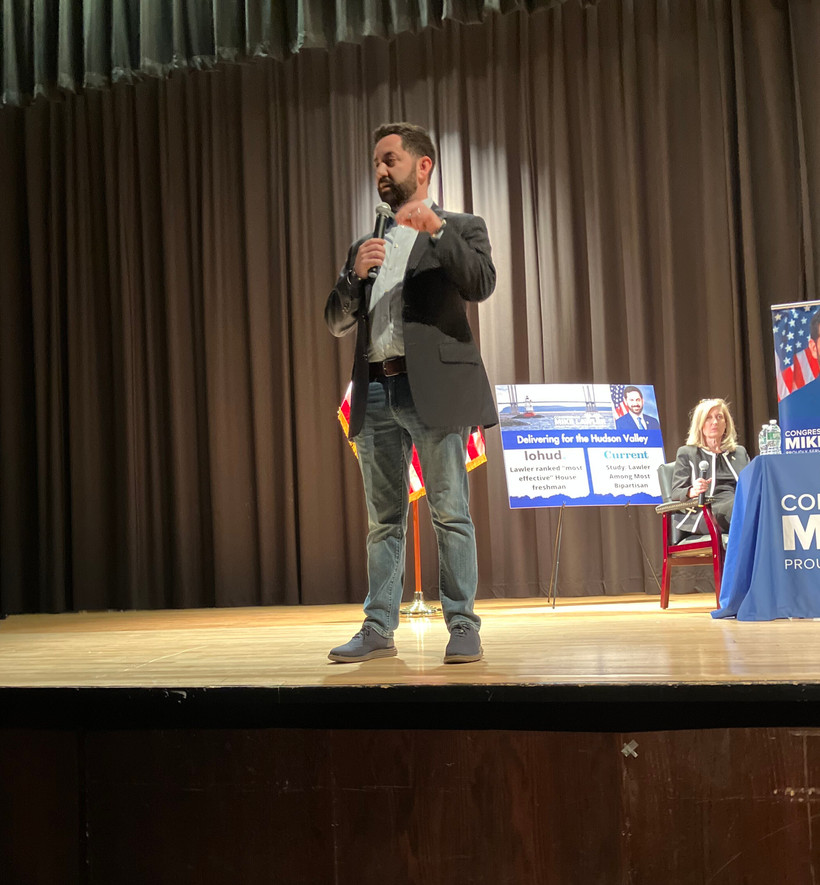
Rep. Mike Lawler tells a hostile crowd at Clarkstown South High School in West Nyack on April 27 that budget cuts are necessary, but he'll protect Medicaid for the most vulnerable.
Rep. Mike Lawler tells a hostile crowd at Clarkstown South High School in West Nyack on April 27 that budget cuts are necessary, but he'll protect Medicaid for the most vulnerable. | Clara Hemphill

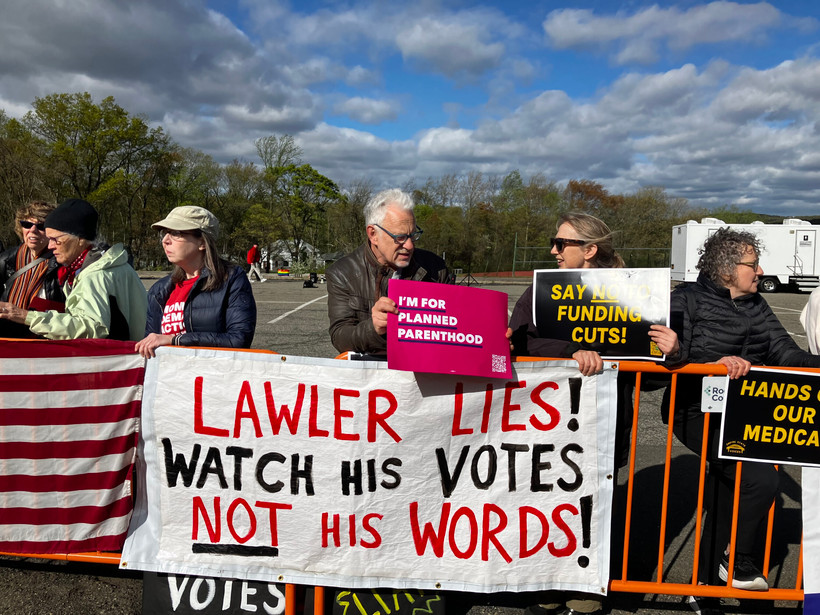
At a raucous town hall meeting Sunday night, Rep. Mike Lawler, a Republican from the Hudson Valley, distanced himself from some of the most drastic proposals to cut Medicaid, but stressed that spending must be reduced to balance the budget. “Taxing the rich is not going to close the budget deficit,” he said, eliciting jeers and boos from the crowd at Clarkstown South High School in West Nyack.

He pledged to preserve Medicaid for the elderly, the disabled, children and single mothers, but said able-bodied people should only be on the program temporarily. “Work requirements are imperative because Medicaid is not intended for those who do not need long-term support,” he said. “It’s not intended for somebody to stay on permanently.”

For Democrats in New York, the steady expansion of free and low-cost care since the passage of the Affordable Care Act in 2014 is a source of pride — a sign that the state is making affordable health care a reality for millions of New Yorkers.

“Taxing the rich is not going to close the budget deficit.”

—Rep. Mike Lawler
New York State has successfully leveraged federal money to offer care to millions of working people who don’t get insurance through their jobs — self-employed people, students who work part-time in retail sales, non-unionized construction workers, house cleaners, people who work irregular hours, people who piece together several part-time jobs.

But the Republican leadership in Congress sees the growth of Medicaid as an example of runaway spending, a wasteful public subsidy for able-bodied people who should pay their own way.

Republicans in the House of Representatives passed a budget resolution in February calling on the committee that oversees Medicaid to cut $880 billion over the next 10 years; a Senate resolution was less specific. Now, both chambers are wrestling with the details, and House Speaker Mike Johnson hopes to have an agreement by Memorial Day.

Protesters outside Clarkstown South High School in West Nyack on April 27 say they don't trust Rep. Mike Lawler's promise to protect Medicaid recipients.
Protesters outside Clarkstown South High School in West Nyack on April 27 say they don't trust Rep. Mike Lawler's promise to protect Medicaid recipients. | Clara Hemphill

“If there are dramatic cuts in federal funding, then the state will have no choice but to take its current Medicaid program and shrink it significantly,” said Edwin Park, a research professor at the Center for Children and Families at Georgetown University. “The states are left holding the bag. The states will have to take the political blame for the inevitable, painful cuts.”

Governor Kathy Hochul has not made public any contingency plans beyond suggesting she would call the state legislature back in session to deal with a loss of federal funding.

Before the Affordable Care Act, only the disabled and the very poor were covered by Medicaid. (Children and pregnant women slightly above the poverty line were also covered.) That changed when the ACA, in a bid to decrease the number of uninsured Americans, encouraged states to offer Medicaid to people whose incomes were a bit above the poverty line.

As an incentive, the federal government agreed to pick up 90 percent of the cost — much more than the 50 percent the federal government reimburses New York for traditional Medicaid. The expansion now covers 2.6 million New Yorkers, including single people whose incomes range from $15,650 to $21,597, or 138 percent of the federal poverty line. A family of four may have income up to $44,367.

One House proposal would decrease reimbursements for this group from 90 percent to 50 percent — in line with the reimbursement rate for traditional Medicaid. If New York state were to pick up the extra costs, it would have to find a staggering $71.7 billion over the next decade, according to an analysis by KFF, a policy research group. Alternatively, if New York abandoned the Medicaid expansion, 2 million New Yorkers would lose coverage, KFF said.

Mariella Carmago, a volunteer patient advocate at a community health clinic in White Plains, said this would be devastating for many of the families she helps. She gave the example of Jorge, a construction worker who is married with two small children. “He makes $35,000 a year, and he and the children have asthma. He can’t afford to pay for insurance, and he’s on Medicaid. Asthma requires regular check-ups to stay on top of it.”

“Whatever you say about Obama, he gave health care to millions of people.”

—Phil, self-employed carpenter in Johnsburg

Without insurance to pay for an inhaler, Carmago said, Jorge would wind up in the emergency room with serious asthma attacks — threatening his life and costing the healthcare system much more than if he had preventive care.

If people like Jorge lose their insurance, the clinic where he gets care will also suffer, said Carmago, a retired certified nurse midwife. “It affects everybody — the patient directly, the providers, all the employees,” she said. “If they have no clients, they will have to let a lot of people go. So the ripple effect is big.”

New York went further than most other states when it created another plan with funding from ACA, called the Essential Plan, that provides free or very low-cost care to people with incomes up to 250 percent of poverty: $39,125 for a single person or $80,375 for a family of four. About 1.6 million New Yorkers are covered by the Essential Plan, the entire cost of which is picked up by the federal government. Thanks to the expansion of these plans under the ACA, the percentage of uninsured New Yorkers dropped from 10.9 percent in 2013 to 4.8 percent in 2023, according to KFF.

“Whatever you say about Obama, he gave health care to millions of people,” said Phil, who asked to be identified only by his first name. Phil’s work is seasonal, slow in the winter, busier in the summer. Like a lot of people in the small towns of the Adirondack mountains, his income is unpredictable and fluctuates from month to month. This spring, he’s putting new doors on someone’s cabin and building a deck. This past winter he worked part-time in a cross country ski shop to pick up a little extra cash.

“I’m a carpenter,” he said. “I do maintenance, construction, remodeling. A little bit of everything.”

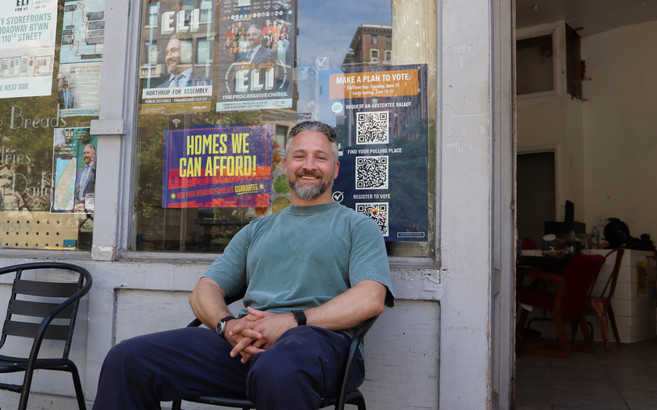
Phil, a self-employed carpenter in Johnsburg, is one of millions of New Yorkers who receive free or low-cost health care under the Affordable Care Act. "I don't know what I would do without it," he said. | Photo courtesy of Phil

Before the ACA, his only option for health insurance would have been a private insurance policy with a sky-high premium. “Probably for 25, 30 years, I never went to a doctor unless it was urgent,” said Phil, who is single. Now, his health care is free, and he has a primary care doctor and regular check-ups. “I don’t know what I would do without it.”

The proposed budget cuts have sparked a wave of protests across the state, many led by the advocacy group Indivisible. “Medicaid gave me the tools to recover,” VanScoy, who receives treatment for substance abuse, said at an April 15 protest in Corning, organized by Citizen Action of New York. “I’m speaking out because I’m deeply afraid of a future where families like mine can’t access the care we need.”

VanScoy worked in fracking gas fields in Pennsylvania, but returned to his hometown of Candor in 2016 to care for his father, who had advanced Parkinson disease. “I was able to make sure dad could use a shower, get in the car, get up when he fell down,” he said in an interview. After his father died in 2021, VanScoy stayed on in the family home to care for his mother.

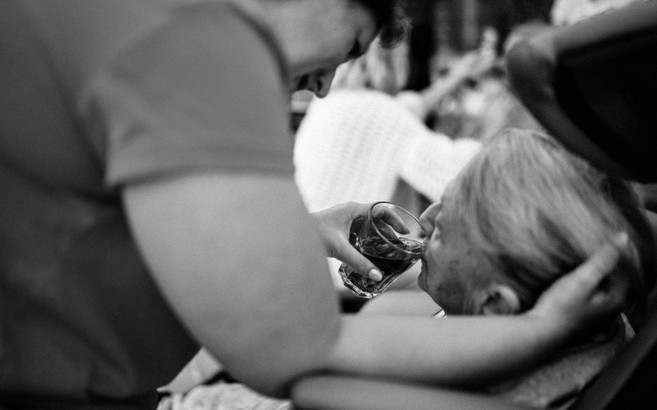
“I make her her meals when it looks like she’s not going to eat. I make sure that her laundry gets up the stairs to the laundry. Make sure that the cat box gets changed. Count her pills and make sure that she’s taking them,” he said.

Along the way, VanScoy got in trouble with drugs and alcohol, including arrests for driving under the influence. Medicaid paid for inpatient treatment, and continues to pay for outpatient treatment that he said helps keep him sober. “It turned my life around,” he said. “My health and relationships have improved in ways I never thought possible.”

Medicaid is the largest program in the state budget, accounting for $100 billion a year or one-third of spending. The Citizens Budget Commission estimates Medicaid costs, shared by the federal, state, and local governments, are projected to grow at 7 percent a year for the next three years, a rate that the fiscally conservative watchdog group calls unsustainable.

House Republicans agree. Nicole Malliotakis, a Republican congresswoman from Staten Island, asserts “rampant waste, fraud and abuse” in Medicaid limits the ability of the program to offer care to the most vulnerable. In a speech to Congress in March, she cited a 2024 state audit that found New York failed to verify $14.5 billion in payments to home care providers over the past two years. (Leaving claims unverified increases the risk of fraud, but does not mean the money was spent inappropriately, the audit said.)

In a long list of examples, Malliotakis cited a 2024 indictment from the US Attorney in Brooklyn that accused home care providers of billing the state for $68 million in fictitious services and a 2024 conviction of five taxi companies that billed the state $4.4 million for fake rides for Medicaid recipients. She pointed out that Hochul called a home health care program that allows recipients to hire their own caregivers a “racket.”

Bill Hammond, senior fellow at the Empire Center for Public Policy, a conservative think tank, said the state should reduce enrollments that have grown since the ACA, particularly able-bodied adults whom he suspects are lying about their income and elderly people who he said may hide their assets to qualify for home health care. “What used to be a safety net program, which was limited to a very needy population, has expanded into increasingly less-needy populations,” he said.

“If they think that they’re going to get $880 billion in savings from fraud, waste and abuse, they’re woefully mistaken.”

—Kevin McAvey, Manatt
Other policy analysts say the magnitude of the proposed cuts dwarfs possible savings from better reporting and stricter controls on payments and eligibility.

“There is fraud, waste and abuse in every public service, and that should be audited and weeded out,” said Kevin McAvey, healthcare analyst for the consulting firm Manatt. “I don’t think anyone’s arguing that the program can’t be run better. However, if they think that they’re going to get $880 billion in savings from fraud, waste and abuse, they’re woefully mistaken.”

Michael Kinnucan, health policy director of the Fiscal Policy Institute, a liberal think tank, said Medicaid is more cost-effective than alternatives. He points to a KFF analysis that shows per-person Medicaid costs have risen significantly less than the cost of private insurance in the past 15 years. That’s because the government has more clout negotiating doctor and hospital fees than private insurance companies do, he said.

It’s fairly cheap to insure healthy adults, Kinnucan said; the big costs come from the growth in long-term care. “Medicaid costs are going up, and it’s driven for the most part by people getting older and using more home care,” he said.

The House leadership has called for work requirements — Johnson famously suggested Medicaid is “not for 29-year-olds sitting on their couch playing video games.” Lawler has echoed that, adding that able-bodied recipients should recertify every three months to prove they are still eligible. He also says undocumented immigrants shouldn’t get care at all. One analysis found work rules would cause as many as 850,000 New Yorkers to lose their Medicaid coverage, largely because of the red tape involved in verifying employment.

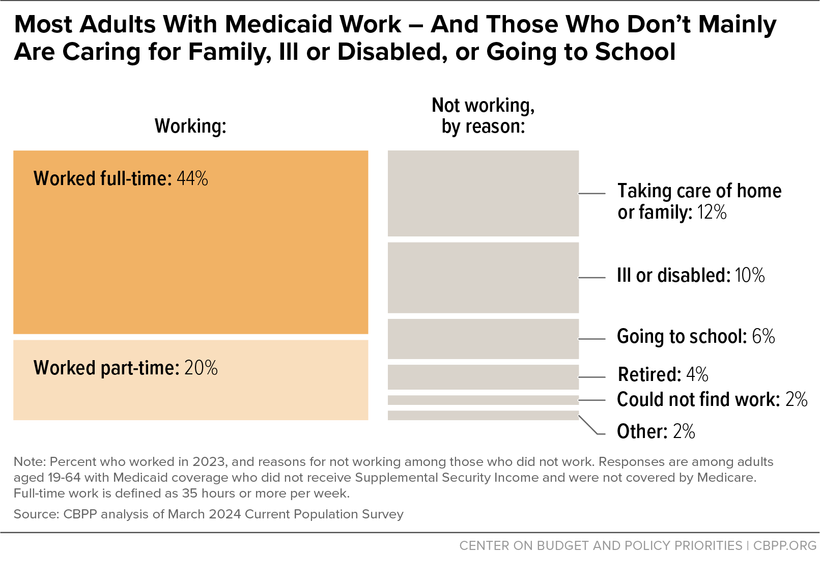
Medicaid advocates note that the projected savings from work requirements — just 1.3 percent of the total Medicaid budget, according to the Congressional Budget Office — don’t come close to meeting the House budget goals. “Work requirements are expensive to administer, they kick sick people off Medicaid, and they don’t save much money,” Kinnucan said.

| Center on Budget and Policy Priorities

A 2023 KFF study found nearly two-thirds of Medicaid recipients were already working — 44 percent full time and 20 percent part time. Most of the rest could not work because of illness or disability, or because they were caregivers for a family member. Just 8 percent were out of the workforce for other reasons. Moreover, most of the cost of Medicaid — 59 percent, according to KFF — goes to the elderly and people with disabilities.

Federal law requires hospitals to offer emergency care to anyone — people without insurance, tourists, and immigrants — and the government reimburses the state for a portion of the cost of that care. In addition, New York state offers Medicaid to pregnant women and to people over 65 regardless of immigration status; the state picks up 100 percent of the cost.

Lawler, Malliotakis, and two other Republican congressmen, Nick LaLota and Andrew R. Garbarino of Long Island, signed a letter to the House Leadership calling for “responsible savings” that do not come at the expense of “children, seniors, individuals with disabilities and pregnant women.” But some advocates are skeptical that it is possible.

“You know, it’s fantasy what they’re talking about,” said Elisabeth Benjamin, vice president of health initiatives at the Community Service Society in New York. “You’re not going to make up $880 billion on so-called able-bodied adults. Many other people are going to be hurt. It’s not real. Their math doesn’t work.”

At New York Focus, our central mission is to help readers better understand how New York really works. If you think this article succeeded, please consider supporting our mission and making more stories like this one possible.

New York is an incongruous state. We’re home to fabulous wealth — if the state were a country, it would have the tenth largest economy in the world — but also the highest rate of wealth inequality. We’re among the most diverse – but also the most segregated. We passed the nation’s most ambitious climate law — but haven’t been meeting its deadlines and continue to subsidize industries hastening the climate crisis.

As New York’s only statewide nonprofit news publication, our journalism exists to help you make sense of these contradictions. Our work scrutinizes how power works in the state, unpacks who’s really calling the shots, and reveals how obscure decisions shape ordinary New Yorkers’ lives.

In the last two decades, the number of local news outlets in New York has been nearly slashed in half, allowing elected officials and powerful individuals to increasingly operate in the dark — with the average New Yorker none the wiser.

We’re on a mission to change that. Our work has already shown what can happen when those with power know that someone is watching, with stories that have prompted policy changes and spurred legislation. We have ambitious plans for the rest of the year and beyond, including tackling new beats and more hard-hitting stories — but we need your help to make them a reality.

If you’re able, please consider supporting our journalism with a one-time gift or a monthly gift. We can't do this work without you.

Thank you,

Akash Mehta
Editor-in-Chief
A photo of Akash Mehta.
Clara Hemphill was a writer for Newsday, where she shared the 1991 Pulitzer Prize for local reporting; a foreign correspondent for The Associated Press; and the founding editor of Insid​eSchools​.org.
Also filed in New York State

State leaders are expected to pass a bill that avoids resolving how much Resorts World New York City needs to pay.

New York state has pumped millions of taxpayer dollars into an online portal that vowed to make life easier for Rochester’s neediest, but critics say it’s fallen short.

Resorts World is floating legislation to avert more than $500 million in payments to the horseracing industry.

Also filed in Health

Despite last-ditch efforts by a coalition of lawmakers, the state failed to avert a health coverage cliff coming this summer.

160,000 injured New Yorkers seek workers’ compensation each year — but in recent years, regulators have tilted the scales towards employers and insurers.

Amid abortion bans and rising digital surveillance, Albany lawmakers are revisiting an effort to stop companies from selling sensitive health information.