She Says She Was Sexually Abused in New York Prisons. Now She’s Fighting the State From Her Hospital Bed

Sierra Johnson is one of nearly 1,600 women who filed claims under the Adult Survivors Act alleging sexual abuse in state prisons.

Jessy Edwards   ·   June 19, 2025
Sierra Johnson alleges that three corrections officers and a doctor sexually assaulted her during two separate stints in New York state prisons. | Courtesy of Sierra Johnson

This story was produced in partnership with Hell Gate. The reporting for this story was supported by the Fund for Investigative Journalism.

Sign up for Staying Focused, our newsletter keeping readers up to speed on New York politics.

Diagnosed with a terminal heart condition, Sierra Johnson sometimes spends weeks at a time in the hospital. But she’s determined to not let her health get in the way of her lawsuit against the state of New York.

The 36-year-old Native American resident of the Mohawk Nation at Akwesasne sued the state in 2023, alleging that four of its employees sexually assaulted her while she was incarcerated in two state prisons in 2014 and 2017.

At the end of May, Johnson spoke with Hell Gate and New York Focus from her hospital bed at the University of Vermont Medical Center, where she was recovering from a two-week stint in intensive care after suffering a severe heart attack and cardiogenic shock. Doctors have diagnosed her with end-stage heart failure, and have twice told her that she has days to live. Johnson, who has a teenage daughter, said she intends to spend the time she has left making state prisons safer for the women who will be held in them in the future.

“It’s not just about me. If it was, I would have just ate it,” she said. “But I don’t know if I’m gonna make it through this year. And no matter what, when it comes to the treatment of inmates, we should be treated as human beings.”

Johnson filed her lawsuit under the Adult Survivors Act, which in 2022 temporarily allowed sexual assault survivors to file complaints outside of the typical statute of limitations. She’s one of nearly 1,600 women who have filed claims against the state of New York alleging they were sexually abused by prison staff, according to a Hell Gate and New York Focus analysis. Collectively, the complaints paint a damning portrait of a longstanding, systemic pattern of sexual abuse in the state prison system, according to the women’s attorneys.

In her complaint, Johnson alleges that three corrections officers and a doctor sexually assaulted her during two separate stints in New York state prisons, the first beginning in 2014 and the second in 2017. She details several instances in which prison staff allegedly raped her, groped her, and in one case, performed a sexually abusive medical procedure. One of the officers, David Stupnick, brutally raped her in her dormitory room, she says.

Two years later, Stupnick was arrested and sentenced to six months in prison, in a separate case, for a criminal sex act with an imprisoned woman. He is also accused of sexual assault by at least 20 other women who have filed Adult Survivors Act cases.

Johnson’s attorney, Anna Kull, a partner at Levy Konigsberg, alleges that prison leadership has known for years that guards have been sexually abusing incarcerated people, often with impunity.

When Governor Kathy Hochul signed the Adult Survivors Act into law in 2022, she said it was “an important step in empowering survivors across New York to use their voices and hold their abusers accountable.” Yet her administration has since taken an uncompromising defensive approach to survivors suing New York itself, attorneys say.

Rather than resolving Johnson’s claim with urgency, for instance through negotiations or a settlement, the state is taking her to trial, said Kull, even though one of her alleged abusers had already been found guilty of a sex crime involving an incarcerated woman, and is alleged to have abused tens of other women. The approach risks retraumatizing victims, she said, by forcing them to repeatedly relive the alleged assault in an adversarial setting. It’s an early indicator of how the state intends to approach the nearly 1,600 cases that are still pending, Kull added.

“These cases deserve a process that reflects the seriousness of the harm and the courage it took to come forward,” she said.

Kull recently convinced a court to expedite Johnson’s case due to her illness, making it one of the first Adult Survivors Act cases with allegations from the five largest women’s prisons to move toward trial. But Kull estimated that the other cases could take years to resolve due to the state’s aggressive approach to the lawsuits.

In total, New York is being sued for at least $30 billion in damages by claimants who allege they were sexually abused in state prisons, according to a Hell Gate and New York Focus analysis.

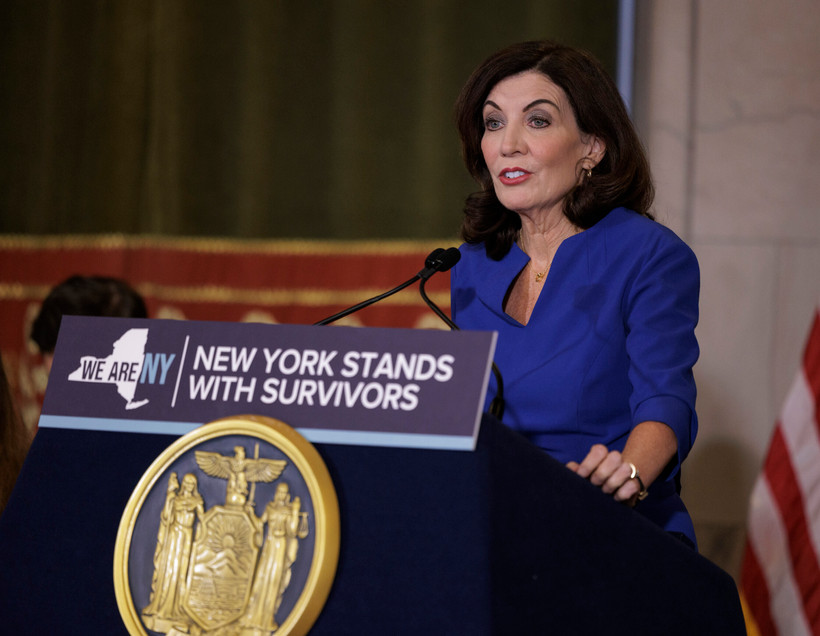
Kathy Hochul stands at a podium that bears a sign reading "New York stands with survivors."
Governor Kathy Hochul signs the Adult Survivors Act at the State Capitol, May 24, 2022. | Mike Groll/Office of Governor Kathy Hochul

Survivors filed more than 3,000 claims during the one-year window the Adult Survivors Act opened. High-profile cases include the lawsuit filed by Cassie Ventura against Sean “Diddy” Combs, the case filed by E. Jean Carroll against President Donald Trump, and claims filed by more than 300 alleged victims of Columbia University Medical Center gynecologist Robert Hadden.

Legislators didn’t anticipate that the majority of the Adults Survivors Act lawsuits would be against the state itself, said State Senator Brad Hoylman-Sigal, a lead sponsor of the Adult Survivors Act.

“I don’t think anyone expected it,” he said. “I think my colleagues and I were all aghast at the numbers, and then the details of the crimes were particularly appalling.”

New York City is facing a similar situation. More than 700 women filed Adult Survivors Act lawsuits against the city alleging they were sexually assaulted by staff at the Rikers Island women’s jail, in cases of systemic abuse spanning more than 50 years. Some of those lawsuits are already in the settlement phase.

The Office of the New York State Attorney General, under the leadership of Letitia James, is responsible for defending the lawsuits filed against the state by women alleging sexual assault in New York prisons. Attorneys representing survivors, including Kull, say the state has taken a hardline approach, opting to litigate each case individually and delaying the disclosure of records that could help identify alleged sexual abusers still working in the prisons. It’s also sought to to dismiss claims when a claimant doesn’t remember the perpetrator’s name — “a common and well-documented consequence of trauma, particularly in cases involving abuse that occurred decades ago,” said Kull.

The attorney general’s office said that it’s just doing its job.

“Sexual assault victims deserve to be heard, respected, and to pursue justice through the Adult Survivors Act,” communications director for the attorney general’s office Geoff Burgan told Hell Gate and New York Focus. “As the state’s attorney, the office is committed to fulfilling its responsibility to defend the state while supporting survivors and their ability to heal.”

Hochul’s office did not respond to multiple requests for comment.

“These cases deserve a process that reflects the seriousness of the harm and the courage it took to come forward.”

—Anna Kull, Sierra Johnson's attorney

The AG has taken the trial-centric approach in Johnson’s case.

According to state records, Johnson was first incarcerated in New York in 2014 at Albion Correctional Facility, due to a parole violation for an earlier attempted robbery charge.

When she arrived at the prison, located between Rochester and Buffalo, an officer whose name she says she can’t remember told her to perform oral sex on him twice in a secluded corner of a shower area, she alleges. If she didn’t, Johnson said he told her, she wouldn’t get access to her needed contact lenses.

On two other occasions, an officer who worked at the prison rubbed his groin on her as she sat at a desk in a school building. He made sexual and racist comments, like calling women “Pocahontas” and referring to another inmate as his “favorite Indian,” Johnson said.

“I felt so singled out,” she said as she began crying. “But then I noticed the real rules of surviving there. Everybody knows it’s all about sex trade. It’s all about using your body, using manipulation, and having to give up the fact that you’re human.”

Johnson, who suffered from on-and-off substance use issues, was sent to prison again in 2017. At Bedford Hills Correctional Facility, she was abused by a doctor during intake, she says in her complaint. On the day of the alleged abuse, Johnson said, she was summoned to the doctor’s office, informed that she had abnormal results on a gynecological test, and told that she needed a biopsy on her uterus then and there.

Johnson said she was held down as the doctor forced a speculum and their fingers into her vagina, causing pain and tearing, while she said “no.” Afterwards, she said, she bled for several days, and has never had a menstrual cycle since.

She was then sent to Albion again. It was there, she says, that she was targeted by corrections officer David Stupnick.

The first time Stupnick abused her was in the prison’s showers, Johnson alleges in her complaint. The officer, whom she described as young, white, and covered in tattoos, came in when she was showering and groped her chest and groin, while insulting her body and laughing, she said.

Another time, Stupnick followed Johnson out of the shower and to her dorm, she said. While she crouched in her dorm cubicle in a pink robe, she said Stupnick walked in, shoved her head into her closed locker, and anally raped her.

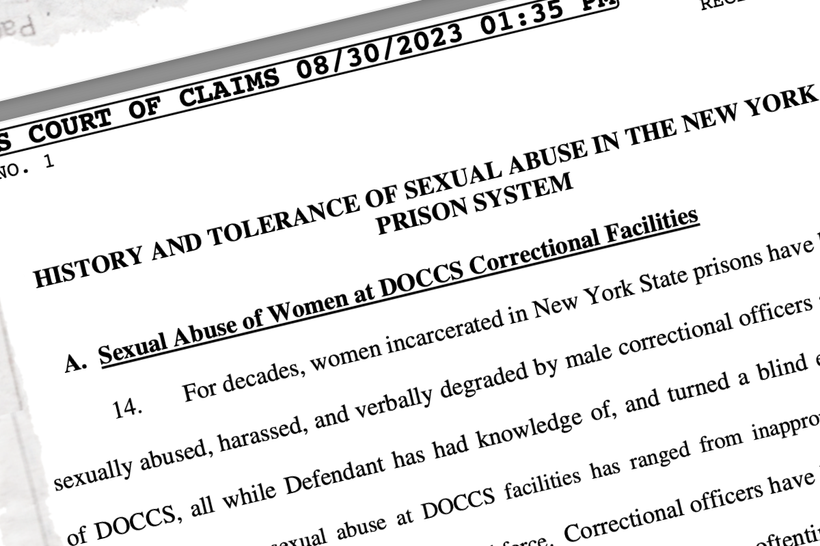
Attorneys of claimants who sued New York over sexual assault in state prisons say the sexual abuse of imprisoned women is systemic. | Court of Claims

Johnson said she stayed silent about the abuse at the time, fearing for her life. Years later, after she’d gotten out of prison and was studying to become a mental health and substance abuse counselor, she heard a radio ad about the Adult Survivors Act.

“I just sat there and I cried,” she said. “It made me realize I’m not going to heal if I have to carry this.”

At least 20 other women have accused Stupnick of sexual abuse under the Adult Survivors Act in claims ranging from 2001 to 2019. In 2020, Stupnick pleaded guilty to a criminal sex act, after being charged with sexually abusing two incarcerated women at Albion. He was sentenced to six months in county jail and required to register as a sex offender.

Hell Gate and New York Focus left multiple messages for Stupnick, but did not receive a response.

The Department of Corrections and Community Supervision said it does not comment on pending litigation. A spokesperson said the agency “thoroughly investigates” all reports of sexual victimization and refers cases for prosecution where there is evidence that a crime has been committed. The spokesperson said that this year, the agency expanded the number of staff it employed to prevent and respond to sexual abuse.

Johnson’s attorneys are seeking $25 million in damages in her case. If Johnson does not live to see a resolution in her case, any damages awarded would go to her estate. Her lawsuit is currently in the discovery phase.

Johnson said she isn’t motivated by a settlement. Speaking from her hospital bed, she said she sees telling her story as one step toward helping to heal her Native American community, her family, and future generations.

“It goes beyond just my own little life,” she said. “Before that, there was intergenerational trauma: watching my mother, watching my people as Indigenous people becoming institutionalized and being removed from their homes. They tried to wipe us out. And being incarcerated is just an evolution of what has already been happening for generations.”

“I had to experience all of these things firsthand,” Johnson added. “The only thing that made sense to me was that maybe, just maybe, I was destined to start breaking a cycle of abuse.”

BEFORE YOU GO, consider: If not for the article you just read, would the information in it be public?

Or would it remain hidden — buried within the confines of New York’s sprawling criminal-legal apparatus?

I started working at New York Focus in 2022, not long after the outlet launched. Since that time, our reporters and editors have been vigorously scrutinizing every facet of the Empire State’s criminal justice institutions, investigating power players and the impact of policy on state prisons, county jails, and local police and courts — always with an eye toward what it means for people involved in the system.

That system works hard to make those people invisible, and it shields those at the top from scrutiny. And without rigorous, resource-intensive journalism, it would all operate with significantly more impunity.

Only a handful of journalists do this type of work in New York. In the last decades, the number of local news outlets in the state has nearly halved, making our coverage all the more critical. Our criminal justice reporting has been cited in lawsuits, spurred legislation, and led to the rescission of statewide policies. With your help, we can continue to do this work, and go even deeper: We have endless ideas for more ambitious projects and harder hitting investigations. But we need your help.

As a small, nonprofit outlet, we rely on our readers to support our journalism. If you’re able, please consider supporting us with a one-time or monthly gift. We so appreciate your help.

Here’s to a more just, more transparent New York.

Chris Gelardi
Justice Bureau Chief

A photo of Chris Gelardi
Jessy is a Brooklyn-based reporter who writes about housing, social justice, and the people of New York City for Hell Gate. Jessy previously covered incarceration at WNYC/​Gothamist, where she was part of a Pulitzer-nominated project investigating sexual assault on Rikers Island. She’s previously… more
Also filed in Criminal Justice

It’s unclear whether the Correctional Association of New York will have to scale back its nascent reform initiatives.

The legislation comes after months of haggling over how best to protect New Yorkers from President Trump’s immigration crackdown.

Footage published by New York Focus sparked a debate over deputies’ practice of calling Border Patrol on Spanish-speaking drivers.

Also filed in New York State

State leaders are expected to pass a bill that avoids resolving how much Resorts World New York City needs to pay.

New York state has pumped millions of taxpayer dollars into an online portal that vowed to make life easier for Rochester’s neediest, but critics say it’s fallen short.

Resorts World is floating legislation to avert more than $500 million in payments to the horseracing industry.