Transparency Advocate Rejected From Ethics Commission Plans to Sue

Gary Lavine says law school deans illegally blocked his nomination to the state’s ethics body.
Chris Bragg   ·   October 22, 2025
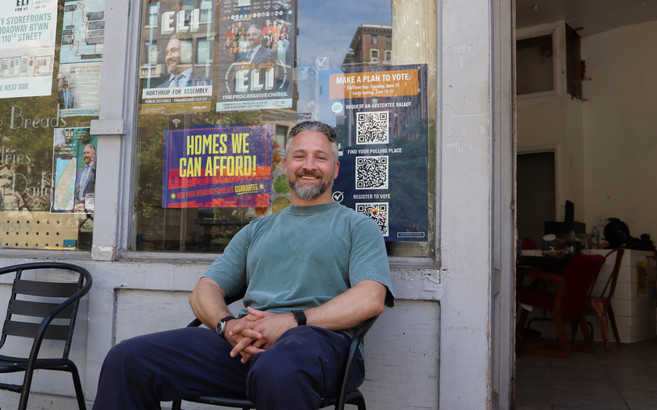
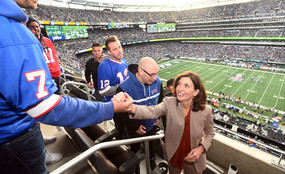
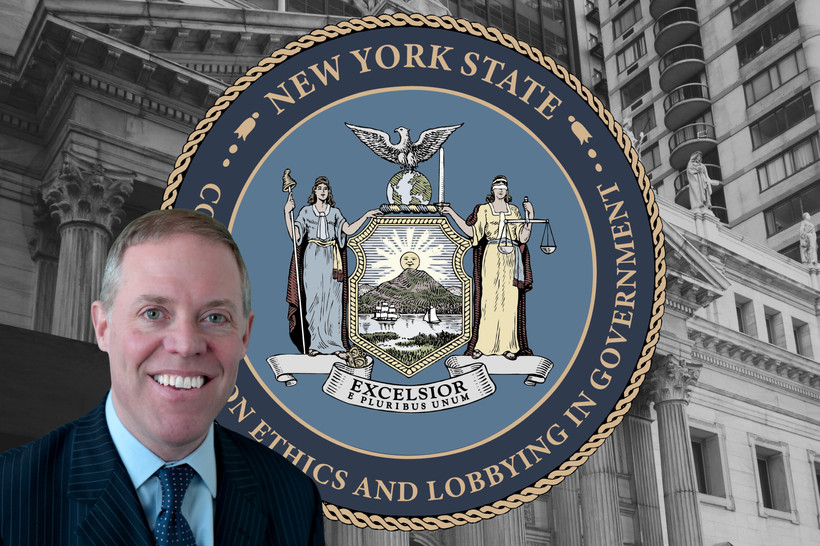
Assembly Minority Leader Will Barclay nominated former JCOPE commissioner Gary Lavine to serve on the Commission on Ethics and Lobbying in Government. | Photos: Santosh Bhunia; New York state Assembly; Logo: New York State Commission on Ethics and Lobbying in Government | Illustration: Leor Stylar

Sign up for Staying Focused, our newsletter keeping readers up to speed on New York politics.

A longtime state ethics commissioner is planning to sue New York’s ethics commission after his nomination to join a new iteration of the body was rejected.

Syracuse lawyer Gary Lavine served as a commissioner on the Joint Commission on Public Ethics (JCOPE) for a decade, where he ruffled feathers as he pushed for the commission to become more transparent and criticized then-Governor Andrew Cuomo’s influence over the body.

Charged with regulating the conduct of New York’s public officials and lobbyists, the commission was disbanded in 2022 and replaced by the Commission on Ethics and Lobbying in Government (COELIG). This year, Assembly Minority Leader Will Barclay nominated Lavine to serve on the replacement body.

In September, a collection of 15 New York law school deans charged with vetting nominees unanimously rejected Lavine’s nomination. Lavine argues that the rejection was unconstitutional and plans to sue in state court.

“They don’t want any commissioners on the new body to know what happened at JCOPE, who are able to warn other commissioners about past missteps,” Lavine told New York Focus. “They don’t want somebody on there who will be an activist and raise issues in public.”

For much of its 11-year lifespan, JCOPE operated in secret. Critics contended the panel was controlled by Cuomo, a Democrat. That dynamic shifted only in the body’s final years, when commissioners appointed by the legislature — from both political parties — aligned against Cuomo and his appointees to the body amid the governor’s alleged ethical abuses.

Lavine began publicly airing these internal disputes, sparking conflict with JCOPE’s executive director, who now serves as the top staffer of the replacement body. Unlike Lavine, the commissioners that have been approved to sit on the new panel have generally worked quietly. (A COELIG spokesperson said the body does not comment on litigation.)

The current ethics body is no stranger to lawsuits. Cuomo asked courts to disband COELIG after it took major steps toward forcing him to repay $5 million from a controversial book deal. Two lower courts ruled that the law creating the body was unconstitutional, but the Court of Appeals — New York’s highest court — reversed those decisions in a 4–3 ruling this February, and the commission survived.

Since winning the lawsuit, it’s unclear if the ethics commission has made any further effort to force the ex-governor to repay the $5 million. A spokesperson for Cuomo declined to comment, and the commission’s chief of staff, Emily DeSantis, noted that the commission cannot legally comment on ongoing investigations.

“The Commission is assiduously working through hundreds of pending matters and more than 50 open and active investigations. With the Cuomo litigation behind us, our enforcement and investigations team is diligently investigating and pursuing resolution in these matters and is now taking strenuous steps to move forward,” DeSantis said in a statement.

Lavine’s track record suggests that if he joined the commission, he might be willing to publicly raise such high-profile issues.

Lavine led the prior body’s efforts to force Cuomo to repay the $5 million. He also pushed for an investigation into an apparent leak of highly sensitive commission information to the ex-governor. Lavine advocated for a more transparent JCOPE and spoke to reporters about his criticisms of the conduct of government officials, including, at times, his colleagues at JCOPE.

The chairman of the COELIG vetting panel, New York Law School Dean Anthony Crowell, wrote in the rejection letter that Lavine’s prior tenure had “negatively shaped his expectations regarding the new commission, and his potential role on it.”

“If I were a member of the public watching this, I would be throwing my hands up in despair.”

—Ethics Commissioner Leonard Austin

By a 14–0 vote, the review panel concluded that Lavine had given the appearance of an “inability to act impartially, fairly, and even-handedly.”

Lavine notes that much of what he’d stated about Cuomo and the book deal was confirmed in a 2022 report issued by an outside law firm.

The vetting panel has “never challenged the accuracy of my account of what transpired at JCOPE or my veracity,” Lavine told New York Focus. “They have disqualified me simply for expressing my view of what actually happened.”

The law governing the ethics body charges the panel with vetting the “qualifications” of candidates nominated by legislative leaders. Lavine argues that his rejection was based on his opinions, not his qualifications. The law school deans, as unelected officials operating in secret, cannot lawfully exclude a nomination on this basis, Lavine contends. He says the deans are “undermining the constitutional prerogative” of Assembly Minority Leader Barclay to appoint a nominee who shares his opinion and political philosophy.

The review panel required Lavine provide the names of five references, but never contacted any of them, he said, making the process a “sham.”

Crowell did not respond to a request for comment.

David Grandeau, the state’s former top lobbying regulator, has been a harsh critic of both JCOPE and the new ethics commission. Grandeau, who now works as a lobbying compliance attorney, told New York Focus that he thought the vetting panel’s recent rejection of Lavine was “ridiculous.”

“While he certainly has his personality quirks, his competence and knowledge far exceeds that of anyone on the commission at this time, including most of the staff,” Grandeau said.

This is not the first time Lavine has been rejected by the current commission’s vetting panel.

Lavine, a Republican, was nominated in 2022 by the other Republican leader in the legislature, Senate Minority Leader Robert Ortt.

During that year’s vetting process, Crowell’s review panel asked nominees to answer a question about whether it was “ever” appropriate for commissioners to speak to the news media.

In response, Lavine wrote a letter to the panel criticizing the ethics commissioner’s top staffer, Sanford Berland, as overly secretive. Lavine said he’d be willing to speak to journalists about matters that came up during meetings’ public sessions. He argued that New York had a history of ineffective ethics panels and that Cuomo had sought to subvert both JCOPE and the Office of the New York State Inspector General.

The panel unanimously rejected Lavine in 2022, citing the same rationale as it did this year.

The panel was a compromise between Governor Kathy Hochul and the legislature. Hochul touted the measure as ensuring commissioners would be independent and objective.

Still, the public generally doesn’t know why nominees are approved or rejected. The deans’ vetting is largely conducted in secret. The reasons for its verdicts are not made public unless nominees choose to reveal them.

After his 2022 rejection, Lavine filed litigation arguing that the vetting process itself — allowing unelected law school deans to reject appointments by the legislature — was an unconstitutional delegation of authority.

Lavine lost that lawsuit, and the February Court of Appeals decision upheld the deans’ power to make such rejections. The ruling indicated that vetting panel determinations should be made on an “objective and nonpartisan basis” and allowed future challenges to how it was making its decisions.

The Cuomo investigation isn’t the only issue on which the new ethics commission has recently been quiet.

It’s also unclear whether the commission is still pursuing a high-profile matter it was examining in 2024, concerning discount luxury football tickets received by Hochul, Assembly Speaker Carl Heastie, and their family and friends. The complainant in that matter, Grandeau, said the commission hasn’t told him the investigation has been closed — but he hasn’t heard anything about it being further pursued.

Since its inception more than three years ago, the commission has settled a total of 10 enforcement cases it has pursued against lobbyists or state officials. The subjects have largely been obscure public employees, and none of the cases involved elected officials.

At a meeting in June, Commissioner Leonard Austin aired unusually sharp criticism of his colleagues over their priorities. According to Austin, at at least six different meetings, commissioners had spent more than an hour debating the minutia of internal voting procedures.

“It’s just silly. And if I were a member of the public watching this, I would be throwing my hands up in despair,” Austin said. “Let’s get down to our business … and deal with our cases. That’s what we should be doing.”

This article has been updated with comments from Emily DeSantis, chief of staff of the Commission on Ethics and Lobbying in Government, received after it was first published.

At New York Focus, our central mission is to help readers better understand how New York really works. If you think this article succeeded, please consider supporting our mission and making more stories like this one possible.

New York is an incongruous state. We’re home to fabulous wealth — if the state were a country, it would have the tenth largest economy in the world — but also the highest rate of wealth inequality. We’re among the most diverse – but also the most segregated. We passed the nation’s most ambitious climate law — but haven’t been meeting its deadlines and continue to subsidize industries hastening the climate crisis.

As New York’s only statewide nonprofit news publication, our journalism exists to help you make sense of these contradictions. Our work scrutinizes how power works in the state, unpacks who’s really calling the shots, and reveals how obscure decisions shape ordinary New Yorkers’ lives.

In the last two decades, the number of local news outlets in New York has been nearly slashed in half, allowing elected officials and powerful individuals to increasingly operate in the dark — with the average New Yorker none the wiser.

We’re on a mission to change that. Our work has already shown what can happen when those with power know that someone is watching, with stories that have prompted policy changes and spurred legislation. We have ambitious plans for the rest of the year and beyond, including tackling new beats and more hard-hitting stories — but we need your help to make them a reality.

If you’re able, please consider supporting our journalism with a one-time gift or a monthly gift. We can't do this work without you.

Thank you,

Akash Mehta
Editor-in-Chief
A photo of Akash Mehta.
A photo of Chris Bragg.
Chris Bragg is the Albany bureau chief at New York Focus. He has done investigative reporting on New York government and politics since 2009, most recently at The Buffalo News and Albany Times Union.
Also filed in New York State

At a Board of Regents meeting Monday, state officials proposed eliminating credit-based diploma requirements.

The last-minute influx, the biggest ever for a legislative primary, is boosting her opponent, Jessica González-Rojas.

City budget gaps and an ambitious affordability agenda may require pressing Albany again for taxes and aid.