Hochul May Veto Bill to Protect LLC Transparency Act from Trump

The governor is poised to veto a bill to insulate a business transparency law from federal shifts, according to the bill’s sponsor.
Chris Bragg   ·   December 17, 2025
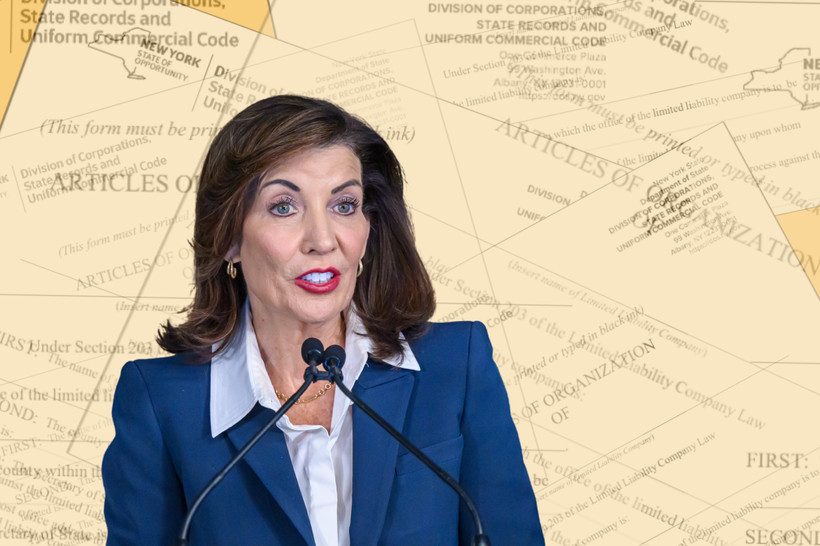
Hochul celebrated a corporate transparency law two years ago, but is now poised to issue a veto that could leave it dramatically weakened. | Photo: Office of Governor Kathy Hochul; Paperwork: New York state Department of State | Illustration: Leor Stylar

Sign up for Staying Focused, our newsletter keeping readers up to speed on New York politics.

Two years ago, Governor Kathy Hochul signed a bill to require limited liability companies in New York to share more information about their true owners. It’s set to take effect in two weeks, on January 1.

But actions taken by President Donald Trump’s administration this spring threaten to dramatically narrow the bill’s scope. So New York lawmakers passed a new bill this year, making what they describe as minor alterations to the bill to protect it from Trump’s new rules. They didn’t expect problems getting Hochul’s signature, since she’d signed and celebrated the original bill.

Yet the entire initiative is now in peril, according to Assemblymember Emily Gallagher, a Brooklyn Democrat and the lead Assembly sponsor of both bills.

Gallagher has received information indicating that Hochul is likely to veto the new bill, she told New York Focus. That could effectively gut the bill Hochul already signed, she said.

Gallagher blames the influence of business interests, some of whom have been major campaign donors to Hochul’s reelection bid.

“The governor likes to pay lip service to the pressure that she feels from the left, but she has absolutely no vested interest in the left being successful,” Gallagher said. “And she has deep vested interest in the billionaires continuing to be able to exploit people in this state.”

The government reform group Reinvent Albany also believes the bill is poised to be vetoed. The bill’s main Senate sponsor, Democrat Brad Hoylman-Sigal, declined to comment. Hochul’s office said only that the governor “is continuing to review the legislation.”

Hochul faces a Friday deadline to sign or veto the bill. Her office has not yet offered any proposed amendments to the bill to the legislative sponsors, Gallagher said.

Before Hochul signed the original bill, business interests succeeded in paring it down dramatically. As Gallagher sees it, they’re now taking a second bite at the apple.

The version of the LLC Transparency Act lawmakers initially passed two years ago sought to publicly unmask the owners of limited liability companies in New York. High-end Manhattan real estate owned by anonymous shell companies has served as a hub for money laundering, and the bill gained the support of New York’s government reform groups.

Many local unions, including healthcare, hotel, and building trades workers, jumped on board. The bill would allow the public to see the true identities of contractors committing wage theft, they argued, and reveal the names of unscrupulous landlords.

In 2023, an influential real estate lobbying group argued that a key part of the bill — requiring that beneficial owners of LLCs be disclosed in a public database — could lead to identity theft. In closed-door chapter amendment negotiations, Hochul’s office nixed the public database. Under the bill Hochul ultimately signed, information about LLC owners would only be available to law enforcement and regulatory authorities.

According to Reinvent Albany, Hochul had taken out the heart of the original bill. But the governor heralded it as a win.

“For far too long, bad actors have been protected by the loose disclosure requirements of LLC ownership,” Hochul said in a press release in December 2023. “Wage theft, money laundering, tenant mistreatment and other unlawful activity has been masked by the opaque ownership structure of an LLC. The new LLC Transparency Act will give law enforcement and State regulators the tools they need to hold bad actors accountable.”

Then came the Trump administration. Near the end of his first term as president, Trump vetoed a bipartisan bill aimed at a similar purpose. Congress took the rare step of overriding the veto, and President Joe Biden’s administration wrote regulations for the law. Then in March, during Trump’s second presidency, the Treasury Department announced it would stop enforcing that law for domestic companies, and only apply it to companies owned by foreign entities.

That posed a problem for New York’s transparency law, too. The bill Hochul signed two years ago referenced federal definitions and regulations, meaning that Trump’s new rules might effectively restrict the New York law — like its federal counterpart — to regulating only foreign companies.

In response, the New York legislature passed Gallagher’s new bill, which amends the 2023 law to define terms like “beneficial owner,” “reporting company,” and “exempt company” directly in state law.

Kevin Elkins, political director for the NYC & Vicinity District Council of Carpenters, said he couldn’t see any policy-based rationale for Hochul to veto a bill clarifying definitions in a bill she had already signed.

“For far too long, bad actors have been protected by the loose disclosure requirements of LLC ownership.”

—Governor Kathy Hochul, 2023

“I’m trying to rack my brain to understand the difference between the bill that was signed [two years ago] and the bill that might be vetoed,” Elkins said. “The only difference is Donald Trump altering the rules to make the bill ineffective. So I’ll be curious to understand what kind of potential reasoning there is to veto such a bill.”

According to the state’s leading business group, there are plenty of reasons.

Earlier this year, the state Business Council issued an opposition memo to the new bill making definitional changes, arguing it is a “clear example of regulatory overreach” that adds “costly, confusing, and punitive requirements on businesses at a time when New York’s economic competitiveness is already under serious strain.”

The memo argues that the new Albany bill sweeps in smaller businesses “that were never intended to be subject to this law.”

“The beauty salon, the neighborhood grocers, all of these mom and pops, everybody has an LLC,” Joseph Alston, director of government affairs at the Business Council, told New York Focus. “You’re going to find people who just really have no knowledge of the bills that are coming out of Albany. Then, if they’re not compliant, there’s a $250 fine … This is really just an additional tax on business owners — more compliance, more money for more filer fees.”

Alston believes the Hochul administration doesn’t support the bill in its current form. Based on conversations he’s had, he believes the administration may have concerns over future lawsuits, given the major shift in the federal rules.

John Kaehny, executive director of Reinvent Albany, called the Business Council’s concerns unfounded and said the bill would impose little burden on LLC owners. For someone with the sophistication to set up an LLC, he said, it won’t take “more than a couple minutes to fill out the form that the LLC Transparency Act requires.”

Kaehny said that a Hochul veto would be fuel for lawyers representing business interests who want to overturn the original New York law in court.

“We think that her veto is going to be directly used by bad guy money launderers who want to hide their stashes of hot money,” he said. “And that’s why this is just an appallingly weak and pathetic show by her office and her.”

Gallagher says the definitions in this year’s bill are the exact same as had been in federal law.

“I think everybody took for granted that, because she signed the first one, she would sign this,” she said. “But she’s kind of thinking about her next election against a Trump Republican, and wants to try to win over moderate Republicans, I guess.”

At New York Focus, our central mission is to help readers better understand how New York really works. If you think this article succeeded, please consider supporting our mission and making more stories like this one possible.

New York is an incongruous state. We’re home to fabulous wealth — if the state were a country, it would have the tenth largest economy in the world — but also the highest rate of wealth inequality. We’re among the most diverse – but also the most segregated. We passed the nation’s most ambitious climate law — but haven’t been meeting its deadlines and continue to subsidize industries hastening the climate crisis.

As New York’s only statewide nonprofit news publication, our journalism exists to help you make sense of these contradictions. Our work scrutinizes how power works in the state, unpacks who’s really calling the shots, and reveals how obscure decisions shape ordinary New Yorkers’ lives.

In the last two decades, the number of local news outlets in New York has been nearly slashed in half, allowing elected officials and powerful individuals to increasingly operate in the dark — with the average New Yorker none the wiser.

We’re on a mission to change that. Our work has already shown what can happen when those with power know that someone is watching, with stories that have prompted policy changes and spurred legislation. We have ambitious plans for the rest of the year and beyond, including tackling new beats and more hard-hitting stories — but we need your help to make them a reality.

If you’re able, please consider supporting our journalism with a one-time gift or a monthly gift. We can't do this work without you.

Thank you,

Akash Mehta
Editor-in-Chief
A photo of Akash Mehta.
A photo of Chris Bragg.
Chris Bragg is the Albany bureau chief at New York Focus. He has done investigative reporting on New York government and politics since 2009, most recently at The Buffalo News and Albany Times Union.
Also filed in New York State

A bill awaiting the governor’s signature would relax restrictions on who can qualify for victim compensation.

We’ve compiled information for the 450,000 New Yorkers who will lose health care coverage on July 1.

A lobbyist who has been romantically linked to Assembly Speaker Carl Heastie led a rally opposing the legislation a week before the speaker declined to bring it to a vote.