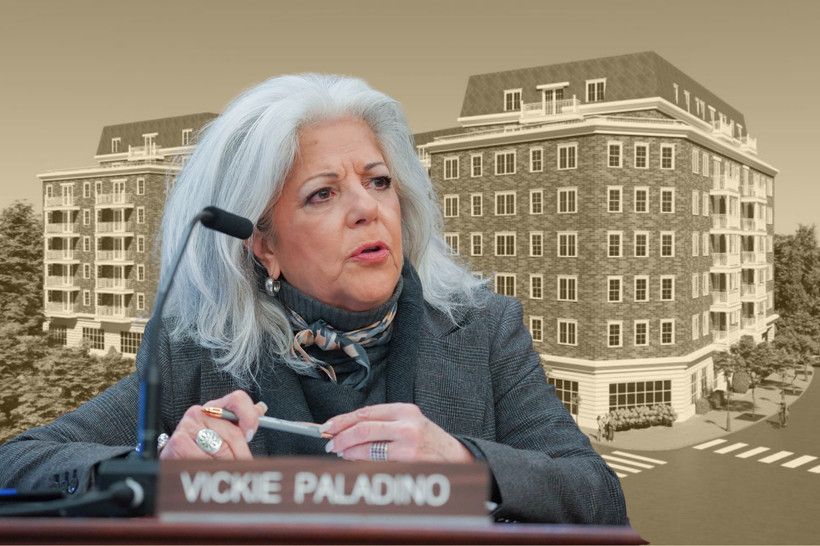
An anti-development New York City Councilmember approved a project in her district rather than risk being overruled by a new appeals board — the first sign of a potential sea change in the city’s housing landscape caused by the ballot questions that voters approved in November.
Vickie Paladino, a firebrand Republican who has railed against past efforts to increase housing density, announced Sunday that she would support a rezoning to build an eight-story building in Bay Terrace, Queens with 248 apartments.
In a six-minute Facebook video, Paladino noted that her opposition could have been enough to kill the project in the past when the council generally deferred to members on projects in their districts. But that changed with the passage of Question 4, which created a three-person appeals board including the mayor, council speaker, and local borough president, with the power to overturn the council’s rejections.
Paladino made it clear that she was worried that the project could be made more affordable for residents and potentially include transitional housing. “That is not what we want for Bayside,” she said in the video. While the appeals board does not have the power to modify the project, she suggested that it could find some way to make the project accessible to lower-income households. “We do not want this placed in the hands of the borough president and Mayor Zohran Mamdani,” she said.
With Paladino’s support, the council’s land use and zoning committees voted Monday to advance the project at 217-14 24th Ave, and the full council approved it unanimously Tuesday afternoon. It was a significant turnabout for Paladino, who had previously joined an unsuccessful lawsuit that tried to block the questions last year.
Apart from granting power to the new appeals board, the framers of the ballot question hoped that it would bring councilmembers to the table to negotiate and discourage them from quickly voting down a project. The commission, convened by then-Mayor Eric Adams, argued that the council’s final say on land use has worsened New York’s housing crisis — a shortage of hundreds of thousands of homes that has caused rents to skyrocket — since lawmakers are too beholden to neighborhood interests to responsibly set policy for the entire city. Council leaders and some labor unions campaigned against the measures, arguing they would reduce their leverage to extract concessions from developers.
“These changes were designed as a backstop to prevent abuse of member deference, ensuring that every neighborhood does its part,” the pro-development group Open New York wrote on social media after Paladino’s announcement. “They’re working.”
A Project Abandoned
Despite this early victory, the appeals board may not always compel lawmakers to strike deals. In December, shortly after the policy took effect, a developer quietly withdrew a proposal to build a 12-story, 263-unit building containing a new space for the Variety Boys and Girls Club on the site of a former Jackson Heights bowling alley. The developer, Cord Meyer, abandoned the project after local Councilmember Shekar Krishnan insisted on more deeply affordable units that would have made it economically infeasible, according to Cord Meyer vice president Danielle Molaison.
“In outer Queens, market-rate rents are not high enough to subsidize the more deeply affordable units, as they might be in Manhattan or Long Island City,” Molaison said in an email.
She declined to address why Cord Meyer did not push its project through anyway, knowing that it could be revived by the appeals board even if Krishnan persuaded the council to vote it down. Such a move could have been politically risky for a developer whose future projects may hinge on good relationships with local elected officials.
“While we have withdrawn our application for this project, Cord Meyer Development remains committed to building much-needed housing in Queens,” Molaison said. “We own several other properties in outer Queens that have the potential to deliver hundreds of additional housing units, including a significant number of affordable units, if we can get the support of our local officials and make the economics work.”
Krishnan confirmed to New York Focus that he pushed for that project to have more units available at 60 percent of the area median income, rather than 80 percent as the developer had sought. He said the developer “refused to work with us” to deepen the affordability, noting that he recently struck a deal to approve a 13-story building in Elmhurst that included affordable housing.
“In my opinion, if a project only works by pricing out our community, that’s not the right project for Jackson Heights,” he said.
“The City Wants Buildings Built”
The project in Paladino’s district will be built on the site of a former country club, containing 55 income-restricted units and 65 long-term care units for senior citizens. Developers Barone Management and Apex Development needed city approval to build greater-than-allowed density on the site, which overlooks Little Neck Bay.
It faced typical neighborhood pushback: Residents of the suburban-style neighborhood packed rowdy public meetings to argue that the building was out of scale and that nearby streets lacked enough parking spots for new residents. The local community board voted 31–1 against it in a symbolic vote in October.
Explaining her support, Paladino said the project could have been modified by the appeals board to add floors and make it more accessible to low-income residents. And although Paladino claimed on social media that she had extracted various commitments to make the building smaller and add parking, the council approved it without making any modifications to the project, which had been approved by the City Planning Commission in December.
Asked for comment, Paladino said in an emailed statement that “we don’t really know” how the project could change on appeal.
“This would be the first appeal, and I really don’t want to be the test case,” she said. “We know the developers were asked to put an additional story on the building, and we know they’re under pressure to go more affordable.”
Mayor Mamdani and Council Speaker Julie Menin both praised the outcome. Menin told New York Focus that she personally urged Paladino to support the project, given Menin’s goal of approving “as much affordable housing as possible” as speaker.
Mamdani, who agonized over whether to support the ballot measures before finally endorsing them on Election Day, said the project’s advancement shows that “every neighborhood has to do its part” in building housing.
“If we want a truly affordable city, it can’t just be a promise for a few ZIP codes — it has to be a reality everywhere,” Mamdani said in a statement. “I’m encouraged to see this project advancing, and we’ll have more to share soon about how we plan to use every tool available to deliver deeply affordable housing — faster, at scale, and in every corner of our city.”
The full impact of the ballot questions is just starting to be felt. Last week, Mamdani announced that the city will do an expedited, 90-day review on a proposal to build mixed-income housing on a city-owned Bronx site — the first use of a sped-up review for affordable projects created by Question 3.
The biggest impact could be felt from Question 2, which will allow faster reviews in the 12 neighborhoods that have built the least housing between 2021 and 2026, and remove the council’s final say over those projects. The Department of City Planning will identify those neighborhoods by October 1, and districts like Paladino’s are likely to be on the list.
“My office phone has not stopped ringing with developers looking forward to building in this district,” Paladino lamented. “Every empty parcel of land, as it stands, is up for grabs. And the city wants buildings built.”