Bill to Loosen Education Standards Quietly Circulates in Albany

Yeshivas and other nonpublic schools face a looming deadline to prove they offer an education similar to the state’s public schools. A proposed bill would loosen those rules and potentially delay the deadline.

Bianca Fortis   ·   April 3, 2025
Yeshiva Bnei Shimon Yisroel of Sopron, in Williamsburg, Brooklyn, is one of six yeshivas that has lost public funding, according to the state Education Department. | Bianca Fortis

Sign up for Staying Focused, our newsletter keeping readers up to speed on New York politics.

Update: This story has been updated with a comment from the state Education Department.

New York lawmakers are considering weakening the state Education Department’s recent guidelines on yeshivas and other nonpublic schools, New York Focus has learned.

These schools face a looming deadline — June 30 — to prove they offer a “substantially equivalent” education as the state’s public schools, under regulations issued in 2022. A draft bill circulating the legislature would loosen those rules and potentially delay the deadline for some schools.

Critics have argued for years that yeshivas, which may prioritize the teaching of religious Jewish texts over subjects like English, math, and science, have deprived students, mostly boys, of equal access to education. Some Ultra-Orthodox community leaders have fiercely opposed efforts to regulate how they teach, advocating to retain autonomy over their schools.

The draft text of the bill, submitted by the Assembly, does not identify a sponsor. Its appearance in the final stretch of budget negotiations signals that its backers are seeking to have it inserted directly into a budget bill, rather than have it considered as part of the normal legislative process. (New York State is notorious for its opaque budget process, which the Center for Public Integrity ranked dead last for accountability and transparency in 2015.)

“This appears to be an attempt by some legislators to go around our state’s courts and dismantle a law that has been in place for over a century,” said state Education Department spokesperson JP O’Hare, who added that the agency is “concerned that access to a high-quality education for every child could be traded away as part of a political deal to pass a state budget.” (Read the agency’s full statement here.)

A 2022 New York Times investigation found that many yeshivas, which had received $1 billion in public funds during the prior four years, had failed to teach students core subjects. Soon after, the state Education Department released new guidelines requiring schools to meet these standards or risk losing public funding. Schools must meet one of seven different pathways offered by the agency.

The education department has already pulled funding for six schools — all yeshivas based in Brooklyn — which it said had failed to cooperate with the New York City Department of Education, as well as the state Education Department, despite several deadline extensions and invitations to meet.

“In December 2024, the Department wrote to non-compliant schools, inviting them to meet and urging them to re-engage in the process to avoid the consequences associated with final negative determinations,” the state agency said in a statement. “Schools that did not re-engage have been deemed schools that do not provide compulsory education.”

The draft text circulating the legislature would make it easier for schools to meet state requirements. Schools would have more leeway to choose which tests to give students under an “assessment pathway,” which would also delay the deadline for schools to meet this standard until the 2032-33 school year.

The proposed regulation change would also grant approval to nonpublic schools affiliated with schools that do meet guidelines — even if those affiliated schools do not.

The draft text notes that a school meeting any of the outlined criteria would constitute a final determination, which critics say would eliminate the enforcement mechanisms that exist within the current regulations that might require changes between review periods.

Adina Mermelstein Konikoff is the executive director of the nonprofit Young Advocates for Fair Education (YAFFED), which advocates for improving secular education within Haredi Schools. Konikoff said the proposed regulation risks weakening academic standards for students.

“The longer the legislature continues to play with this, the longer students are not receiving a basic education,” she said.

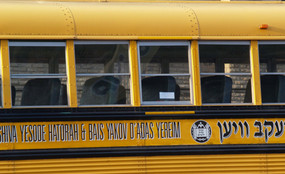
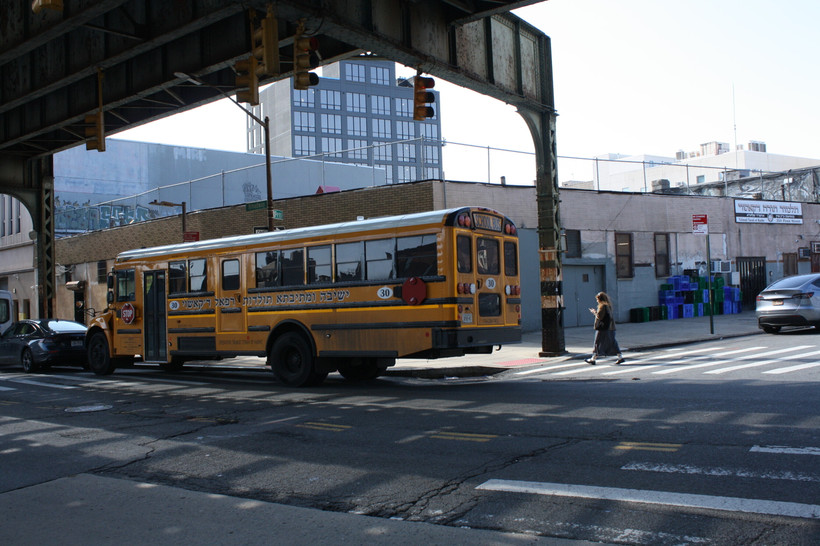
A school bus sits in front of Yeshiva Talmud Torah of Kasho in Williamsburg, Brooklyn. | Bianca Fortis

A spokesperson representing the yeshiva community told New York Focus that the community is also unhappy with the bill, because it doesn’t go far enough in granting yeshivas the autonomy they need to operate.

Changes to the substantial equivalency requirement were a feature of budget negotiations last year, as well; Governor Kathy Hochul had reportedly pushed for the changes.

Last year, the New York State Catholic Conference, which advocates on behalf of Catholic schools, posted to X amid budget talks that the current regulations “were thoughtfully enacted and should not be undermined for political purposes.”

Neither the governor’s office nor representatives for Assembly Speaker Carl Heastie responded to requests for comments about proposed changes during this year’s budget negotiations.

In 2018, Senator Simcha Felder was accused of holding that year’s budget negotiations “hostage” over a prior change to state substantial equivalency regulations.

The New York State Court of Appeals is currently considering a challenge to the state regulations filed by a group that advocates for ultra-Orthodox yeshivas, Parents for Education and Religious Liberty in Schools, which argues that the new state regulations can’t be enforced.

At New York Focus, our central mission is to help readers better understand how New York really works. If you think this article succeeded, please consider supporting our mission and making more stories like this one possible.

New York is an incongruous state. We’re home to fabulous wealth — if the state were a country, it would have the tenth largest economy in the world — but also the highest rate of wealth inequality. We’re among the most diverse – but also the most segregated. We passed the nation’s most ambitious climate law — but haven’t been meeting its deadlines and continue to subsidize industries hastening the climate crisis.

As New York’s only statewide nonprofit news publication, our journalism exists to help you make sense of these contradictions. Our work scrutinizes how power works in the state, unpacks who’s really calling the shots, and reveals how obscure decisions shape ordinary New Yorkers’ lives.

In the last two decades, the number of local news outlets in New York has been nearly slashed in half, allowing elected officials and powerful individuals to increasingly operate in the dark — with the average New Yorker none the wiser.

We’re on a mission to change that. Our work has already shown what can happen when those with power know that someone is watching, with stories that have prompted policy changes and spurred legislation. We have ambitious plans for the rest of the year and beyond, including tackling new beats and more hard-hitting stories — but we need your help to make them a reality.

If you’re able, please consider supporting our journalism with a one-time gift or a monthly gift. We can't do this work without you.

Thank you,

Akash Mehta
Editor-in-Chief
A photo of Akash Mehta.
Bianca Fortis was the education reporter at New York Focus. She was previously an Abrams reporting fellow at ProPublica, where she spent 18 months investigating how Columbia University protected a predatory doctor who had sexually abused hundreds of patients for more than 20 years… more
Also filed in New York State

City budget gaps and an ambitious affordability agenda may require pressing Albany again for taxes and aid.

A bill awaiting the governor’s signature would relax restrictions on who can qualify for victim compensation.

We’ve compiled information for the 450,000 New Yorkers who will lose health care coverage on July 1.

Also filed in Education

In May, state lawmakers passed a $269 billion budget after haggling for months over thousands of line items and policies affecting New Yorkers.

Advocates welcomed the additional funding but said it falls short of need and doesn’t do enough to support workers.

Some of the city’s new aid will be canceled out by pension boosts.