New York’s School Districts Are Shrinking — But Their Financial Problems Are Growing

New York’s comptroller has flagged 22 school districts as fiscally stressed — up sharply from last year.
Bianca Fortis   ·   May 2, 2025
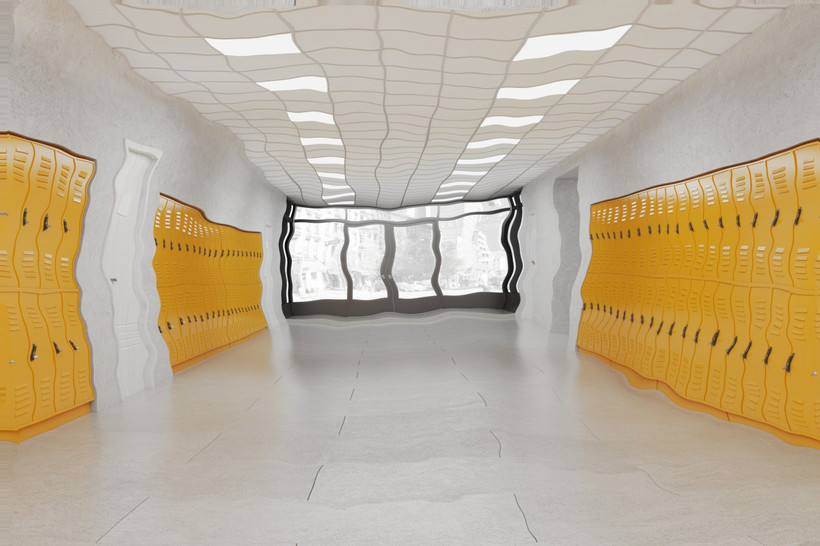
A school corridor lined with yellow lockers is distorted as though underwater.
Environmental stress factors — poverty, teacher shortages, and large class sizes — only add to the pressure on schools designated as fiscally stressed. | Photo: ismagilov / Getty Images | Illustration: Leor Stylar

Sign up for Staying Focused, our newsletter keeping readers up to speed on New York politics.

As part of a broader effort to tackle a massive budget deficit, the Mount Vernon City School District announced in December a plan to close three of its K-8 schools.

Erica Peterson, Mount Vernon High School’s PTA president, worries the closures could demoralize an already economically depressed community.

“How are we going to get new families to come to our district with these three schools closing? It’s going to affect the community,” said Peterson, who is running for a seat on the school board. “It’s heartbreaking to see something like this.”

The Mount Vernon district was flagged as being in the worst “fiscal stress” of any in the state, according to a recent report from the Office of the New York State Comptroller.

The district’s dire financial situation reflects what’s happening at the city level — the City of Mount Vernon is facing $59 million in delinquent taxes, some of which should be going to schools.

But the district also points to steadily declining enrollment as another reason for lost revenue. In 2016, Mount Vernon City School District had more than 8,000 students; by 2027, that number is expected to fall to just 6,000.

As people continue to flee New York state due to issues like affordability and housing, school districts say that enrollment declines, along with inconsistent levels of state aid and a reluctance to increase property taxes, can leave them financially vulnerable. Meanwhile, educators say, the cost of providing an education to children continues to increase.

New York’s Student Population is Declining

New York state’s population began to steadily decrease around 2011, then declined sharply following the Covid-19 pandemic. Experts expect that trend to continue. As a result, school enrollment — currently 2.4 million students statewide — is at its lowest since the early 1950s.

The bulk of state support for school districts stays flat even when enrollment declines. But because of rapidly rising costs, districts feel a budget squeeze even when their aid isn’t cut.

Each year, the state comptroller reviews the finances of more than 670 school districts. The office’s latest report found 22 school districts were in a state of “fiscal stress” — or financial instability. That’s up from 16 districts last year.

The review takes into account things like deficits, poverty levels, turnover, and other indicators to come up with each district’s “score.”

Districts facing budget shortfalls often consider deep spending cuts to stay afloat. But research shows that cuts in per-pupil spending often result in lower test scores and wider achievement gaps, particularly between white students and students of color.

Balancing budgets means navigating competing demands – meeting students’ educational needs, maintaining staff salaries and benefits, upgrading technology, supporting athletic and after-school programs, addressing aging infrastructure, and managing unfunded state mandates.

Brian Cechnicki, executive director of the Association of School Business Officials of New York, said staffing shortages are an added financial pressure. Schools must pay higher wages to attract teachers, aides, and bus drivers, further increasing costs.

Cechnicki also highlighted questions around federal funding. President Donald Trump has vowed to close the US Department of Education, which provides supplemental funding to schools — including Title I schools and those serving students with disabilities.

“Is the government freezing these payments? Are they actually just going to cut some of the programs?” he asked. “That is adding a level of uncertainty here as districts are trying to put their budgets together.”

York Central School District

The York Central School District outside Rochester has seen a steep enrollment drop, from about 1,100 students in the 1990s to just 619 today. Yet Superintendent David Furletti said the district’s needs — and related costs — are rising rapidly.

“Is the government freezing these payments? Are they actually just going to cut some of the programs?”

—Brian Cechnicki

Despite its small size, the rural district tries to offer its students a lot, including mental health services, computer programming, robotics, and digital media arts classes. Furletti said students need to be prepared for a global workforce.

“We’ve really tried to give them an experience that would bridge that gap from a small, rural school to a competitive college experience,” he said.

But these initiatives come at a cost. York ran a budget deficit last year and couldn’t keep a sufficient reserve fund balance, prompting the comptroller to flag the district as susceptible to fiscal stress. More than half of York’s students are considered economically disadvantaged, meaning the district must provide even more support.

Furletti said the district is currently reviewing its budget to figure out how to close the gaps by next year.

“We are looking at making sure the students have the best programming and placements available,” he said. “But we also have to be mindful of the cost of those.”

Middle Country Central School District

When Beth Rella arrived at the Middle Country School District on Long Island, the district already had financial troubles. Then Covid-19 happened.

In the fall of 2020, eager to get kids back into the classroom, Middle Country hired more than 50 new employees, including teachers and custodians, and invested heavily in protective gear and cleaning supplies. The district spent $6 million in the 2020-21 school year alone to support these initiatives.

Rella said unpredictable state aid makes budgeting a challenge because it’s harder to plan ahead. Over recent years, the district has seen funding differences from $400,000 to $12 million, she said.

“My expenses don’t change that much in a year,” she said. “The harsh fluctuations in state aid does make it quite challenging.”

Enrollment has recently rebounded, but many incoming students have disabilities and higher needs, and require special, more costly, services, Rella said.

And fixed costs, like electricity and insurance, are rising at Middle Country.

To reduce costs, Middle Country has installed solar panels, offered a lower-cost medical plan for retirees and reduced some positions through attrition. Middle Country is now out of the fiscal stress designation, according to the comptroller’s latest report.

“We don’t want to disrupt our students, our staff, our programs, so you have to make small, incremental changes along the way to get yourself in a better position,” Rella said. “It will show itself in the years to come.”

Newfield Central School District

Eric Hart became superintendent of the Newfield Central School District, outside Ithaca, at the height of the pandemic in July 2020. He was previously a middle school principal within the district, and was unaware that Newfield was experiencing financial hardship.

“Covid I wasn’t going to control,” Hart said. “I didn’t know what to do with Covid — we basically did what we were told. But financially, I was concerned.”

Enrollment at Newfield has dropped — from nearly 800 students seven years ago to 630 today — yet the district hadn’t adjusted its spending accordingly, Hart learned when he took over. With 65 percent of the student population considered economically disadvantaged, budget pressures were intense.

To cut costs, Newfield reduced staff size through attrition and retirement and cut some electives, including a shop tech class, a local history class and two science classes. Each decision required careful consideration of impacts on students and staff.

The district turned to the community for help during the 2020-21 school year. Administrators proposed a new budget funded in part by a significant property tax increase, just under 14 percent, but voters rejected it. Eventually, a budget with an 8.9 percent tax increase was approved.

“The community stepped up at that point, just knowing the historic nature of what we were dealing with,” said Perry Gorgen, a business administrator in the district.

Pandemic-era federal funds helped close remaining gaps, and Newfield has since moved out of the fiscal stress designation.

Gorgen said districts need to think more about local property values and real estate trends, student demographic data, as well as staff retirements — all factors that can impact a school district’s finances.

“They can’t be ignored,” he said. “You have to think that way. Otherwise, you’re going to get caught. You’re going to be in a really tricky situation.”

At New York Focus, our central mission is to help readers better understand how New York really works. If you think this article succeeded, please consider supporting our mission and making more stories like this one possible.

New York is an incongruous state. We’re home to fabulous wealth — if the state were a country, it would have the tenth largest economy in the world — but also the highest rate of wealth inequality. We’re among the most diverse – but also the most segregated. We passed the nation’s most ambitious climate law — but haven’t been meeting its deadlines and continue to subsidize industries hastening the climate crisis.

As New York’s only statewide nonprofit news publication, our journalism exists to help you make sense of these contradictions. Our work scrutinizes how power works in the state, unpacks who’s really calling the shots, and reveals how obscure decisions shape ordinary New Yorkers’ lives.

In the last two decades, the number of local news outlets in New York has been nearly slashed in half, allowing elected officials and powerful individuals to increasingly operate in the dark — with the average New Yorker none the wiser.

We’re on a mission to change that. Our work has already shown what can happen when those with power know that someone is watching, with stories that have prompted policy changes and spurred legislation. We have ambitious plans for the rest of the year and beyond, including tackling new beats and more hard-hitting stories — but we need your help to make them a reality.

If you’re able, please consider supporting our journalism with a one-time gift or a monthly gift. We can't do this work without you.

Thank you,

Akash Mehta
Editor-in-Chief
A photo of Akash Mehta.
Bianca Fortis was the education reporter at New York Focus. She was previously an Abrams reporting fellow at ProPublica, where she spent 18 months investigating how Columbia University protected a predatory doctor who had sexually abused hundreds of patients for more than 20 years… more
Also filed in New York State

State leaders are expected to pass a bill that avoids resolving how much Resorts World New York City needs to pay.

New York state has pumped millions of taxpayer dollars into an online portal that vowed to make life easier for Rochester’s neediest, but critics say it’s fallen short.

Resorts World is floating legislation to avert more than $500 million in payments to the horseracing industry.

Also filed in Education

Advocates welcomed the additional funding but said it falls short of need and doesn’t do enough to support workers.

Some of the city’s new aid will be canceled out by pension boosts.

The Hochul administration now has a chance to relax New York’s child care staffing ratios — among the country’s strictest — after 26 years. But will it?