Comptroller to ‘Slow Roll’ Returning Lost Money to New Yorkers

Several states already proactively send out payments in much larger amounts than New York currently does.
Chris Bragg   ·   August 5, 2025
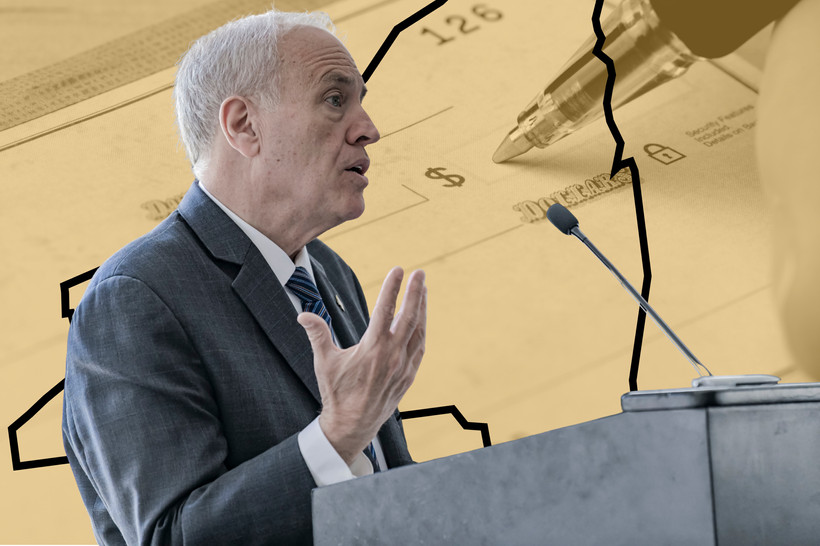
Comptroller Tom DiNapoli said that his office intends to “slow roll” the return of unclaimed funds to New Yorkers. | Photos: Office of the NYS Comptroller; Alexeyes/Getty Images | Illustration: Leor Stylar

Sign up for Staying Focused, our newsletter keeping readers up to speed on New York politics.

Comptroller Tom DiNapoli will soon have the clear authority to proactively mail out checks of any size from the $20 billion pot of “lost money” he oversees — but he’s wary of using it too aggressively.

DiNapoli recently told the public radio program The Capitol Pressroom that his office intends to “slow roll” automatic returns, citing concerns that checks, especially in larger amounts, could be sent to the wrong addresses and lead to fraud.

“People are always trying to scam everything these days, right?” he said. “I don’t want to send a $5,000 check without 100 percent assurance that it’s going to somebody who, in fact, is entitled to it.”

A number of states already proactively send out payments in much larger amounts than New York currently does. New York Focus contacted eight of them. The seven states that responded all said that fraud has not been a major problem.

Ron Lizzi, an unofficial watchdog on unclaimed funds whose advocacy has resulted in several states speeding up returns, told New York Focus that the “best way to prevent fraud is to automatically return money when possible.”

New York currently allows anyone to see online who’s owed unclaimed funds, which stem from sources like inactive bank accounts, uncashed checks, and security deposits. That system can invite fraud, said Lizzi, who argued that if the state knows the identity of a property’s owner, “automatically sending the money to that owner immediately makes fraud impossible.”

DiNapoli’s office disagreed that the current system invites fraud. The comptroller’s office is “careful to confirm rightful ownership to ensure that the money goes to the legitimate owner,” a DiNapoli spokesperson said.

To access unclaimed funds, New Yorkers generally need to fill out an online form with DiNapoli’s office. But many don’t know they’re owed money in the first place. A new state law, which DiNapoli championed, allows him to send out checks without individuals needing to apply. In a 2025 test run, DiNapoli’s office is only automatically sending out checks to people who have recently lost money, and only in amounts up to $250. It’s unclear if he will increase the threshold past $250 next year, or automatically send checks to older accounts that comprise the vast majority of the $20 billion.

“We’ve had a good rate of appropriate recovery of these funds,” DiNapoli told the Capitol Pressroom.

But the amount of money New York owes has nearly tripled since he took office in 2007. Last fiscal year, his office returned 2.6 percent of outstanding funds — significantly less than states that make heavier use of automatic returns.

States that automatically send out large checks told New York Focus that they haven’t seen significant fraud.

Illinois’s program “has not experienced significant fraud,” North Carolina has found that “fraud associated with these higher-dollar payments has not been an issue,” and West Virginia is aware of “no instances of fraud,” spokespeople at each state treasurer’s office said. All three states proactively send checks up to $5,000.

Connecticut and Rhode Island, which sends checks up to $2,500, said they weren’t aware of any incidents of fraud, either.

Louisiana has “not identified any problems,” according to a spokesperson for the treasurer’s office. As of 2018, Louisiana sent out checks up to $1,500; the office does not publicly discuss its current threshold amount, the spokesperson said.

The only state that described issues with automatic returns was Utah, which paused its program not because of fraud but because of returned mail.

“[The] best way to prevent fraud is to automatically return money when possible.”

—Ron Lizzi, Unclaimed Funds Advocate

“Many checks were returned as undeliverable or caused confusion among recipients who didn’t expect them, significantly increasing call volume and straining available resources,” explained Brittany Griffin, policy and communications deputy at the Utah State Treasurer’s office. The office is now working on legislation that would give it access to email addresses on tax returns, enabling faster and more reliable outreach and, down the line, potential electronic payments.

Five of those seven states either allow their tax departments to share physical addresses from tax returns with the state treasurer for purposes of returning money, or allow the tax regulator to confirm address data shared by the treasurer.

It’s not currently legal in New York for DiNapoli’s office to obtain such data from the Department of Taxation and Finance, making it harder for DiNapoli to verify addresses.

Asked whether DiNapoli’s office would support legislation allowing such access, a spokesperson said it was having “conversations about” and is interested in “any efforts or legislation that would help us return money to its rightful owners.”

Although other states told New York Focus that higher check thresholds had not led to significant fraud, DiNapoli’s office cautioned against comparing them with New York, citing its size.

“We processed nearly 700,000 claims, about 2,000 a day in the last state fiscal [year], and we’re returning an average of $2 million a day,” said DiNapoli spokesperson Matt Sweeney. “We deal with a very high volume. Some states have significantly smaller programs, so the consequences of error are proportionately smaller.”

DiNapoli’s plan to “slow roll” automatic returns drew fire from Drew Warshaw, his challenger in next summer’s Democratic primary for comptroller.

Warshaw has made returning unclaimed funds as soon as “humanly possible” a focus of his campaign. He highlighted New York Focus’s finding that the state legislature and governor has already borrowed — and spent — the $20 billion pot.

Following New York Focus’s article on this topic in June, DiNapoli’s office removed language from its website highlighting that the state owes $20 billion.

The site now touts the more than $385 million returned so far this year, but does not list the outstanding amount.

“I wouldn’t read too much into the change on the website,” Sweeney said. “We regularly revise, update and rotate online messaging to promote various aspects of the Office of the State Comptroller.”

According to DiNapoli’s office, some unclaimed funds would be difficult to ever return, including unredeemed gift cards and money orders that lack recipient names, decades-old accounts that lack Social Security numbers, and complex high-dollar cases involving unclear estate beneficiaries or corporate mergers and acquisitions.

A DiNapoli campaign spokesperson told New York Focus in June that Warshaw’s plan to return the full $20 billion is unrealistic: The comptroller can’t “just send out $20 billion with fewer checks and balances than you’d find at the lost and found at your local mall.”

DiNapoli’s office has been evaluating a new, improved system for retrieving information about property owners. According to Kelly Kuracina, director of the comptroller’s Office of Unclaimed Funds, that assessment will play into DiNapoli’s final decisions about how aggressively to use his new discretion to automatically mail checks.

At New York Focus, our central mission is to help readers better understand how New York really works. If you think this article succeeded, please consider supporting our mission and making more stories like this one possible.

New York is an incongruous state. We’re home to fabulous wealth — if the state were a country, it would have the tenth largest economy in the world — but also the highest rate of wealth inequality. We’re among the most diverse – but also the most segregated. We passed the nation’s most ambitious climate law — but haven’t been meeting its deadlines and continue to subsidize industries hastening the climate crisis.

As New York’s only statewide nonprofit news publication, our journalism exists to help you make sense of these contradictions. Our work scrutinizes how power works in the state, unpacks who’s really calling the shots, and reveals how obscure decisions shape ordinary New Yorkers’ lives.

In the last two decades, the number of local news outlets in New York has been nearly slashed in half, allowing elected officials and powerful individuals to increasingly operate in the dark — with the average New Yorker none the wiser.

We’re on a mission to change that. Our work has already shown what can happen when those with power know that someone is watching, with stories that have prompted policy changes and spurred legislation. We have ambitious plans for the rest of the year and beyond, including tackling new beats and more hard-hitting stories — but we need your help to make them a reality.

If you’re able, please consider supporting our journalism with a one-time gift or a monthly gift. We can't do this work without you.

Thank you,

Akash Mehta
Editor-in-Chief
A photo of Akash Mehta.
A photo of Chris Bragg.
Chris Bragg is the Albany bureau chief at New York Focus. He has done investigative reporting on New York government and politics since 2009, most recently at The Buffalo News and Albany Times Union.
Also filed in New York State

The legislation would make it easier for currently and formerly incarcerated people and child victims to sue the state over allegations of past abuse.

State leaders are expected to pass a bill that avoids resolving how much Resorts World New York City needs to pay.

New York state has pumped millions of taxpayer dollars into an online portal that vowed to make life easier for Rochester’s neediest, but critics say it’s fallen short.