New York Owes $20 Billion in Lost Cash. An Upstart Challenger Says He’ll Give It All Back.

Drew Warshaw is taking on Comptroller Tom DiNapoli with a pledge to repay the entire pot of unclaimed funds as soon as ‘humanly possible.’

Chris Bragg   ·   June 18, 2025
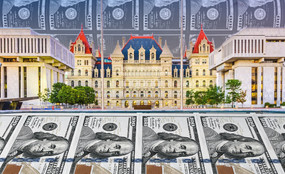
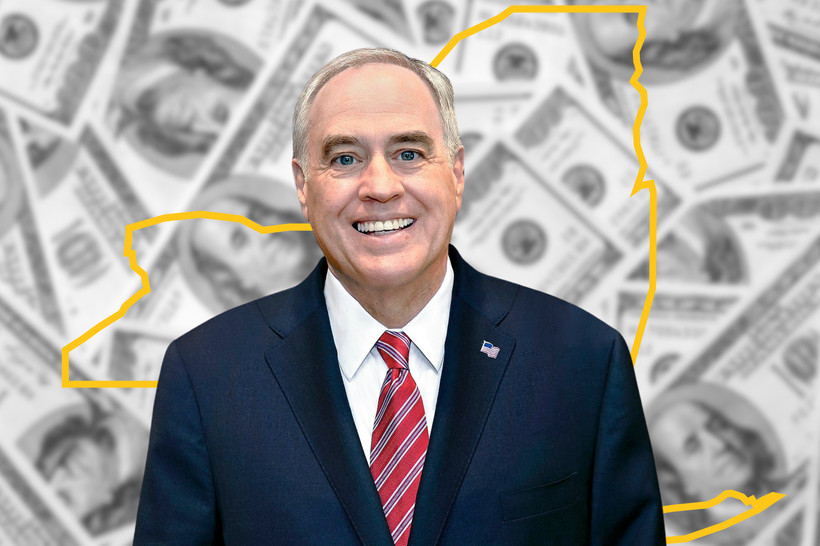
For every three dollars Comptroller Tom Dinapoli has returned to its owners since he took office in 2007, he has given roughly five to the state government to shore up its annual budgets. | Photo: Office of the New York State Comptroller | Illustration: Leor Stylar

Sign up for Staying Focused, our newsletter keeping readers up to speed on New York politics.

The New York state government is sitting on $20 billion of the public’s money, and an upstart challenger wants to give it all back.

Banks, insurers, and other companies often owe money to customers from inactive accounts, uncashed checks, security deposits, and other sources. If they don’t return it directly, they eventually have to hand it over to the state comptroller’s office, which takes over the job of getting the money back to its rightful owners.

Yet the mountain of cash keeps growing, and the governor and legislature routinely spend huge sums from the pot with little expectation of repaying it. Last fiscal year, lawmakers treated nearly $900 million in unclaimed funds as revenue to spend however they saw fit.

That’s been a pattern. For every three dollars Comptroller Tom DiNapoli has returned to its owners since he took office in 2007, he has given roughly five to the state government to shore up its annual budgets.

The total pot has swelled from $7.2 billion in 2006 to over $20 billion, far more than any other state in the country.

DiNapoli’s office currently only has about $100 million of the money on hand — meaning state lawmakers owe a tab of about $20 billion. That’s more than many other states’ entire annual budgets, to put it in perspective.

If the bill suddenly became due, it could blow a massive hole in the New York state budget.

And a recently declared comptroller candidate would take steps towards doing just that.

The state comptroller maintains a website allowing New Yorkers to look up if they’re owed money, verify their identity, and have a check mailed to them. Since DiNapoli became comptroller, his office reports having returned more than $7 billion, including $633 million in the most recent fiscal year.

State law requires the comptroller to hand over unclaimed funds in excess of $750,000 to the state Division of the Budget at the end of each fiscal year, essentially as interest-free cash for lawmakers to borrow.

As a result, nearly $11.8 billion has been transferred to the general fund since 2007. The transfers have gotten bigger over the past five years, which DiNapoli’s office attributes to the coronavirus pandemic, during which people suddenly died without informing family members about their assets.

Other states have returned much greater proportions of funds to residents. Florida, which has a larger population than New York, reports holding only about $2 billion in unclaimed funds and returned $428 million to residents in fiscal year 2024 — roughly 20 percent of the total owed at the time. That same year, New York returned $504 million to residents, roughly 2.6 percent of its total.

New York’s status as a global financial center plays a role in its nation-high $20 billion total, and DiNapoli’s office has grown increasingly adept at collecting funds from banks and other companies.

Unlike some states, New York law requires financial institutions to first attempt to find rightful owners before turning money over to the state. That means the comptroller’s office is starting from a place where the recipient is difficult to locate, according to DiNapoli’s office.

The office alerts New Yorkers that they’re owed money through social media, press releases, appearances at events like county fairs, and targeted mailings. DiNapoli routinely highlights the funds in public appearances and events with elected officials. Last year, the office returned $1.5 million in lost money each day to thousands of people; this year, the daily figure has increased to $2 million.

Still, many New Yorkers remain unaware that they have money waiting for them, and the pot keeps growing.

For the first time, DiNapoli is facing a challenger in the Democratic primary for state comptroller. Last month, nonprofit-housing executive Drew Warshaw — the former chief of staff at the Port Authority of New York and a key figure in the World Trade Center rebuild — launched a primary bid to unseat the 18-year incumbent in the June 2026 election.

Like any new candidate taking on an entrenched incumbent, Warshaw is a long shot. But he believes the comptroller’s office needs a jolt of urgency and imagination, someone willing to take “bigger swings” — including at returning money to New Yorkers.

Warshaw wants to repay the entire pot of unclaimed funds as soon as “humanly possible,” he told New York Focus. Instead of New Yorkers having to learn they are owed money and then fill out forms verifying their identities, Warshaw says he would seek to proactively mail out the entire $20 billion.

“It’s nearly tripled under [DiNapoli’s] watch, and this is New Yorkers’ money,” Warshaw said. “This is a scandal, and they are treating it with a casual shrug, a thumb in the eye of New Yorkers who can’t afford their rent and can barely afford to put food on the table.”

A picture of Drew Warshaw sitting against a wall
Nonprofit-housing executive Drew Warshaw launched a primary bid to unseat 18-year incumbent State Comptroller Tom DiNapoli. | Drew Warshaw for Comptroller


Governor Kathy Hochul is campaigning for reelection on $2 billion worth of “inflation refund” checks her administration is sending residents to help with rising costs of living. Warshaw noted that the unclaimed funds pot has 10 times that amount, yet argues there’s “not an ounce of urgency to get it back to them.”

He believes the comptroller could employ data engineers and more sophisticated technology, including artificial intelligence, to identify owners and send checks with a “99.999 percent confidence interval.”

Certain accounts can be sizable. Last year, DiNapoli’s office issued a record-breaking nearly $74 million refund in a matter involving a large financial investment. Warshaw would allow checks of any amount to be sent out, even without verifying the owner’s identity.

He suggested that correct addresses could be determined through recent tax returns collected by the state government. Yet according to DiNapoli’s office, the state Department of Taxation and Finance won’t provide such information to the comptroller’s office, citing a state tax privacy law.

Instead, the comptroller’s office uses sources such as a national change of address database to locate owners. The office said that tools and data sources locating people who change addresses have “greatly improved.”

Even so, DiNapoli’s team says it’s a fanciful idea to mail out $20 billion to owners who might have moved or died.

When politicians “propose schemes that are literally too good to be true, it’s because they lack the experience and skills for the job,” said Doug Forand, a DiNapoli campaign spokesperson. “You can’t just send out $20 billion with fewer checks and balances than you’d find at the lost and found at your local mall.”

Warshaw thinks that’s a convenient excuse.

“This is a scandal, and they are treating it with a casual shrug.”

—Drew Warshaw

“The reality that they are afraid to admit is that they are not giving New Yorkers back their money because there’s no more money to give back,” Warshaw said. “They’ve spent it all.”

“They want to worry about fraud. They want to not be able to solve this problem with technology,” he continued. “They’re incentivized not to figure this out.”

Several prominent New York politicians — including former Governor Andrew Cuomo, US Senators Chuck Schumer and Kirsten Gillibrand, and House Speaker Hakeem Jeffries — show up as being owed funds on the comptroller’s website, Warshaw pointed out. The politicians are all listed at the address of one of their current or former government offices. Yet they remain unpaid.

Warshaw said he would not seek to blow an immediate $20 billion hole in New York’s budget, but would “sit down with the governor and legislature and develop a responsible approach to get the money back.”

During DiNapoli’s 18 years, nothing in state law explicitly prohibited his office from proactively sending out checks to people owed funds, Warshaw noted.

But DiNapoli’s office believed the authority was unclear at best and pushed for legislation to clarify it. The bill, signed last year, now explicitly allows the comptroller to automatically issue checks.

The new law makes 2025 a test run for automatic payments. This year, DiNapoli’s office can only send out checks of up to $250. And during the test period, the office is only sending out automatic payments stemming from newly lost money.

Beginning in 2026, DiNapoli can automatically send out checks in whatever amount he deems fit. It can be from any portion of the $20 billion, no matter how ancient the account.

DiNapoli’s office has not yet determined whether to increase the threshold past $250 or whether to start sending out checks to older accounts. Kelly Kuracina, director of the comptroller’s Office of Unclaimed Funds, told New York Focus that those decisions will likely be made this fall, after the office has evaluated how a new, improved system for retrieving information about property owners is functioning.

But Kuracina described drawbacks to automatically sending checks to older accounts. Individuals or estates may already have pending claims, she said, and sending out a check based on outdated information could interfere with that process. Older accounts also are more likely to have wrong addresses.

So far, during the 2025 test run, about 70,000 people have automatically been sent checks and have been repaid about $5 million, Kuracina said. The check clearing rate is about 40 percent, a figure lower than the office had hoped. But the office is not yet aware of any cases of fraud stemming from the new initiative. (The office has a team dedicated to detecting fraudulent claims.)

While the state lawmakers technically have a $20 billion liability, they’re unlikely to ever have to repay the full amount, Kuracina said.

“That number is likely to continue to increase,” Kuracina said. “The likelihood of being able to pay everything that has ever been reported —- and remains outstanding — is very low.”

Addressing the idea of simply returning the entire $20 billion at once, she said, “I wish it were that easy — I really do.”

But a litany of obstacles make it impractical, she said: unredeemed gift cards and money orders that lack recipient names, decades-old accounts that lack Social Security numbers, and complex high-dollar cases involving unclear estate beneficiaries or corporate mergers and acquisitions.

Some states already allow the automatic return of unclaimed funds, and some have seen success. For instance, Illinois has touted returning more than $2 billion since 2015, and allows automatic returns up to $5,000 — 20 times New York’s current threshold.

Unlike New York, a number of states allow tax data to be used for tracking down recent addresses.

In Illinois, the Department of Revenue is permitted to provide the state treasurer with recent address information based on tax returns. In turn, the treasurer may send out checks up to $5,000 if information about a last known address is less than a year old. According to the state treasurer, such larger checks are only sent out for “simple claims” — cash owed to an individual — and not more complex cases.

Eric Krol, spokesperson for the Office of the Illinois State Treasurer, said the age of a claim doesn’t affect whether a check is automatically sent. Illinois verifies addresses using tax records and the statewide voter registration file, both of which require individuals to confirm their identity under penalty of perjury, and by a test letter sent in the mail.

Connecticut, meanwhile, has been criticized for spending far more on collecting lost funds from financial institutions than on advertising the reclaimed money to its owners.

DiNapoli’s office said that it has 70 staff dedicated to recouping funds from financial institutions and 100 for outreach and assistance with claims.

According to a 2018 academic study, states that relied on such transfers for significant portions of their budgets — such as Delaware — tended to turn lost money over to claimants at a lower rate.

As of 2023, unclaimed funds transfers reportedly accounted for about 6 percent of Delaware’s budget. In New York’s, unclaimed funds transfers comprised less than .4 percent of the total budget in 2024, despite the record nearly-$900 million sweep.

One change the New York legislature could consider: allowing the comptroller’s office to access the most recent address information on individuals’ tax returns, as its counterparts in many other states can do.

“That is an example of legislative action they’re choosing not to take,” said Darrin Wilson, one of the study’s co-authors and an associate professor of public administration at Northern Kentucky University.

“I don’t know the reason, but lowering that type of barrier could help the comptroller get more money out. But that would also mean less funding being available for the general fund, and for the legislature.”

At New York Focus, our central mission is to help readers better understand how New York really works. If you think this article succeeded, please consider supporting our mission and making more stories like this one possible.

New York is an incongruous state. We’re home to fabulous wealth — if the state were a country, it would have the tenth largest economy in the world — but also the highest rate of wealth inequality. We’re among the most diverse – but also the most segregated. We passed the nation’s most ambitious climate law — but haven’t been meeting its deadlines and continue to subsidize industries hastening the climate crisis.

As New York’s only statewide nonprofit news publication, our journalism exists to help you make sense of these contradictions. Our work scrutinizes how power works in the state, unpacks who’s really calling the shots, and reveals how obscure decisions shape ordinary New Yorkers’ lives.

In the last two decades, the number of local news outlets in New York has been nearly slashed in half, allowing elected officials and powerful individuals to increasingly operate in the dark — with the average New Yorker none the wiser.

We’re on a mission to change that. Our work has already shown what can happen when those with power know that someone is watching, with stories that have prompted policy changes and spurred legislation. We have ambitious plans for the rest of the year and beyond, including tackling new beats and more hard-hitting stories — but we need your help to make them a reality.

If you’re able, please consider supporting our journalism with a one-time gift or a monthly gift. We can't do this work without you.

Thank you,

Akash Mehta
Editor-in-Chief
A photo of Akash Mehta.
A photo of Chris Bragg.
Chris Bragg is the Albany bureau chief at New York Focus. He has done investigative reporting on New York government and politics since 2009, most recently at The Buffalo News and Albany Times Union.
Also filed in Elections

The last-minute influx, the biggest ever for a legislative primary, is boosting her opponent, Jessica González-Rojas.

Millions in outside spending was a boon to Gov. Kathy Hochul’s 2022 opponent, Lee Zeldin, and influenced down-ballot races.

Hakeem Jeffries urged Albany to avoid maps that aggressively boosted Democrats, sources told New York Focus.

Also filed in New York State

At a Board of Regents meeting Monday, state officials proposed eliminating credit-based diploma requirements.

City budget gaps and an ambitious affordability agenda may require pressing Albany again for taxes and aid.

A bill awaiting the governor’s signature would relax restrictions on who can qualify for victim compensation.

Also filed in Budget

In May, state lawmakers passed a $269 billion budget after haggling for months over thousands of line items and policies affecting New Yorkers.

State leaders are expected to pass a bill that avoids resolving how much Resorts World New York City needs to pay.

Resorts World is floating legislation to avert more than $500 million in payments to the horseracing industry.

Also filed in Affordability

We’ve compiled information for the 450,000 New Yorkers who will lose health care coverage on July 1.

We’ve compiled information for SNAP recipients in New York on the changing work requirements.

Despite last-ditch efforts by a coalition of lawmakers, the state failed to avert a health coverage cliff coming this summer.