Insurance Said His Treatment Was Covered. Then They Sent a $17,000 Bill.

Thousands of New Yorkers have new health insurance from the company Leading Edge Administrators. One Massachusetts retiree’s battle with the company highlights the risks they face.

Sam Mellins   ·   September 17, 2025
Kevin Danahy at his son George's college graduation. | Courtesy of Kevin Danahy

Sign up for Staying Focused, our newsletter keeping readers up to speed on New York politics.

Kevin Danahy was shocked when he got a $17,000 bill for a treatment his health insurance company had told him would be covered.

The 60-year-old retiree suffers from cardiac sarcoidosis, a heart condition that is generally treatable but can be dangerous or even fatal without medical attention. It forced him into early retirement from a career in book publishing, so he has relied on a combination of Medicare and the insurance that his wife received from her work.

Since 2020, when he was first diagnosed, his doctors have treated his condition with regular infusions of a drug called Remicade. It’s highly effective, but costs up to five-figure sums per treatment. New York Focus reviewed his doctor’s records, which note that his disease was “severe” before the Remicade treatments, but “highly responsive” once the infusions began. Without them, he runs the risk of his condition worsening dramatically.

In March, a change in his wife’s health insurance endangered his access to the lifesaving drug: Her company switched employees’ health insurance provider to a company known as Leading Edge Administrators, a small private insurer that often partners with Anthem Blue Cross Blue Shield. New York Focus has extensively reported on Leading Edge’s history of unpaid bills, lawsuits, and shoddy coverage.

Danahy lives in Massachusetts, but his story is relevant to many New Yorkers. That’s because in May, Leading Edge became the insurer for tens of thousands of low-wage home health aides who care for the elderly and disabled under a state-funded program known as CDPAP. As of this spring, that program is run by private company Public Partnerships, LLC (or PPL), which hired Leading Edge to provide insurance to its workforce.

The two health plans that PPL and Leading Edge are offering workers provide only limited coverage for prescription drugs. One of the plans offers no coverage at all for most drugs.

It’s possible that PPL will end or change its relationship with Leading Edge. At a public hearing last month, PPL vice president Patty Byrnes said that the company is speaking to insurance brokers and hoping to “provide better services” by the end of this year.

Danahy has been planning to skip Remicade treatments, despite the danger that would put him in.

“My wife is mad at me because I don’t want to go for the infusions, and I’m like, ‘We can’t afford it,’” Danahy said. “All this money that we thought we saved over the past couple of years could be out the window.”

So how did Danahy get hit with such a huge surprise bill?

Insurance companies often require doctors to ask for permission before giving patients expensive drugs like Remicade, so that the company can verify that the patients truly need them before it shells out the cash. Accordingly, earlier this year, Danahy’s doctor asked Leading Edge for permission to continue the medication. On April 1, Danahy and his doctor received a letter from Anthem stating that he had been approved for seven Remicade treatments over the next year.

“This approval means that, based on the information given to us, the medication is considered medically necessary,” the letter stated. Danahy received his next Remicade treatment a few weeks later.

A letter from Danahy's insurance confirming that his medication would be covered. | Courtesy of Kevin Danahy


In May, he received a bill for the visit for $672, which seemed reasonable, since he had not yet met the full deductible on his plan. He paid it without complaint.

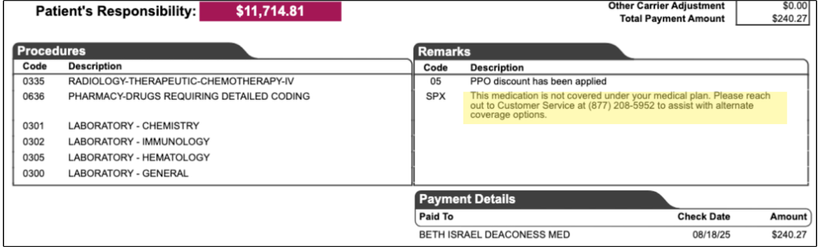
But then in July, he received a new bill for that same visit. According to the new bill, he would have to pay the full cost of the Remicade treatment: $11,126. Leading Edge paid nothing. “This medication is not covered under your medical plan,” the bill stated.

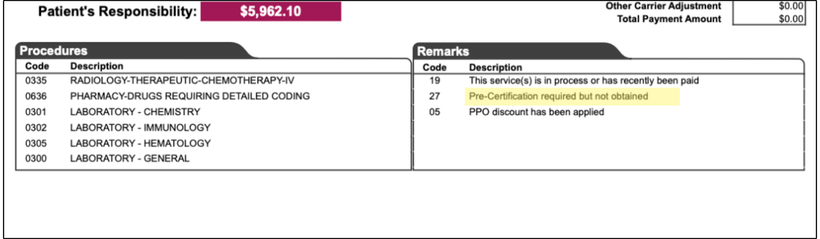
In August, another bill arrived, this one for the Remicade treatment Danahy had received in June. That one said that he owed $5,959, listing a different reason for the lack of coverage: “Pre-certification required but not obtained.”

Danahy's bills from Leading Edge, stating that his medication was not covered after he'd previously received confirmation that it was. | Courtesy of Kevin Danahy


Danahy was baffled at how Leading Edge could claim that he hadn’t obtained authorization or that the Remicade wasn’t included in his plan, when he and his doctor had received a letter specifically stating that the treatments would be covered.

He called Leading Edge repeatedly, seeking answers, and was told that Remicade wasn’t covered by his plan.

“They said, ‘Your plan doesn’t pay for specialty medication.’ I said ‘Why did you approve it then?’” Danahy told New York Focus. “They had nothing to say to that.”

Benjamin Chartock, a health care economist at Bentley University, said that this series of events was “concerning.”

“At the very least they ought to put more safeguards to make sure that the information that gets to their patients is accurate and timely,” he said of Leading Edge.

After weeks of effort, Danahy got some good news. After a phone call last week in which he threatened legal action, Leading Edge sent him revised statements showing that he owed only $1,451 for the two treatments.

But on Tuesday, his wife’s supervisor told her that the company was ending her employment due to subpar performance and failure to adhere to proper procedures, Danahy said. He suspects that the real reason was to get out of paying for his future treatments; Leading Edge’s insurance plans are self-funded, meaning that employers pay for medical care themselves.

Stellar Health Group, the former employer, denied that this had factored into the decision.

“All employment decisions at Stellar Health Group related facilities are made based on business-related factors and in accordance with all applicable laws and internal policies. Any suggestion that a termination decision was based on an employee’s spouse’s medical condition or related healthcare costs is categorically false,” a spokesperson said in an email.

Leading Edge did not respond to questions for this story.

Danahy will now have to rely only on Medicare. His current plan doesn’t cover infusion treatments, so he is applying for a plan that does.

Meanwhile, he skipped his scheduled August infusion because he was worried about Leading Edge charging him thousands more dollars. His next treatment is scheduled for October, and his doctor said delaying it could cause his condition to return and threaten serious consequences for his health.

Even before his wife lost her job, Danahy wasn’t sure he would go for that treatment either.

“I don’t want to put any burden on the family financially,” he said on Monday. “Rather than pay for my infusion, I want to be able to pay for my daughter’s wedding.”

“I’m just hoping that I haven’t hurt myself,” he added.

Correction: A previous version of this story stated that Kevin Danahy's wife was fired from her job on Monday. In fact, she was fired on Tuesday.

At New York Focus, our central mission is to help readers better understand how New York really works. If you think this article succeeded, please consider supporting our mission and making more stories like this one possible.

New York is an incongruous state. We’re home to fabulous wealth — if the state were a country, it would have the tenth largest economy in the world — but also the highest rate of wealth inequality. We’re among the most diverse – but also the most segregated. We passed the nation’s most ambitious climate law — but haven’t been meeting its deadlines and continue to subsidize industries hastening the climate crisis.

As New York’s only statewide nonprofit news publication, our journalism exists to help you make sense of these contradictions. Our work scrutinizes how power works in the state, unpacks who’s really calling the shots, and reveals how obscure decisions shape ordinary New Yorkers’ lives.

In the last two decades, the number of local news outlets in New York has been nearly slashed in half, allowing elected officials and powerful individuals to increasingly operate in the dark — with the average New Yorker none the wiser.

We’re on a mission to change that. Our work has already shown what can happen when those with power know that someone is watching, with stories that have prompted policy changes and spurred legislation. We have ambitious plans for the rest of the year and beyond, including tackling new beats and more hard-hitting stories — but we need your help to make them a reality.

If you’re able, please consider supporting our journalism with a one-time gift or a monthly gift. We can't do this work without you.

Thank you,

Akash Mehta
Editor-in-Chief

A photo of Akash Mehta.
A photo of Sam Mellins.
Sam Mellins is senior reporter at New York Focus, which he has been a part of since launch day. His reporting has also appeared in The San Francisco Chronicle, The Intercept, THE CITY, and The Nation. Reach him on Signal: mellins.613
Also filed in New York State

State leaders are expected to pass a bill that avoids resolving how much Resorts World New York City needs to pay.

New York state has pumped millions of taxpayer dollars into an online portal that vowed to make life easier for Rochester’s neediest, but critics say it’s fallen short.

Resorts World is floating legislation to avert more than $500 million in payments to the horseracing industry.

Also filed in Health

Despite last-ditch efforts by a coalition of lawmakers, the state failed to avert a health coverage cliff coming this summer.

160,000 injured New Yorkers seek workers’ compensation each year — but in recent years, regulators have tilted the scales towards employers and insurers.

Amid abortion bans and rising digital surveillance, Albany lawmakers are revisiting an effort to stop companies from selling sensitive health information.