Home Health Aides Are Getting New Insurance Coverage — From a Company With a History of Cutting It Off

Health insurer Leading Edge once tried to cancel a coma patient’s insurance and, in another case, retracted approval for surgery after the bill arrived.

Sam Mellins   ·   April 28, 2025
An insurance claim has first been stamped "approved," but then stamped "denied."
A New York Focus review of lawsuits against Leading Edge show it has a record of backing out of paying for covered health procedures — and trying to leave patients with the bill. | Photo: c-George / Getty Images | Illustration: Leor Stylar

Sign up for Staying Focused, our newsletter keeping readers up to speed on New York politics.

A health insurance company founded by a man convicted of insurance-related felonies doesn’t sound like a recipe for success.

But since its founding in 2010, insurer Leading Edge Administrators has flourished despite the checkered past of its founder, Jerry Weissman, who in 1997 was convicted of obstructing a congressional investigation into Empire Blue Cross and Blue Shield, then the nation’s largest medical insurer, where he served as CFO.

On May 1, Leading Edge will begin offering two bare-bones insurance plans to hundreds of thousands of low-wage home health aides in New York. As New York Focus previously reported, one of these plans will fail to cover many basic health needs — like doctor’s visits, maternal care, and hospitalization — for the workers who provide state-funded care to elderly and disabled people across the state.

The state health department, in an attempt to lower the cost of its $9 billion home care program, is replacing the hundreds of companies that currently run the program with just one: Public Partnerships, LLC. PPL selected Leading Edge to provide health coverage to home care workers, funded by taxpayer dollars. The transition has generated intense controversy, and since PPL’s official launch on April 1, home health aides have complained of missed paychecks and unanswered calls. Last week, two home health aides in Western New York filed a class action lawsuit against PPL, alleging wage theft.

Neither PPL nor Leading Edge responded to a request for comment for this story.

Home health aides might have difficulty getting Leading Edge to pay for even the services it claims to cover. A New York Focus review of lawsuits against Leading Edge show it has a record of backing out of paying for covered health procedures — using tactics that experts say went far beyond standard industry practices — and trying to leave patients with the bill.

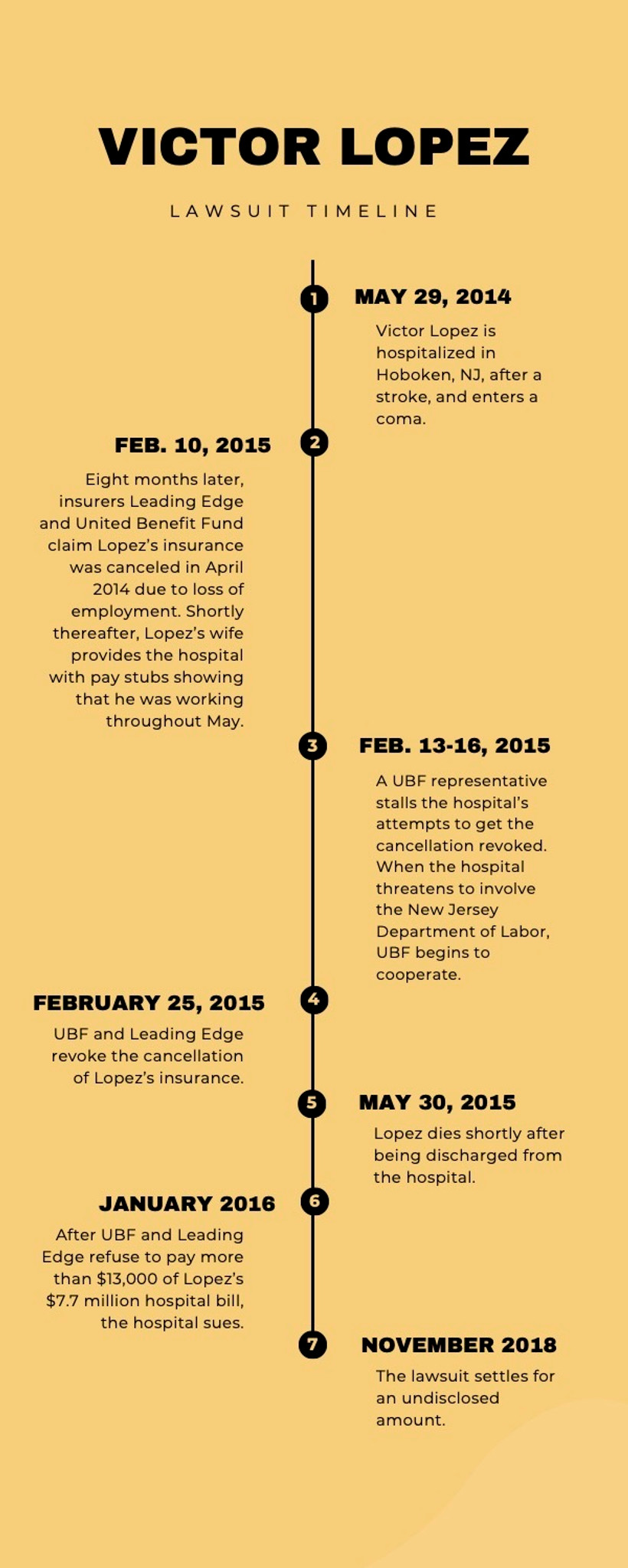
By February 2015, Victor Lopez had been fighting for his life for eight months. He’d suffered a stroke the previous spring, and since then, had been in a coma at Hoboken University Medical Center in New Jersey. His medical bills were adding up to tens of thousands of dollars a day.

A small comfort was that he had health insurance. Lopez had worked at the Parker Imperial, a luxury apartment tower just across the Hudson River from Manhattan’s Upper West Side. He was a union member and had insurance provided by the United Benefit Fund, a union-affiliated nonprofit. UBF’s health plan was run by Leading Edge, then known as Omni Advantage.

Then, on Feb. 10, 2015, the hospital caring for Lopez received a letter from Omni and UBF. It said Lopez’s insurance plan had been canceled in April 2014, the month before his stroke. The reason: “End of employment.”

Under federal law, if an employee quits their job or is fired, their employer can cancel their health insurance. This is what Omni and UBF claimed had happened.

But something was strange: The letter was dated May 2014, eight months prior. And neither the hospital nor Lopez’s wife Carmen had seen it before.

The timing had huge financial stakes. If Lopez hadn’t been insured when he had his stroke, Omni and UBF wouldn’t have to pay anything for his hospital stay. The cost would fall to Lopez and his family.

But when the hospital investigated, it quickly became clear that Lopez’s employment hadn’t ended prior to his stroke. His paystubs showed that he had worked until the week he was hospitalized.

That left two explanations.

Either Lopez’s insurance had been cancelled in April 2014, while he was still employed, and he and his wife had missed the letter informing them of the cancellation. However, canceling a full-time employee’s health insurance is generally illegal under the Affordable Care Act, also known as Obamacare.

Or the letter had been backdated to get Omni and UBF off the hook for Lopez’s medical costs.

On February 13, Sean Hayes, a consultant working for the hospital, emailed UBF Assistant Director Jeanna Talamo and asked for her help getting the cancellation revoked. Emails show that she initially resisted. But when Hayes threatened to report the matter to the New Jersey Department of Labor, Talamo began to cooperate.

On February 25, two weeks after the cancellation letter surfaced, UBF and Omni sent a new letter acknowledging that Lopez’s insurance had been in effect when he was hospitalized. Talamo did not address how or why the letter purporting to cancel his insurance the previous year had been sent.

Victor Lopez died on May 30, 2015, shortly after he was discharged from the hospital. In January 2016, Hoboken University Medical Center sued Omni and UBF after Omni refused to reimburse more than $13,000 of Victor Lopez’s $7.7 million hospital bill. The case settled for an undisclosed amount in November 2018.

Reached by phone, Talamo, who still works for UBF, refused to discuss the case.

Leading Edge has used other strategies to avoid paying medical costs, too.

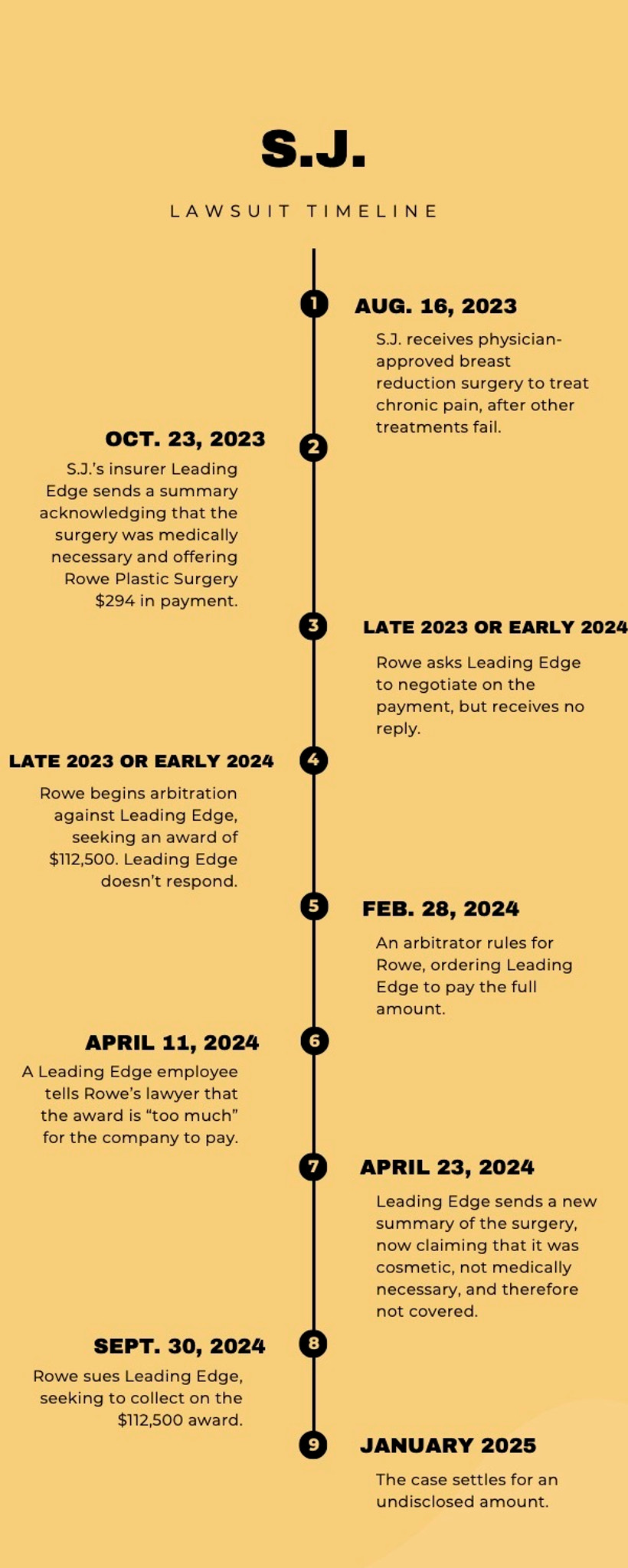
A patient referred to in court records as S.J. underwent breast reduction surgery in New Jersey in August 2023 to treat her chronic neck and back pain. Since the procedure was medically necessary, not cosmetic, it was covered by her Leading Edge insurance plan.

But that didn’t mean that Leading Edge was willing to pay.

Rowe Plastic Surgery billed Leading Edge $150,000 for the complex and labor-intensive surgery.

Bills generally decrease significantly during negotiations between doctors and insurance companies. But Leading Edge’s counteroffer was startlingly low: $294.

Rowe asked Leading Edge to negotiate, but didn’t receive a response. So Rowe disputed the bill before an arbitrator, cutting its demand to a still hefty $112,500.

Though Leading Edge was required to accept the arbitrator’s ruling, the company ignored the proceeding. In February 2024, the arbitrator ruled that Leading Edge owed Rowe Plastic Surgery the full amount.

Leading Edge still wouldn’t pay. Its employee Denise Molina emailed Rowe’s lawyers several weeks after the ruling to say that the amount was “too much” and to ask for leniency.

Rowe’s lawyer, Michael Gottlieb, was unmoved by the plea of poverty.

“Are they filing for bankruptcy? I didn’t see anything to that effect,” he said in an interview with New York Focus. His firm told Leading Edge that they’d lost a fair arbitration process and had to pay up.

Molina switched tactics: She emailed Gottlieb saying that Leading Edge didn’t have to cover the surgery because it was actually cosmetic.

This contradicted not only S.J.’s medical records and bills, which explicitly said that the surgery was medically necessary, but also Leading Edge’s previous summary of the procedure, which had said that it was covered by S.J.’s insurance.

So Leading Edge did something unusual: It redid the paperwork for the surgery and sent a new summary stating that it was not covered — and that S.J. owed the full $150,000.

“It seems like they said, ‘Let’s come up with a workaround here so that we don’t pay,’” said Benjamin Chartock, a Bentley University health care expert New York Focus asked to review the case. “It causes me quite a bit of trouble that the loser of the arbitration is not paying as they’re supposed to do according to the law.”

Jack Hoadley, an emeritus Georgetown professor with a specialty in health policy, said that Leading Edge’s strategy “violates the spirit” of the No Surprises Act, a federal law that took effect in 2022 and protects people from receiving surprise medical bills.

“Once you’ve made a decision to consider something a medically covered service, you usually stick with that,” he said.

Rowe sued Leading Edge last September, seeking the $112,500 awarded by the arbitrator. The case settled for an undisclosed sum in January 2025.

Whether Leading Edge’s behavior is legal isn’t completely clear. The No Surprises Act is a fairly new law, and courts haven’t had much time yet to hammer out its finer points. But in 10 years of work as a medical billing lawyer, Gottlieb said he’s never seen any other insurance company redo a bill to try to avoid paying.

“We bump up against various issues, including a huge amount of awards that don’t get paid,” he said. “No one has ever had the audacity to try to pull something like what Leading Edge did in that case.”

Do you have more information about Leading Edge, PPL, or New York’s home care transition? We want to know. Email sam@nysfocus.com. Your personal information will not be published without your permission.

At New York Focus, our central mission is to help readers better understand how New York really works. If you think this article succeeded, please consider supporting our mission and making more stories like this one possible.

New York is an incongruous state. We’re home to fabulous wealth — if the state were a country, it would have the tenth largest economy in the world — but also the highest rate of wealth inequality. We’re among the most diverse – but also the most segregated. We passed the nation’s most ambitious climate law — but haven’t been meeting its deadlines and continue to subsidize industries hastening the climate crisis.

As New York’s only statewide nonprofit news publication, our journalism exists to help you make sense of these contradictions. Our work scrutinizes how power works in the state, unpacks who’s really calling the shots, and reveals how obscure decisions shape ordinary New Yorkers’ lives.

In the last two decades, the number of local news outlets in New York has been nearly slashed in half, allowing elected officials and powerful individuals to increasingly operate in the dark — with the average New Yorker none the wiser.

We’re on a mission to change that. Our work has already shown what can happen when those with power know that someone is watching, with stories that have prompted policy changes and spurred legislation. We have ambitious plans for the rest of the year and beyond, including tackling new beats and more hard-hitting stories — but we need your help to make them a reality.

If you’re able, please consider supporting our journalism with a one-time gift or a monthly gift. We can't do this work without you.

Thank you,

Akash Mehta
Editor-in-Chief

A photo of Akash Mehta.
A photo of Sam Mellins.
Sam Mellins is senior reporter at New York Focus, which he has been a part of since launch day. His reporting has also appeared in The San Francisco Chronicle, The Intercept, THE CITY, and The Nation. Reach him on Signal: mellins.613
Also filed in New York State

A lobbyist who has been romantically linked to Assembly Speaker Carl Heastie led a rally opposing the legislation a week before the speaker declined to bring it to a vote.

In May, state lawmakers passed a $269 billion budget after haggling for months over thousands of line items and policies affecting New Yorkers.

Millions in outside spending was a boon to Gov. Kathy Hochul’s 2022 opponent, Lee Zeldin, and influenced down-ballot races.

Also filed in Health

Despite last-ditch efforts by a coalition of lawmakers, the state failed to avert a health coverage cliff coming this summer.

160,000 injured New Yorkers seek workers’ compensation each year — but in recent years, regulators have tilted the scales towards employers and insurers.

Amid abortion bans and rising digital surveillance, Albany lawmakers are revisiting an effort to stop companies from selling sensitive health information.