State Prisons Are Turning Away Visitors After Scanners Pick Up Their Tampons

Guards demanded body scanners to cut down on contraband. Now they’re turning visitors away over their hygiene and medical supplies.

Raina Lipsitz, Chris Gelardi and Sydney Umstead   ·   December 6, 2025
Visitors to New York state prisons now must pass through body scanners in order to qualify for a full-contact visit in which they can sit at a table with their incarcerated loved one and touch them. | Anoka County Sheriff's Office

Sign up for Staying Focused, our newsletter keeping readers up to speed on New York politics.

Vanessa Kelder was weeks away from getting married when, in early August, she went to visit her fiancé in Central New York’s Auburn Correctional Facility, where he’s incarcerated. She followed the same procedures she did in previous visits, she said, and wore the same kind of leggings she usually wears to the prison.

This time, however, officers stopped her after she went through one of the facility’s body scanners. They ordered her to go in the scanner again, then turn around and bend over. A few minutes later, two male officers arrived to review her scans, she said. They told her they were turning her away based on what they saw.

Kelder had no idea what it was. “I know damn well that I didn’t bring anything in that was illegal,” she said. Letters she and her fiancé later received from the prison agency said the scan had revealed an “unknown object” in her “vaginal area,” which she realized must have been her piercing. She’d gone through the body scanners with the piercing before; it’s unclear why officers only flagged her this time. They suspended her visiting privileges for six months. Her wedding would have to wait.

Attorneys, advocates, and legislators say they have repeatedly heard stories like Kelder’s since earlier this year, when New York’s state prison agency started requiring most people to go through scanners before visits with their loved ones. The agency implemented the body scanning policy shortly after a three-week corrections officer strike in March, and advocates say they started hearing high numbers of complaints over the summer.

The scanner rollout was one of the striking officers’ demands, aimed at reducing cavity searches and alleviating what they described as high numbers of visitors smuggling drugs and other contraband into the facilities. (Officers themselves are a steady source of contraband, and most New York state prison guards refuse to go through body scanners.)

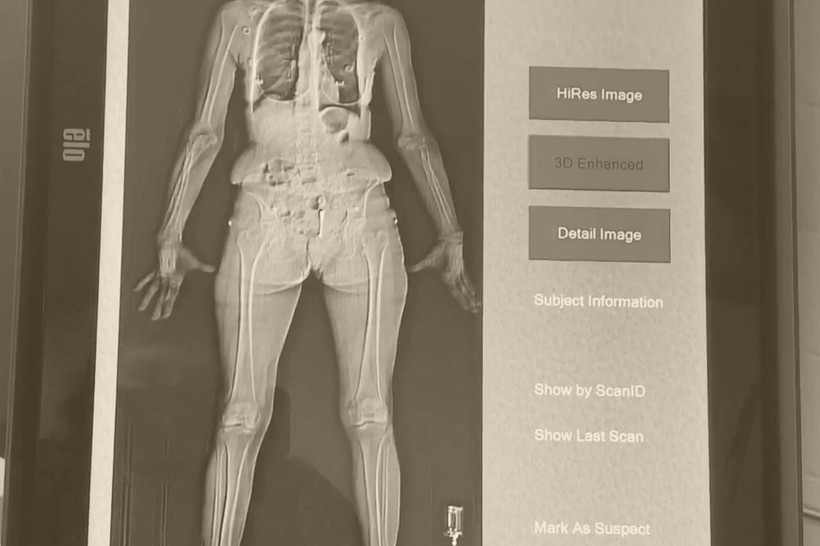
Visitors now must pass through body scanners in order to qualify for a full-contact visit in which they can sit at a table with their incarcerated loved one and touch them. The scanners use X-ray imaging to identify physical anomalies, including items under someone’s clothing and inside their body. Under the new body scanner policy — only published as an official directive in September — staff should deny visitors entry to a prison if they’re found with contraband or if they are “unable to clear the body scanner screening,” though it doesn’t define what it means to “clear” the scan.

Guards are turning visitors away after their body scans pick up “normal anatomy, medical conditions, and predictable artifacts,” said Michelle Bonet, an advocate who has been organizing prison families since the strike. That can include piercings like Kelder’s.

Menstrual or contraceptive products, like tampons and intrauterine devices, also get flagged, advocates and visitors told New York Focus. A vast majority of those flagged are women, the advocates have noted. This month, the New York Civil Liberties Union sent a letter to the state prison agency asserting that its body scanner practices amounted to sex discrimination.

“Protocols with respect to scanning and visitation do not appear to take into account that women menstruate, need to use menstrual products, and will frequently have tampons or other reproductive health care devices in their body cavities,” the letter said.

The Department of Corrections and Community Supervision (DOCCS), which runs the state prison system, did not answer questions about specific allegations regarding the body scanners, but instead sent a statement detailing its visitation and mail security policies. “Contraband, such as drugs and weapons, contribute to violence in prisons,” the statement said.

“Menstrual products, surgical scars, and gastrointestinal anomalies ... can create shadows or densities that inexperienced staff misinterpret.”

—Michelle Bonet, NYS DOCCS Federal Oversight

DOCCS ordered the scanners, made by the company Tek84, in December 2023, paying nearly $13 million for them. Tek84 declined a request for comment, stating that they do not comment on “customer operations.”

Before the March policy change, visitors had to pass through metal detectors and were often subjected to scent detection dogs, said Marc Cannan, a New York-based civil rights and criminal defense attorney. Those methods raised complaints about aggressive and invasive searches, he said, “but the body scan cases are much more frequent.”

The issue stems from guards’ interpretation of the scanner images, which varies from officer to officer, advocates and visitors said, and may explain why some, like Kelder, have gone through the machines without issue in the past.

The most common source of “false positives” — menstrual products, surgical scars, and gastrointestinal anomalies — “can create shadows or densities that inexperienced staff misinterpret,” said Bonet. “Across nearly all reports, the core issue is misinterpretation.”

James Bogin, senior supervising attorney at Prisoners’ Legal Services of New York, said his organization has been hearing from people — “always women” — who were denied visits on the basis of scans a few times a week. He said many of them get barred from visiting their loved ones — sometimes temporarily, sometimes indefinitely.

Most aren’t getting a chance to prove they’re not trying to smuggle things into the prison, advocates and visitors said. “The scanner is not proof of contraband, but they are treating it like proof of contraband,” said Cannan.

Those who do get a chance to plead their case report being forced to remove their menstrual products and endure “humiliating and dehumanizing” scrutiny, according to the NYCLU. In October, Caroline Hansen and her 16-year-old daughter drove three hours from their home on Long Island to visit Hansen’s husband at Eastern Correctional Facility. Hansen had gone through the body scanners before, she told New York Focus, but this time, she was using a tampon.

When Hansen got to the scanner, guards ran the machine several times, which was unusual, she said. Eventually, an officer had her step into a back room. When she opened the door, she found herself face-to-face with three male officers and a dog. “This is how horror movies start,” she remembered thinking.

The officers interrogated her, asking to search her and her car. They had the dog smell her several times, she said. Hansen offered to remove her tampon and go back through the machine. The officers searched the bathroom before and after she used it, but ultimately allowed her to remove the tampon and go back through the scanner.

By that point, Hansen said, she and her daughter were both “hysterical.” The experience was “dehumanizing,” she said. Prison officials then denied the pair their usual visit at a table, where they could touch and interact. Instead, they were downgraded to a no-contact visit, and had to speak to her husband through a pane of glass.

“Now, I just don’t go when I’m on my period,” Hansen said. “I don’t want to deal with that again.”

Hansen said she has seen other women go through similar experiences in the last several months. One person she saw in line at the prison told her that the staff turned her away because they saw her IUD in the scan. She had to return with a doctor’s note, she said.

State Senator Julia Salazar, who chairs the chamber’s correction committee, said that her office has received around 50 complaints in recent months from people across the state about DOCCS employees denying visits “ostensibly due to body scans.” In June, she introduced a bill that would prohibit jails and prisons from denying visitors entry or contact visits because they are menstruating or using contraceptive devices.

While Salazar believes it makes sense for prison staff to decide whether or not to grant a contact visit, their expertise as security professionals “can’t be used as an excuse to deny visitation arbitrarily,” she added.

Salazar’s office said that DOCCS has said that staff are properly trained on the scanners, but the senator’s staff hasn’t seen what that training entails. “From what we’ve seen, they do whatever they want,” Shafeeqa Kolia, a spokesperson for Salazar, said.

“Staff need to be trained and need to be sensitized to the fact that this is a clear discrimination issue,” said Ify Chikezie, staff attorney at the NYCLU.

Prison officials in other states have said that officers cannot visually distinguish a scan that indicates the presence of a tampon from one that indicates the presence of drugs, leading to guards being fired and women being denied visits.

In its statement, DOCCS did not respond to requests for data showing whether use of the scanners has reduced the amount of contraband entering prisons. The new policy doesn’t do much to cut down on contraband that staff bring into prisons: Employees are occasionally randomly screened, but have the right to request methods that don’t include a body scanner. Visitors can request that DOCCS exempt them from body scans if they have a medical condition that would be impacted by the radiation or other effects of the body scanners. During a public hearing held by the state legislature in May, DOCCS’s commissioner testified that approximately 80–90 percent of visitors willingly pass through the body scanners, while approximately 80–90 percent of staff refuse.

Sydney Umstead, a graduate student who contributed to this article, attempted to visit a pen pal she has who is incarcerated at Auburn prison in August. Prison officers said they saw something on her scan and that she wouldn’t be allowed to visit that day.

“It’s like a pass or fail system, and you failed,” an officer said.

Approximately 80–90 percent of visitors willingly pass through the body scanners, while approximately 80–90 percent of staff refuse.

Officials never told her where on her body the problem was. Umstead was not using any menstrual products and has no lower body piercings. Shortly after her attempted visit, she received a letter stating that she was banned from all state prisons for 180 days. The letter states that the scanner had detected “the presence of an object inside [her] body that’s inconsistent with human anatomy.” Umstead doesn’t know what it picked up and has received no communication from DOCCS in regard to her appeal.

DOCCS has restricted visitation in other ways. In May, the agency announced that its facilities would permit weekend visits only, due to staffing shortages. This means that many visitors come at once, and, when they arrive — in many cases after having spent hours in transit — they must then wait several hours more to see their loved ones. When it’s their turn to be scanned, some are turned away based on the results.

Kelder, who was suspended from visiting Auburn, has to leave her house by 3 am to make the two-and-a-half hour drive to spend time with her fiancé during their allotted visits every two weeks. You have to be one of the first in line to get ample visitation time: “If you’re not in line by 6:30, you’re waiting,” she said.

Kelder ultimately appealed her suspension, sending doctor’s notes that showed her piercing as well as titanium in her arm. In a follow-up letter, DOCCS upheld the basis for the original denial, but reduced the length of her suspension and restored her visiting rights.

The episode derailed her wedding: Because Kelder had been barred from visiting her fiancé while challenging the suspension, the couple had to restart the complex process of prison marriage, which involves lining up a number of appointments with various prison officials and the local town clerk.

That process is back on track, but Kelder worries about future visits.

“What are you going to accuse me of bringing in next time?” she said.

BEFORE YOU GO, consider: If not for the article you just read, would the information in it be public?

Or would it remain hidden — buried within the confines of New York’s sprawling criminal-legal apparatus?

I started working at New York Focus in 2022, not long after the outlet launched. Since that time, our reporters and editors have been vigorously scrutinizing every facet of the Empire State’s criminal justice institutions, investigating power players and the impact of policy on state prisons, county jails, and local police and courts — always with an eye toward what it means for people involved in the system.

That system works hard to make those people invisible, and it shields those at the top from scrutiny. And without rigorous, resource-intensive journalism, it would all operate with significantly more impunity.

Only a handful of journalists do this type of work in New York. In the last decades, the number of local news outlets in the state has nearly halved, making our coverage all the more critical. Our criminal justice reporting has been cited in lawsuits, spurred legislation, and led to the rescission of statewide policies. With your help, we can continue to do this work, and go even deeper: We have endless ideas for more ambitious projects and harder hitting investigations. But we need your help.

As a small, nonprofit outlet, we rely on our readers to support our journalism. If you’re able, please consider supporting us with a one-time or monthly gift. We so appreciate your help.

Here’s to a more just, more transparent New York.

Chris Gelardi
Justice Bureau Chief
A photo of Chris Gelardi
Raina Lipsitz is the author of The Rise of a New Left: How Young Radicals Are Shaping the Future of American Politics. Her work has appeared in The Appeal, The Atlantic, The Nation, and The New Republic, among other publications.
A photo of Chris Gelardi
As New York Focus’s justice bureau chief, Chris Gelardi reports and edits work on the state’s criminal-legal and immigration systems. His writing on cops, jails, ICE, and the US military has appeared in more than a dozen other outlets, most frequently The Intercept… more
Sydney Umstead is a freelance journalist focused on the criminal justice system and politics. She is a 2025 graduate of Canisius University’s journalism program and pursuing a masters degree.
Also filed in Criminal Justice

A bill awaiting the governor’s signature would relax restrictions on who can qualify for victim compensation.

In May, state lawmakers passed a $269 billion budget after haggling for months over thousands of line items and policies affecting New Yorkers.

The legislation would make it easier for currently and formerly incarcerated people and child victims to sue the state over allegations of past abuse.

Also filed in New York State

At a Board of Regents meeting Monday, state officials proposed eliminating credit-based diploma requirements.

The last-minute influx, the biggest ever for a legislative primary, is boosting her opponent, Jessica González-Rojas.

City budget gaps and an ambitious affordability agenda may require pressing Albany again for taxes and aid.