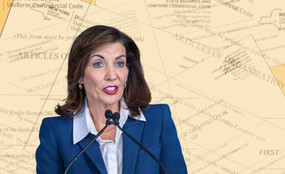
Hochul Pushes to Narrow Domestic Violence ‘Coerced Debt’ Bill

Eleventh-hour negotiations could decide the fate of legislation to make it easier for survivors to cancel debt caused by their abuse.

Chris Bragg   ·   December 19, 2025
Photo collage of a desk with a notepad and voice recorder in a newsroom.
| Photos: Venca24 / Wikimedia Commons; Billion Photos; natatravel, vasabii, theeradech sanin, jmccurley51 / Canva | Illustration: Leor Stylar

Sign up for Staying Focused, our newsletter keeping readers up to speed on New York politics.

The Reporters’ Notebook features bite-sized stories and updates from New York Focus reporters on the topics they cover.

Governor Kathy Hochul is pushing to narrow a bill to protect domestic violence survivors from being held financially responsible for debt incurred as a result of their abuse, according to the bill’s Assembly sponsor.

The bill would make it easier for survivors to get out of “coerced debt,” defined as nonconsensual credit-related transactions that occur in the context of a violent relationship — for example, an abuser forcing someone to sign credit card applications or take out loans under the threat of violence.

It’s extremely common for survivors of intimate partner violence to face this kind of economic abuse, advocates say, and it can have long-term financial consequences that may lead them to stay in an abusive relationship.

Hochul has until midnight tonight to sign or veto the bill. She has proposed an amendment that would remove one of the bill’s pathways that requires lenders to pause debt collection for survivors, according to Assemblymember Linda Rosenthal, a Manhattan Democrat and the bill’s lead Assembly sponsor. As of Thursday afternoon, it remained unclear whether the governor would reach a compromise with legislative sponsors or veto the bill.

“It’s still up in the air,” Rosenthal told New York Focus. ”I want to pass something. I want to really think this will be helpful, but I think they have to just give a little more.”

Domestic violence “is something the governor always talks about — that her mother was devoted to helping survivors — so I’m a little surprised about the resistance here,” Rosenthal added.

The bill has received considerable attention from the financial industry. JPMorgan Chase, Capital One and the New York Bankers Association have all lobbied on the bill, records show. Supporters include the New York City Bar Association and groups that advocate for domestic violence victims.

Currently, when victims ask lenders to cancel coerced debt, the lenders frequently require police reports in order to trigger an investigation. Those police reports often aren’t available, advocates say, because coercing someone into debt isn’t necessarily illegal.

The bill requires the lender to cease collection activities and complete a review of a coerced debt claim within thirty business days, if the alleged victim provides a sworn or notarized statement that the debt was coerced. They would also need to provide one of four other types of documentation: a court order; a police report; a notarized statement from a “qualified third party,” such as a social worker, attorney, or member of the clergy; or a Federal Trade Commission identity theft report that identifies a “particular debt, or portion thereof, as coerced debt.”

As of Thursday afternoon, Rosenthal said, Hochul’s office was not objecting to the first three of those documentation options.

But she is pushing to strike the FTC option from the list.

Rosenthal says that’s an important option for victims. “Getting a police report is hard, going to court is hard,” she said. “So we want to offer various pathways, and one is the FTC [report] ... I want to make it as smooth as possible for a victim of coerced debt.”

A Hochul spokesperson said only that the governor is reviewing the legislation.

Under existing state law, FTC reports are treated as a valid form of proof for cases of identity theft.

Some members of the business-friendly Assembly Republican conference raised objections to the coerced debt bill during floor debate in June. Assemblymember John Mikulin cited the risk that individuals who are not survivors could “lie and say they were abused” and use a “false affidavit” to escape debts they legitimately owe.

“It seems to me that this bill does create a one-sided process, with the presumption being in favor of the debtor,” Mikulin said.

Lauren Schuster, vice president of government affairs at the Urban Resource Institute, which works with domestic abuse survivors, said she was “surprised” by the difficulty of the negotiation. (Schuster previously worked as Rosenthal’s chief of staff.)

“These institutions, they’re multibillion-dollar institutions in annual revenue, and they are going up against survivors who cannot leave abusive situations because of $2,500 in debt,” Schuster said. “The disparity is so, so clear here.”

At New York Focus, our central mission is to help readers better understand how New York really works. If you think this article succeeded, please consider supporting our mission and making more stories like this one possible.

New York is an incongruous state. We’re home to fabulous wealth — if the state were a country, it would have the tenth largest economy in the world — but also the highest rate of wealth inequality. We’re among the most diverse – but also the most segregated. We passed the nation’s most ambitious climate law — but haven’t been meeting its deadlines and continue to subsidize industries hastening the climate crisis.

As New York’s only statewide nonprofit news publication, our journalism exists to help you make sense of these contradictions. Our work scrutinizes how power works in the state, unpacks who’s really calling the shots, and reveals how obscure decisions shape ordinary New Yorkers’ lives.

In the last two decades, the number of local news outlets in New York has been nearly slashed in half, allowing elected officials and powerful individuals to increasingly operate in the dark — with the average New Yorker none the wiser.

We’re on a mission to change that. Our work has already shown what can happen when those with power know that someone is watching, with stories that have prompted policy changes and spurred legislation. We have ambitious plans for the rest of the year and beyond, including tackling new beats and more hard-hitting stories — but we need your help to make them a reality.

If you’re able, please consider supporting our journalism with a one-time gift or a monthly gift. We can't do this work without you.

Thank you,

Akash Mehta
Editor-in-Chief
A photo of Akash Mehta.
A photo of Chris Bragg.
Chris Bragg is the Albany bureau chief at New York Focus. He has done investigative reporting on New York government and politics since 2009, most recently at The Buffalo News and Albany Times Union.
Also filed in New York State

A lobbyist who has been romantically linked to Assembly Speaker Carl Heastie led a rally opposing the legislation a week before the speaker declined to bring it to a vote.

In May, state lawmakers passed a $269 billion budget after haggling for months over thousands of line items and policies affecting New Yorkers.

Millions in outside spending was a boon to Gov. Kathy Hochul’s 2022 opponent, Lee Zeldin, and influenced down-ballot races.