A Judge Tossed a Prison Sex Abuse Lawsuit Over Typos. Hundreds More Dismissals Could Be Coming.

The state plans to ask a court to dismiss some 500 prison sexual assault lawsuits for not strictly abiding by filing requirements.

Chris Gelardi and Jessy Edwards   ·   December 22, 2025
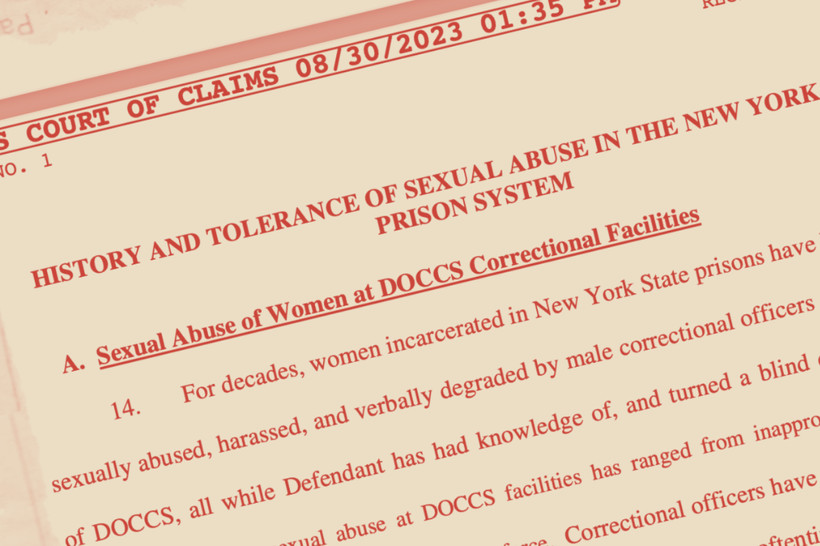
The state, represented by the office of Attorney General Letitia James, argued that the typos created a “jurisdictional defect” in the case. | Illustration: Hell Gate

This story was reported in partnership with Hell Gate and supported by the Fund for Investigative Journalism.

Sign up for Staying Focused, our newsletter keeping readers up to speed on New York politics.

Ernastiaze Moore knew the name of the state prison guard who he alleges sexually assaulted him on two separate occasions at Sullivan Correctional Facility, where he was incarcerated. He remembered the dates of the abuse and the rooms where the attacks took place. His lawyers obtained video of one of the assaults and internal prison reports of both incidents.

His case seemed like exactly the type that the Adult Survivors Act was created for. The 2022 state law temporarily allowed sexual assault victims to bring civil suits against their alleged abusers outside of the typical statute of limitations, which would have required Moore to begin filing within 90 days.

In November 2023, Moore’s lawyers filed his lawsuit. But a judge dismissed his case before it could get off the ground. The reason: The complaint misstated the year the alleged abuse took place.

Moore’s lawyers were taken aback. The errors were mere typos, they said. A guard had made the same mistake in two of the state prison agency’s internal reports about the incidents, miswriting the date of one as January 2022, rather than 2023. The attorneys asked the judge to let them amend the complaint, a common practice in lawsuits, but the state, represented by the office of Attorney General Letitia James, argued (in a filing that misspelled the judge’s name) that the typos created a “jurisdictional defect.” Court of Claims Judge Catherine Schaewe agreed.

Hundreds more lawsuits alleging sexual assault by staff from New York’s Department of Corrections and Community Supervision, or DOCCS, may soon face the same fate as Moore’s. The state’s lawyers plan to ask judges to dismiss up to 500 prison sexual assault cases filed under the Adult Survivors Act, New York Focus and Hell Gate have learned.

The maneuver would be rooted in the strict filing requirements of the Court of Claims, which hears civil cases against the state. In other civil courts — like the state’s supreme courts, where hundreds of women have filed Adult Survivors Act suits against New York City over sexual abuse by Rikers Island jail staff — claimants can initiate cases by providing limited details. But in cases filed against New York state, judges have ruled that they need to share more information at the outset.

Lawmakers say they didn’t intend for filing requirements to stymie Adult Survivors Act claims. “I am very concerned by reports that hundreds of Adult Survivors Act cases alleging sexual abuse in state prisons may be subject to dismissal on mere technicalities,” said state Senator Brad Hoylman-Sigal, the law’s lead sponsor.

Hoylman-Sigal introduced a bill earlier this year that would exempt cases filed under the act from the strict requirements. “For survivors of sexual abuse, recalling exact details of these traumatic moments can be difficult, particularly for those whose abuse occurred decades ago,” a memo accompanying the bill said. The bill passed the Senate but did not make it to the Assembly floor.

There is an “urgent need” to amend the Court of Claims law, said Konstantin Yelisavetskiy, a managing attorney at the law firm Slater Slater Schulman, which represents over 1,200 people alleging prison abuse under the Adult Survivors Act.

“Without this change, hundreds of abuse survivors risk being denied the day in court that the ASA was designed to guarantee them,” he said.

“Hundreds of abuse survivors risk being denied the day in court that the Adult Survivors Act was designed to guarantee them.”

—Konstantin Yelisavetskiy, Slater Slater Schulman

To date, New York Focus and Hell Gate have located two cases where the state has asked a court to dismiss prison Adult Survivors Act claims based on the strict filing criteria. In the first case, Moore’s, the judge agreed with an assistant attorney general’s argument that even typos in the original complaint can render a case dismissable — even while acknowledging that “absolute exactness is not required” for the state to be able to investigate the claims.

Moore’s lawsuit alleged that an officer shoved his finger in Moore’s anus during a violent strip search in which no contraband was found, then, six months later, beat him in the shower and inserted an object in his rectum. In video of the strip search, first reported by The New York Times, Moore can be heard screaming that officers are punching and sexually assaulting him. The footage shows blood on the walls and on Moore’s swollen face, and an officer discarding Moore’s bloodstained underwear.

Moore’s lawyers are appealing the decision. They argue that the 1930s law and court decisions that established the modern Court of Claims and its filing requirements were never meant to create such a roadblock.

A prison guard looks at a handcuffed Ernastiaze Moore after he is allegedly sexually assaulted.
A prison guard looks at a handcuffed Ernastiaze Moore after he is allegedly sexually assaulted. | Screenshot from DOCCS video

The second dismissal motion, which state lawyers filed in a case brought by a formerly incarcerated woman, has yet to be decided. The woman alleges that throughout 1990 and 1991, two guards and a civilian employee at Groveland Correctional Facility orally and vaginally raped her hundreds of times. The claim includes the last names of one of the officers and the civilian employee, and doesn’t include the name of the second officer.

Assistant Attorney General Margaret Jones has argued that the court must dismiss the case because the woman’s claim did not offer discrete dates of when the hundreds of alleged assaults took place, because the physical descriptions of the men were “too vague,” and because DOCCS couldn’t locate records of the employees she named. In addition to last names, the claim described the prison employees’ roles, shift times, physical traits, and in one case, a description of a mole on the employee’s penis.

The two dismissal motions are the first of hundreds that the state plans to file. During an October 15 conference with court officials and lawyers involved in prison Adult Survivors Act cases, attorneys for DOCCS said that the state was planning to ask courts to throw out 500 cases based on the filing requirements, according to Yelisavetskiy and Anna Kull, a partner at the law firm Levy Konigsberg, which represents about 400 claimants in prison Adult Survivors Act cases.

Asked to confirm the planned dismissal motions, the state Office of the Attorney General said that “these matters are under review.”

“Cases brought under the Adult Survivors Act can be emotionally painful and difficult,” a spokesperson for Attorney General James said in a statement. “As the state’s attorney, our office has a legal responsibility to represent state agencies, and we work to fulfill that obligation while also supporting survivors’ rights. Every survivor of sexual assault deserves access to justice, and we are committed to ensuring that they are heard and respected.”

A DOCCS spokesperson said the agency does not comment on active litigation and had no comment on the typo dismissal.

When signing the bill, Governor Kathy Hochul hailed the Adult Survivors Act as “an important step in empowering survivors across New York.” She may not have realized that many of the resulting claims would be against the state itself: Over half of the 3,000 cases filed under the law ended up alleging sexual abuse by staff in the state’s prisons, with those claimants suing New York for over $30 billion in damages, according to a New York Focus and Hell Gate analysis. (Civil cases often settle for far less than the amount claimants originally sue for.)

Advocates have long decried rampant and underreported sexual abuse in New York prisons. A recent nationwide federal Department of Justice study found that two of the state’s women’s facilities have the highest and third highest reported rates of sexual victimization among the 177 prisons surveyed.

The Court of Claims law dictates that when filing a case, claimants must state the “time when,” “place where,” and “nature” of the wrong that took place. Courts have strictly interpreted that requirement. In a consequential decision earlier this year, the Court of Appeals, New York’s highest court, ordered the Court of Claims to dismiss a case filed under the Child Victims Act, a 2019 law that paused statutes of limitations in the same way the Adult Survivors Act did, but for child sexual abuse lawsuits. The claimant didn’t know the names of the state employees who allegedly abused him and could only offer a four-year window during which the alleged abuse occurred — a level of detail that would likely fly in other courts, but which the Court of Appeals ruled didn’t satisfy Court of Claims filing requirements. The case set the bar for how to apply the strict requirements to the thousands of old cases filed under the two laws.

“There are so many stumbling blocks for litigants, especially incarcerated individuals, that it makes it almost impossible for them to successfully bring claims in the Court of Claims,” said Cassandra Rohme, chair of the civil rights division at Liakas Law and one of Moore’s attorneys.

Advocates for survivors say the trauma of being sexually assaulted makes it unreasonable to ask people to recall the exact details of the abuse, especially in years- or decades-old cases. Prison cases are especially difficult, as incarcerated people often don’t know the names of all of the officers and staff who oversee them and need to access prison records to obtain those details. A New York Focus and Hell Gate analysis of the roughly 1,600 prison Adult Survivors Act claims shows that most of the alleged abuse took place in the 2000s and 2010s, but some instances go as far back as the 1970s.

“The State is escaping liability precisely because these survivors were traumatized and the abuse happened long ago, the very circumstances the Legislature sought to remedy,” Kull said in a statement. DOCCS, she added, is “weaponizing” the filing requirements “to do exactly what the revival statute was enacted to prevent: slam the courthouse doors on traumatized prison-rape survivors.”

In its opinion on the Child Victims Act case, the state’s top court suggested that the legislature should have thought of such difficulties when opening windows for old sex abuse claims. “The [Child Victims Act] lacks any indication, let alone a clear expression, that the Legislature intended to exempt CVA claims from” filing criteria, the court wrote.

Hoylman-Sigal said that decision “was fundamentally misguided and contrary to the clear intent” of the Child Victims Act, as well as the Adult Survivors Act, which was “to allow survivors to have their day in court.” Hoylman-Sigal also sponsored the Child Victims Act.

“The ASA should not be construed to require victims of sexual abuse in state prisons to remember the exact details of an assault decades later,” he said. “Nor should cases be dismissed on technicalities so little as a typo in a pleading.”

The top court wrote that the time, place, and other details in Court of Claims abuse complaints need to be specific enough for the state to “promptly investigate the claim and determine its liability.” That leaves room for interpretation, and it’s unclear how judges might wield the standard when the state begins to file more motions to dismiss.

In a statement, state Senator Julia Salazar, who leads the Senate’s corrections committee, called the potential dismissals “an extreme injustice.”

“Instead of burying these issues in legal technicalities, the State should address the crisis directly, compensate individuals who were subjected to sexual abuse while incarcerated, and work urgently on all reforms necessary to prevent such incidents from occurring in the future,” Salazar said.

Chris Bragg contributed reporting. Elsie Carson-Holt, Celia Young, and Paige Oamek contributed research.

BEFORE YOU GO, consider: If not for the article you just read, would the information in it be public?

Or would it remain hidden — buried within the confines of New York’s sprawling criminal-legal apparatus?

I started working at New York Focus in 2022, not long after the outlet launched. Since that time, our reporters and editors have been vigorously scrutinizing every facet of the Empire State’s criminal justice institutions, investigating power players and the impact of policy on state prisons, county jails, and local police and courts — always with an eye toward what it means for people involved in the system.

That system works hard to make those people invisible, and it shields those at the top from scrutiny. And without rigorous, resource-intensive journalism, it would all operate with significantly more impunity.

Only a handful of journalists do this type of work in New York. In the last decades, the number of local news outlets in the state has nearly halved, making our coverage all the more critical. Our criminal justice reporting has been cited in lawsuits, spurred legislation, and led to the rescission of statewide policies. With your help, we can continue to do this work, and go even deeper: We have endless ideas for more ambitious projects and harder hitting investigations. But we need your help.

As a small, nonprofit outlet, we rely on our readers to support our journalism. If you’re able, please consider supporting us with a one-time or monthly gift. We so appreciate your help.

Here’s to a more just, more transparent New York.

Chris Gelardi
Justice Bureau Chief
A photo of Chris Gelardi
As New York Focus’s justice bureau chief, Chris Gelardi reports and edits work on the state’s criminal-legal and immigration systems. His writing on cops, jails, ICE, and the US military has appeared in more than a dozen other outlets, most frequently The Intercept… more
Jessy is a Brooklyn-based reporter who writes about housing, social justice, and the people of New York City for Hell Gate. Jessy previously covered incarceration at WNYC/​Gothamist, where she was part of a Pulitzer-nominated project investigating sexual assault on Rikers Island. She’s previously… more
Also filed in Criminal Justice

It’s unclear whether the Correctional Association of New York will have to scale back its nascent reform initiatives.

The legislation comes after months of haggling over how best to protect New Yorkers from President Trump’s immigration crackdown.

Footage published by New York Focus sparked a debate over deputies’ practice of calling Border Patrol on Spanish-speaking drivers.

Also filed in New York State

State leaders are expected to pass a bill that avoids resolving how much Resorts World New York City needs to pay.

New York state has pumped millions of taxpayer dollars into an online portal that vowed to make life easier for Rochester’s neediest, but critics say it’s fallen short.

Resorts World is floating legislation to avert more than $500 million in payments to the horseracing industry.