Trump Targets New York Climate Laws. But Is It Just for Show?

“There’s no legal basis for what they’re trying to do,” said one legal expert.

Colin Kinniburgh   ·   April 9, 2025
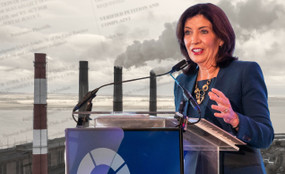
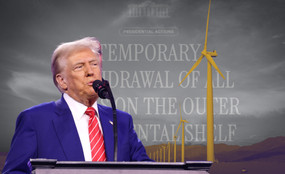
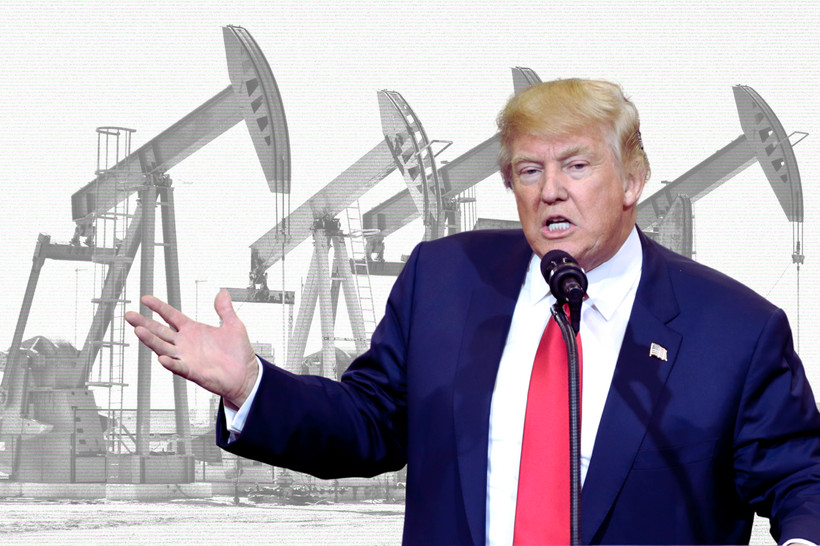
On Tuesday night, President Donald Trump’s administration fired its latest broadside at climate action: an executive order aimed at “protecting American energy from state overreach.” | Photos: JRLPhotographer / Getty Images; Gage Skidmore / Flickr | Illustration: Leor Stylar

Sign up for Staying Focused, our newsletter keeping readers up to speed on New York politics.

On Tuesday night, President Donald Trump’s administration fired its latest broadside at climate action: an executive order aimed at “protecting American energy from state overreach.”

The order seeks to block the enforcement of essentially any state law that restricts or penalizes pollution from fossil fuels. It gives US Attorney General Pam Bondi 60 days to identify such state laws and recommend actions the federal government could take to stop them.

High on its list: New York’s Climate Change Superfund Act, passed last year, which allows the state to charge the world’s biggest fossil fuel companies $3 billion annually over the next 25 years to pay for climate damages. The order refers to the legislation as “a ‘climate change’ extortion law.” It also targets cap and trade programs that put a price on greenhouse gas emissions, like those in California and Washington state — and the one Governor Kathy Hochul has long promised in New York.

“These State laws and policies are fundamentally irreconcilable with my Administration’s objective to unleash American energy,” the order reads. “They should not stand.”

Climate groups were quick to condemn the executive action.

“Donald Trump just declared war on state and local governments,” said Justin Balik, vice president for states at the national group Evergreen Action, in a statement. “By directing the Justice Department to identify any state or local law that challenges fossil fuel dominance, Trump is shredding the Constitution to appease Big Oil.”

Top fossil fuel executives met with Trump at the White House in March to ask for his help fighting state laws and litigation that would make them pay for emissions, according to the Wall Street Journal.

State Senator Liz Krueger, who sponsored the climate superfund bill, likewise blasted the new Trump order.

“Either the Big Oil Billionaires pay to clean up their mess, or you and I do,” she wrote to New York Focus. “Trump and Musk are really working overtime to make sure you and I pay as much as possible.”

But at least one legal expert is skeptical that the executive order will amount to much.

“There’s no legal basis for what they’re trying to do,” said Michael Gerrard, director of the Sabin Center for Climate Change Law at Columbia University. He contrasted the order with the administration’s far-reaching funding and staffing cuts: “Those have direct, immediate impacts. This is more signaling and saber rattling.”

Gerrard said that the White House had no authority to nullify state laws or regulations without backing from Congress or the courts, and that the order would have no immediate legal effect. He likened the directive to the Trump administration’s efforts to stop New York’s congestion pricing program, which have so far failed.

“It may be a test of the resolve of some of the states and cities,” Gerrard said. Even without direct control over state laws, Trump could try to use federal funding as a bargaining chip to achieve his pro–fossil fuel agenda, as he has with the New York City tolling program.

Hochul’s office said it was “thoroughly reviewing” Tuesday’s order.

“The Governor is committed to ensuring a clean, affordable and reliable energy grid in New York State,” spokesperson Paul DeMichele said in an email.

Hochul has defended the climate superfund law in recent months in response to lawsuits New York faces from Republican attorneys general and a business coalition. She “proudly signed the Climate Superfund Act because she believes corporate polluters should pay for the damage done to our environment — not everyday New Yorkers,” DeMichele previously told reporters, adding that Hochul expected to beat “Big Oil” in court.

New York Attorney General Letitia James struck a similar tone, reacting Wednesday to the White House.

“The Trump administration cannot punish states for adopting laws that protect their residents,” she said in a social media post. “New York’s clean energy laws ensure a stronger, greener, and healthier future for all New Yorkers, and we’re not going to back down.”

The broad wording of Trump’s order — which targets state laws “purporting to address ‘climate change’ or involving ‘environmental, social, and governance’ initiatives, ‘environmental justice,’ carbon or ‘greenhouse gas’ emissions, and funds to collect carbon penalties or carbon taxes” — could apply to an enormous range of New York state policies. Among other relevant laws, New York is one of five states that bans fracking, the process of extracting gas from tight underground rock formations.

Gerrard said that the state would have an obvious legal defense if the federal government challenges that ban: the 1938 Natural Gas Act, which gives federal authorities oversight of interstate pipelines but not fuel production within state lines.

It remains unclear whether Trump’s missive will affect New York’s fight over cap and invest, which Hochul postponed in January and environmental groups are now suing to revive. (The first Trump administration sued California over its carbon market and lost.)

One climate and labor advocacy group seized on the White House order to press Hochul to move ahead with the carbon pricing program.

“It is our Governor’s duty to stand up to the White House in these moments,” said Theodore A. Moore, the executive director of ALIGN, in a statement. “Each day that passes with further delays to New York’s Cap and Invest and Climate Change Superfund programs, and minimal investment in climate action, Governor Hochul is doing the bidding of Trump’s corporate playbook.”

I hope this article helped you better answer the question that guides all of our journalism: Who runs New York? Before you click away, please consider supporting our work and making more stories like this one possible.

New York state is standing at a crossroads for climate action. After passing one of the nation’s most ambitious climate laws in 2019, the state is lagging far behind on its targets, struggling to meet deadlines to build renewable energy and clean up its buildings and roads. Other states are closely watching our progress, making decisions about their own climate plans based on New York’s ability to implement this legislation.

As New York’s only statewide nonprofit news publication, we’ve been scrutinizing the state’s climate progress. Our journalism exists to unpack how power works in New York, analyze who’s really calling the shots, and reveal how obscure decisions shape ordinary New Yorkers’ lives.

But we can't do this work without your help. We rely on reader donations to help sustain our outlet, and every gift directly allows us to publish more pieces like this.

Our work has already shown what can happen when those with power know that someone is watching, with my reporting prompting a state investigation and fine for a major corporation. I have more story ideas than I can count, but only limited resources to pursue all the leads that come across my desk.

If you’re able, please consider supporting our journalism with a one-time or monthly gift. Even small donations make a big difference.

Thank you for reading.

Colin Kinniburgh
Climate and Environmental Politics Reporter
A photo of Colin Kinniburgh.
Colin Kinniburgh is a reporter at New York Focus, covering the state’s climate and environmental politics. He has worked in media for more than a decade, across print, television, audio, and online news, and participated in fellowship programs at CUNY’s Graduate School of Journalism… more
Also filed in New York State

State leaders are expected to pass a bill that avoids resolving how much Resorts World New York City needs to pay.

New York state has pumped millions of taxpayer dollars into an online portal that vowed to make life easier for Rochester’s neediest, but critics say it’s fallen short.

Resorts World is floating legislation to avert more than $500 million in payments to the horseracing industry.

Also filed in Climate and Environment

Governor Kathy Hochul was successful in her bid to upend the Climate Leadership and Community Protection Act after legislators caved to finalize an overall budget deal.

The leader of Reinvent Albany discusses a data center subsidy in Rockland County that flew under the radar for years.

No other project in the country has gotten such a large subsidy to create so few jobs, according to watchdogs.