New York Will Boost Unemployment Benefits, Labor and Businesses Celebrate

The state will spend $8 billion to pay off its debt to the feds and increase unemployment benefits for the first time in six years.

Julia Rock   ·   May 8, 2025
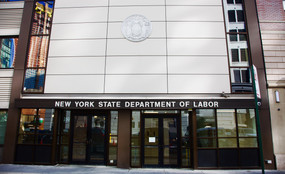
The budget agreement will increase weekly benefits from a maximum of $504 to a maximum of $869, with more increases in future years. | Myshkovsky / Getty Images; Office of Governor Kathy Hochul | Illustration: Leor Stylar

Sign up for Staying Focused, our newsletter keeping readers up to speed on New York politics.

Labor unions and business lobbyists successfully convinced Governor Kathy Hochul to pay off New York’s $6.2 billion unemployment insurance debt — and boost unemployment benefits for the first time in six years — as part of her final budget agreement with the state legislature.

New York owed the money after borrowing from the federal government to cover pandemic-era unemployment claims. The state has been repaying the debt since then, through higher taxes on businesses, but was still years away from being in the black.

State law requires that unemployment benefits remain frozen when the system is in debt, so weekly unemployment benefits have since 2019 been capped at $504, a lower benefit than neighboring states provide and less than a full-time minimum wage salary. The budget agreement will increase weekly benefits to a maximum of $869 this year, with more increases in future years.

“On the business side, this is a huge victory” since employers will no longer face additional taxes to pay off the debt, said Assembly Labor Committee Chair Harry Bronson, who had been advocating for the plan. “On the worker side, this is a huge victory,” because the weekly benefit will increase, he said.

The state will use $8 billion of its reserves to pay off the debt and add to the unemployment trust so that it can pay out claims without going back into debt.

The Assembly first proposed the measure in March after Hochul’s executive budget in January failed to address the issue. The New York AFL-CIO, a statewide federation of labor unions, and corporate lobbying groups like the Business Council pushed for its inclusion in the final budget.

“We weren’t getting a lot of support … from the governor at all up until last week,” said Bronson. He said that organized labor and business lobbyists “did a full court press over the weekend, and ultimately the governor agreed with us.”

The AFL-CIO and Business Council lauded the changes in statements Thursday.

The final deal also includes a small increase, beginning in 2026, to the payroll tax that funds the unemployment system. Under current law, employers are taxed on the first $12,800 of an employee’s wages.

Economists say there are a couple of problems with the current financing structure. First, taxing such a small portion of wages means that low-wage employers end up paying a higher tax rate than high-wage employers. That tends to help the finance and tech industries and hurt small businesses. Second, the state does not tax employers enough to fully fund the system, which means it ends up having to borrow money from the federal government and freeze worker benefits during economic downturns. New York’s system has been underfunded for decades, according to the federal Department of Labor and policy experts.

The final deal will increase the amount of taxable wages by roughly $5,000 in the first year. That’s not nearly enough to fully fund the system, according to three economic policy experts interviewed by New York Focus.

“This is such a minor adjustment to the financing that it doesn’t fix the insolvency,” said James Parrott, the director of economic and fiscal policy at the Center for New York City Affairs at the New School.

Parrott and others argue that if the state was going to bail out employers by using public money to pay off the debt, it should have required them to pay more into the system to ensure that it doesn’t need another bailout after the next recession.

“This was a tremendous missed opportunity to radically improve the financing structure,” Parrott said.

Nathan Gusdorf, executive director of the liberal think tank Fiscal Policy Institute, said that the budget had done a “good job” by paying off the debt and raising the benefit level. But there’s still some risk.

“Given the likelihood of a recession triggered by federal tariffs, there’s a serious risk of future benefit freezes and solvency challenges,” he said. “At some point in the future, the governor and the legislature will need to address unemployment insurance tax reform.”

At New York Focus, our central mission is to help readers better understand how New York really works. If you think this article succeeded, please consider supporting our mission and making more stories like this one possible.

New York is an incongruous state. We’re home to fabulous wealth — if the state were a country, it would have the tenth largest economy in the world — but also the highest rate of wealth inequality. We’re among the most diverse – but also the most segregated. We passed the nation’s most ambitious climate law — but haven’t been meeting its deadlines and continue to subsidize industries hastening the climate crisis.

As New York’s only statewide nonprofit news publication, our journalism exists to help you make sense of these contradictions. Our work scrutinizes how power works in the state, unpacks who’s really calling the shots, and reveals how obscure decisions shape ordinary New Yorkers’ lives.

In the last two decades, the number of local news outlets in New York has been nearly slashed in half, allowing elected officials and powerful individuals to increasingly operate in the dark — with the average New Yorker none the wiser.

We’re on a mission to change that. Our work has already shown what can happen when those with power know that someone is watching, with stories that have prompted policy changes and spurred legislation. We have ambitious plans for the rest of the year and beyond, including tackling new beats and more hard-hitting stories — but we need your help to make them a reality.

If you’re able, please consider supporting our journalism with a one-time gift or a monthly gift. We can't do this work without you.

Thank you,

Akash Mehta
Editor-in-Chief

A photo of Akash Mehta.
Julia Rock is a reporter for the Financial Times. She was previously an investigative reporter at New York Focus and The Lever.
Also filed in New York State

State leaders are expected to pass a bill that avoids resolving how much Resorts World New York City needs to pay.

New York state has pumped millions of taxpayer dollars into an online portal that vowed to make life easier for Rochester’s neediest, but critics say it’s fallen short.

Resorts World is floating legislation to avert more than $500 million in payments to the horseracing industry.

Also filed in Budget

Our searchable database breaks down the most consequential decisions Albany politicians made on climate, immigration, housing, schools, taxes, and more.

It’s unclear whether the Correctional Association of New York will have to scale back its nascent reform initiatives.

Advocates welcomed the additional funding but said it falls short of need and doesn’t do enough to support workers.

Also filed in Labor

160,000 injured New Yorkers seek workers’ compensation each year — but in recent years, regulators have tilted the scales towards employers and insurers.

The leader of Reinvent Albany discusses a data center subsidy in Rockland County that flew under the radar for years.

The Bronx Democratic Party is gaining power. So is a consulting firm tied to its chair.