How New York’s Attorney General Lets Innocence Claims Slip Through the Cracks

Prisoners seeking help from the AG’s office have little chance of review. Here’s one applicant’s story.

Curtis Brodner   ·   September 11, 2025
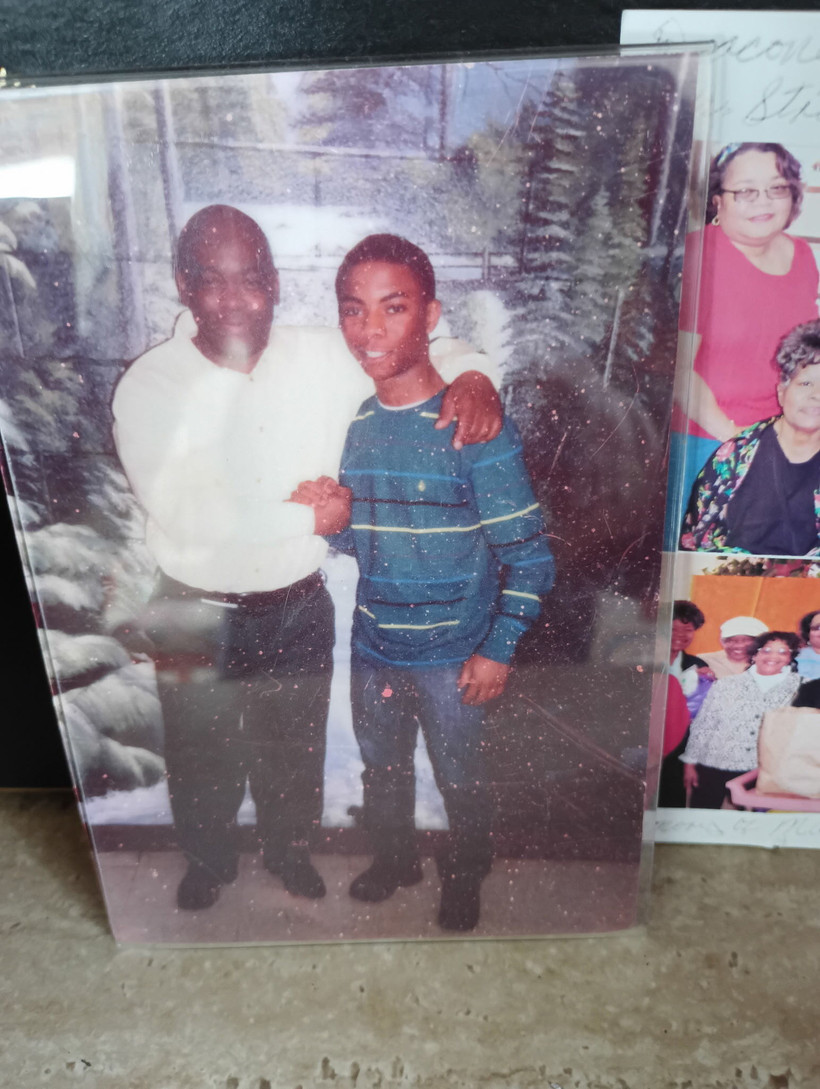
Alexander Reed (left) has spent 31 years behind bars for a murder he says he didn’t commit. | Courtesy of Javon Reed

Sign up for Staying Focused, our newsletter keeping readers up to speed on New York politics.

When the New York Attorney General’s conviction review bureau gets involved in someone’s wrongful conviction case, it often succumbs to pressure from the county prosecutors who originally landed them in prison. But in the vast majority of cases, the bureau doesn’t get that far. Instead, it acts as a mail forwarding service, passing cases on to the prosecutors who originally tried them.

That’s what happened to Alexander Reed.

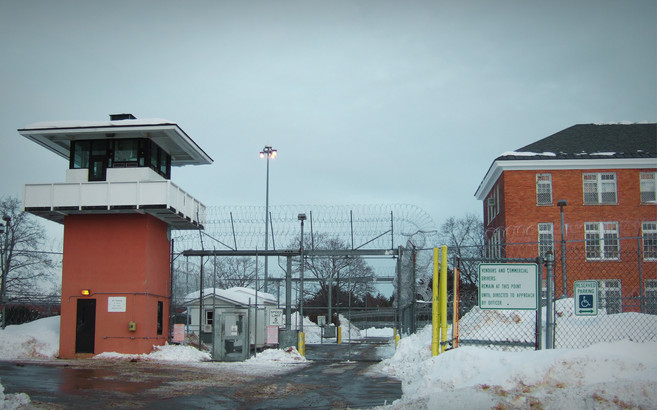
Reed has spent 31 years behind bars for a murder he says he didn’t commit. Now a church leader who has been recognized for his good behavior, he marked his 71st birthday in a cell at Attica Correctional Facility, outside Buffalo. In March 2024, he suffered a heart attack, and some in his family fear he’ll die in prison.

“He’s getting up there,” said Reed’s nephew, Javon, who regularly visits his uncle. “I want to see the guy out before it’s too late.”

Reed says his 1994 murder convictions were based on unreliable eyewitnesses and involved prosecutorial misconduct.

He and Javon contacted the Attorney General’s bureau about the case in 2016. They didn’t hear anything back for two years, Reed said. In 2018, Javon reached out to the bureau again. This time, AG Bureau Chief Gail Heatherly sent a brief email telling Javon to contact the Erie County District Attorney’s Office instead.

She informed him that the AG bureau did not have “original jurisdiction,” but didn’t explain that the local DA could still ask the bureau to reinvestigate the case.

Javon believed the Erie County DA’s office was biased against Reed. “Is there anything you can do to help other than referring me to the same people who locked my uncle up in the first place?” Javon wrote back.

Family photos: Alexander Reed (left) with his nephew Javon. Now 30, Javon remembers childhood prison visits with his uncle. He’s become Reed’s most vocal supporter. | Courtesy of Javon Reed
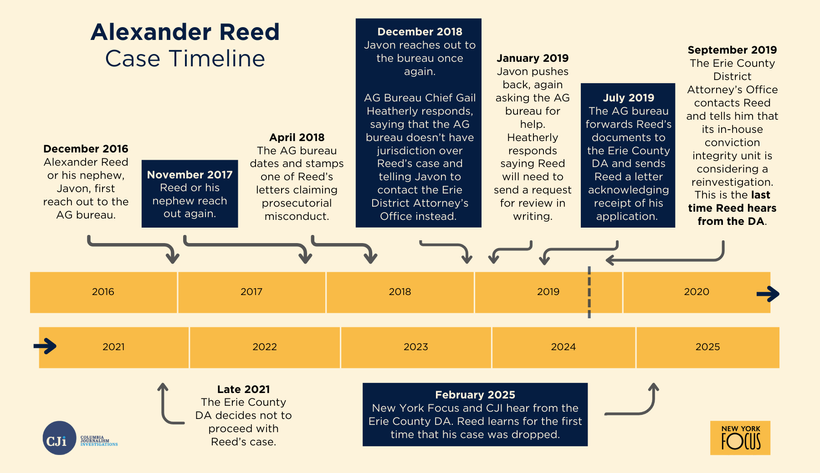

Heatherly then told Javon that the AG bureau could look over his uncle’s materials and correspond with the DA, but first he’d need to apply for a conviction review. The application entails sending a letter to the bureau — which Reed had done two years earlier. Heatherly
didn’t mention Reed’s previous outreach, despite records showing that the bureau had marked it as “received.”

In July 2019, after Reed sent another letter and documents from his case, Heatherly forwarded them to the county DA’s office that had prosecuted him — as the bureau has done with most applications.

The Erie DA’s office contacted Reed and told him that its own conviction integrity unit, or CIU, was considering a reinvestigation. That was the last time Reed would hear from the office.

Erie DA spokesperson Kaitlyn Munro said the unit spent two years reviewing Reed’s case file.

An investigator hired by Reed later produced a report raising questions about the original prosecutor’s reliance on untrustworthy witnesses, among other issues. The report’s list of unreliable witnesses included Reed’s brother — who earned immunity from prosecution by testifying against Reed.

In a recent interview with New York Focus and CJI, Reed’s brother contradicted his original trial testimony that he saw Reed commit the fatal shooting inside a house in Buffalo. In the interview, he recalled hearing the shooting from outside the building.

When reporters pointed out the discrepancy, the brother said, “My [original] testimony was the true testimony. So whatever I said during the trial, that’s what transpired.”


The CIU ultimately decided not to proceed with a formal reinvestigation, Munro told New York Focus and CJI. Reed and his family only learned of the decision when New York Focus and CJI asked the office about his case earlier this year.

“Our office has not had any communication with the defendant because we had been advised that he was represented by counsel,” Munro wrote in an email. Reed was representing himself at the time, he said. Interviews with the defense attorney that the DA had identified as Reed’s counsel and the private investigator confirmed he was pro se.

The office did not explain why Reed’s having a lawyer would have precluded notifying him — or why they decided not to reinvestigate his case.

In passing Reed’s application to the Erie DA’s office, the AG bureau subjected him to a county CIU process that often lets incarcerated people slip through the cracks, as New York Focus and CJI reported earlier this year.

Legal experts say the process could be strengthened by creating a statewide unit with more independence, as some other states have. Governor Kathy Hochul has the authority to allow the Attorney General to investigate innocence claims without DAs’ consent, but she has not used it.

Additional reporting by Willow Higgins.

BEFORE YOU GO, consider: If not for the article you just read, would the information in it be public?

Or would it remain hidden — buried within the confines of New York’s sprawling criminal-legal apparatus?

I started working at New York Focus in 2022, not long after the outlet launched. Since that time, our reporters and editors have been vigorously scrutinizing every facet of the Empire State’s criminal justice institutions, investigating power players and the impact of policy on state prisons, county jails, and local police and courts — always with an eye toward what it means for people involved in the system.

That system works hard to make those people invisible, and it shields those at the top from scrutiny. And without rigorous, resource-intensive journalism, it would all operate with significantly more impunity.

Only a handful of journalists do this type of work in New York. In the last decades, the number of local news outlets in the state has nearly halved, making our coverage all the more critical. Our criminal justice reporting has been cited in lawsuits, spurred legislation, and led to the rescission of statewide policies. With your help, we can continue to do this work, and go even deeper: We have endless ideas for more ambitious projects and harder hitting investigations. But we need your help.

As a small, nonprofit outlet, we rely on our readers to support our journalism. If you’re able, please consider supporting us with a one-time or monthly gift. We so appreciate your help.

Here’s to a more just, more transparent New York.

Chris Gelardi
Justice Bureau Chief
A photo of Chris Gelardi
Curtis Brodner is a New York City-based reporter covering criminal justice, housing and metro news. His work has appeared in Hell Gate, Hyperallergic and 1010 WINS.
Also filed in Criminal Justice

It’s unclear whether the Correctional Association of New York will have to scale back its nascent reform initiatives.

The legislation comes after months of haggling over how best to protect New Yorkers from President Trump’s immigration crackdown.

Footage published by New York Focus sparked a debate over deputies’ practice of calling Border Patrol on Spanish-speaking drivers.

Also filed in New York State

State leaders are expected to pass a bill that avoids resolving how much Resorts World New York City needs to pay.

New York state has pumped millions of taxpayer dollars into an online portal that vowed to make life easier for Rochester’s neediest, but critics say it’s fallen short.

Resorts World is floating legislation to avert more than $500 million in payments to the horseracing industry.