The State Is Locking Kids in Solitary Confinement Without Toilets, Lawsuit Alleges

Office of Children and Family Services facilities keep youth in small cells for days or weeks at a time, violating state regulations, the suit claims.

Chris Gelardi   ·   January 9, 2026
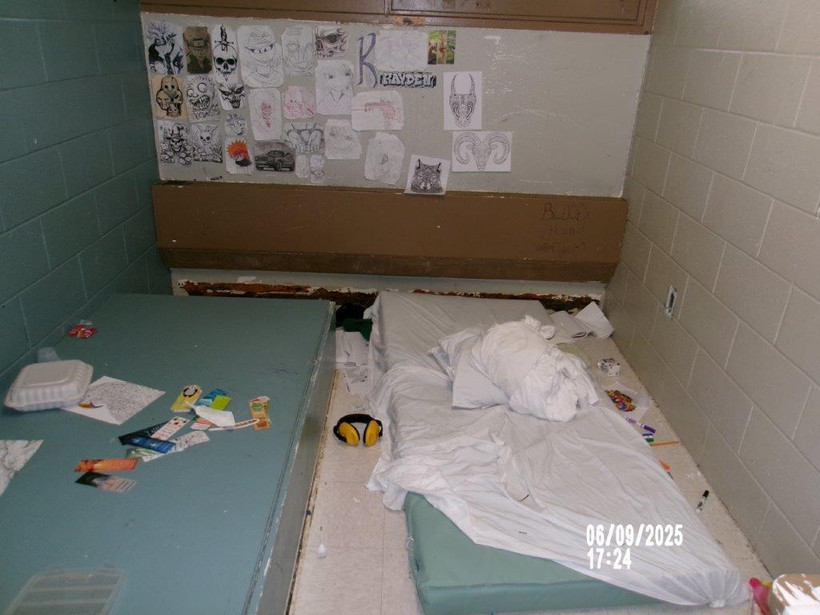
A cell at Industry Residential Center, an Office of Children and Family Services secure placement facility near Rochester. | Courtesy of the Legal Aid Society

Sign up for Staying Focused, our newsletter keeping readers up to speed on New York politics.

Juvenile detention centers in New York are keeping children and young adults in solitary confinement for days or weeks at a time, a federal lawsuit filed Thursday alleges. The facilities lock the youth in small cells without sinks or toilets, often for upwards of 23 hours a day, forcing them to urinate and defecate in bottles, food containers, and garbage bins, according to the lawsuit.

The detention centers routinely use isolation both as punishment and when they’re understaffed, the youth allege. During the lockdowns, the incarcerated young people are often locked in rooms without access to telephones, media, recreational activities, or human contact. Some of the rooms have no windows.

“Anyone who has a child can envision the harmful effects of isolating a youth in a cell,” said Kate Wood, staff attorney with the Legal Aid Society, which filed the lawsuit with the law firm Jenner & Block. She said their clients describe “really losing themselves, drowning in anxiety and fear and total lack of mental stimulation.” Some have threatened suicide, Wood said.

The detention centers, known as secure placement facilities, are operated by the state Office of Children and Family Services, which also runs New York’s foster care, adoption, and child protective services systems. The facilities, which hold young people ages 12–21 who are convicted of crimes in family or youth criminal court, are supposed to focus on rehabilitation and treatment. OCFS policy requires that they offer seven to eight hours of daily educational, vocational, and recreational activities. Instead, according to the lawsuit, they’re frequently locked down, and some have provided little or no classroom education in the last year, even when they haven’t been on lockdown.

“If [parents] were doing the same things these facilities were doing to their children, they would have their children removed from their care by the same agency,” said Emma-Lee Clinger, staff attorney with the Legal Aid Society. Clinger began visiting the youth facilities roughly a year ago and has spoken to dozens of people who are incarcerated in them. “Nearly all of our young people had faced these barbaric conditions,” she said.

Do you work at an OCFS secure facility? Do you have a loved one incarcerated there? New York Focus wants to hear from you. Email reporter Chris Gelardi at chris@nysfocus.com or message him on the Signal messaging app at @cgelardi.42.

A law that went into effect in 2022 limits the use of solitary confinement in state prisons and local jails and prohibits it for those 21 years old or younger, but the law doesn’t apply to OCFS facilities. State regulations allow OCFS staff to isolate young people for short periods if they deem them to be a danger to themselves or others. But they bar OCFS from keeping youth confined to their rooms or cells for more than 24 hours without the approval of agency administration. They also prohibit using isolation as punishment.

OCFS does not endorse or condone the use of isolation for punishment,” an agency spokesperson said in response to a detailed list of questions. “We have clear protocols that are designed to ensure the safety of youth, and staff, while incorporating trauma-informed and mental health-responsive practices. We will continue to work diligently to ensure the safety and well-being of all those under care of our facilities.”

The lawsuit includes the stories of four young people who’ve endured regular solitary confinement at four of OCFS’s five secure placement facilities. Altogether, the five facilities held over 300 children and young adults as of September. As of December 2024, 63 percent of those incarcerated in the facilities were Black, a percentage three and a half times higher than the Black population of New York state.

Conditions in the facilities are so bad that the incarcerated youth are yearning for adult jails and prisons. Christopher, one of the suit’s named plaintiffs, said that Rikers Island — the notoriously dysfunctional New York City jail complex ordered to come under federal receivership — was “significantly better” than his current facility, according to the lawsuit. While at Rikers, where the 20-year-old was incarcerated before he was sentenced, he said he had access to daily schooling and telephones and took part in a basketball league. (The lawsuit uses pseudonyms to protect the young people’s privacy.)

“We’re just adding layers upon layers of harm and deprivation.”

—Jessica Feierman, Juvenile Law Center

Now, at Goshen Secure Center, where he has lived since June, Christopher is subjected to solitary confinement almost every week, the lawsuit claims. Staff regularly lock down his entire housing unit, letting the young people out of their cells for roughly 30 minutes a day — the only time they’re allowed to use the telephone, shower, and bathroom. In the meantime, youth in his wing urinate in whatever containers they can find in their cells.

The repeated bouts of isolation have taken a toll on Christopher’s mental health. In September, staff placed him on suicide watch after he threatened to kill himself if the facility kept him in solitary, according to the lawsuit. He’s considering requesting to transfer to the adult prison system, which is struggling with what the prison agency administration describes as its own staffing crisis.

“Solitary confinement is devastating for youth,” said Jessica Feierman, chief legal officer of the Juvenile Law Center, noting that it can cause irreversible psychological damage and lead to self-harm, psychosis, and a heightened risk of suicide.

“They’re at this moment where their brains are developing, they’re learning social skills and how to problem-solve, and when we cut them off from peers and supportive adults … we’re just adding layers upon layers of harm and deprivation,” Feierman said.

Isaac, also at Goshen, has been trying to stave off that psychological damage. The frequent isolation has given him anxiety attacks, his mother told New York Focus.

“I told him, ‘Whenever you feel that way and you’re on lockdown because of lack of staff, just think of my voice, hear me talking to you, pray, reread my letters,’” she said.

Isaac excels academically, his mother and lawyers said. While awaiting sentencing at a city-run juvenile detention center in Brooklyn, he attended regular schooling, earned academic honors, and completed a restorative justice program that involved group readings, discussions, and writing projects. The 17-year-old wants to finish high school classes and begin college coursework — but has had no classroom time since he arrived at Goshen in February, his mother said. Instead, staff come by roughly once a week to give him worksheets to fill out with no instruction.

Shortly after he arrived at Goshen, staff placed Isaac’s entire unit in solitary for roughly a month, the lawsuit alleges. They were locked in nearly around the clock, let out only for brief individual bathroom trips and occasionally to use the telephone. Since then, his wing has continued to go on regular lockdown.

“All we hear from staff is, ‘We’re short staff, we’re short staff, we’re short staff,” said Isaac’s mother, who also requested anonymity to protect her son. “They’re always short-staffed. What’s going on?”

OCFS did not respond to questions about staffing issues. They may represent an extreme version of a national trend: During the Covid-19 pandemic, youth detention facilities across the country saw a sharp dip in both staff and the number of incarcerated youth, according to Feierman. While the incarcerated populations have ticked back up, staffing levels haven’t kept pace, she said.

OCFS’s secure placement facilities, as well as their five less strict “limited secure” facilities and one “non-secure” facility, saw a 13 percent decrease in full-time employees between 2019 and 2022, according to numbers compiled by the New York State Public Employees Federation, which represents some OCFS workers. Agency-wide spending on overtime tripled over the same timeframe.

“The trends across the facilities are very similar: staff burnout, resignations,” and forced overtime, said Randi DiAntonio, vice president of the Public Employees Federation. Counselors who are supposed to be offering programming are often forced to do the jobs of security staff, she said. “If you don’t have the staff for security purposes, you can’t move people to the proper areas for programs. It really affects the entire system.”

The rise in the incarcerated youth population has also hit OCFS particularly hard. In 2017, the state passed the Raise the Age law, which mandated that courts try most 16- and 17-year-olds accused of crimes as minors rather than as adults. The law diverted youth from adult prisons to OCFS facilities: The secure placement facility population nearly tripled between 2017 and 2025, according to OCFS data. But the state didn’t dedicate enough resources to fund recruiting initiatives to help address the dual crises of increased populations and decreased staff, DiAntonio argued.

In June, the Public Employees Federation penned a letter to state lawmakers outlining a post-pandemic staffing crisis at Industry Residential Center, near Rochester, whose campus contains both a secure placement and a limited secure facility. Since 2022, facility workers have complained of chronic understaffing that has led to “unsafe conditions” and “decimated essential youth programming,” the letter said.

As of September 2024, only 17 percent of the nearly 250 required support staff were available to work across the two facilities, and less than half of the needed counselors were available, the letter said. Eight months later, the number of available staff had decreased by roughly half. As a result, “youth were reportedly confined to their rooms for up to 23 hours a day, often denied basic access to restrooms and served food in unsanitary conditions.” One tried to commit suicide that month, the letter said.

“If [parents] were doing the same things these facilities were doing to their children, they would have their children removed from their care.”

—Emma-Lee Clinger, Legal Aid Society

Since sending the letter, representatives from the Public Employees Federation have met with OCFS leadership to discuss recruiting, retention, and safety, DiAntonio said.

Whatever the agency is doing, it hasn’t been enough to stem the widespread use of solitary confinement, said Wood. “OCFS has been aware of this issue and has refused to act,” she said.

A lack of external oversight likely contributes to the neglect. The Justice Center for the Protection of People With Special Needs, a state agency, has the power to investigate abuse of youth within OCFS institutions. A spokesperson said the agency had no open investigations into solitary confinement at OCFS facilities.

Another body, the State Commission of Correction, has power to audit and penalize OCFS secure facilities, but it does little oversight work outside of county jails, as New York Focus has reported. An SCOC spokesperson said that the commission has no record of receiving any written complaints regarding solitary confinement or understaffing at OCFS secure facilities since 2022.

Legal Aid lawyers hope the lawsuit will compel the state to take the welfare of youth in its custody more seriously.

“There is a real societal, systemic lack of empathy for incarcerated youth of color,” Wood said.

BEFORE YOU GO, consider: If not for the article you just read, would the information in it be public?

Or would it remain hidden — buried within the confines of New York’s sprawling criminal-legal apparatus?

I started working at New York Focus in 2022, not long after the outlet launched. Since that time, our reporters and editors have been vigorously scrutinizing every facet of the Empire State’s criminal justice institutions, investigating power players and the impact of policy on state prisons, county jails, and local police and courts — always with an eye toward what it means for people involved in the system.

That system works hard to make those people invisible, and it shields those at the top from scrutiny. And without rigorous, resource-intensive journalism, it would all operate with significantly more impunity.

Only a handful of journalists do this type of work in New York. In the last decades, the number of local news outlets in the state has nearly halved, making our coverage all the more critical. Our criminal justice reporting has been cited in lawsuits, spurred legislation, and led to the rescission of statewide policies. With your help, we can continue to do this work, and go even deeper: We have endless ideas for more ambitious projects and harder hitting investigations. But we need your help.

As a small, nonprofit outlet, we rely on our readers to support our journalism. If you’re able, please consider supporting us with a one-time or monthly gift. We so appreciate your help.

Here’s to a more just, more transparent New York.

Chris Gelardi
Justice Bureau Chief
A photo of Chris Gelardi
As New York Focus’s justice bureau chief, Chris Gelardi reports and edits work on the state’s criminal-legal and immigration systems. His writing on cops, jails, ICE, and the US military has appeared in more than a dozen other outlets, most frequently The Intercept… more
Also filed in Criminal Justice

A bill awaiting the governor’s signature would relax restrictions on who can qualify for victim compensation.

In May, state lawmakers passed a $269 billion budget after haggling for months over thousands of line items and policies affecting New Yorkers.

The legislation would make it easier for currently and formerly incarcerated people and child victims to sue the state over allegations of past abuse.

Also filed in New York State

At a Board of Regents meeting Monday, state officials proposed eliminating credit-based diploma requirements.

The last-minute influx, the biggest ever for a legislative primary, is boosting her opponent, Jessica González-Rojas.

City budget gaps and an ambitious affordability agenda may require pressing Albany again for taxes and aid.