New York City’s Multibillion-Dollar Black Box Contracts Face Scrutiny

Master agreements let the city wildly exceed spending projections while avoiding typical oversight, the city’s comptroller found.

Nick Garber and Zachary Groz   ·   May 6, 2026
Master agreements make it difficult to discern exactly what goods and services are being paid for with taxpayer dollars. | Box: Carlos Alvarez/Getty Images; Papers: halustd/Canva | Illustration: Leor Stylar

Sign up for Staying Focused, our newsletter keeping readers up to speed on New York politics.

In 2023, New York City signed a $30 million contract with the Texas-based “disaster response” company Garner Environmental Services as part of its emergency effort to house thousands of asylum seekers. Three years later, the city has overspent that deal 25 times over, paying Garner more than $750 million.

Exactly what that money went toward, however, is unknown to the public. A contracting method called a master agreement allowed the city to vastly overshoot its target and let the city’s Department of Citywide Administrative Services disclose little about the goods and services purchased with taxpayer dollars.

Master agreements, which made up 17 percent of the city’s total contract spending over the last four years, are used by city agencies when they expect some future need for goods and services but do not know exactly how much or how often they will have to buy them. Under a master agreement, an agency can set up an “on-call” relationship with a vendor, allowing the city to make purchases much more quickly than it would in a regular procurement cycle.

The city’s initial estimates for those contracts’ value can be wildly off base. In fact, across more than 2,000 master agreements registered from 2015 through 2025, the city’s mayoral agencies spent more than $8.3 billion against a target of $6.7 billion — overshooting by $1.6 billion, or almost 25 percent. (Those figures don’t include the Department of Education, which spends more on master agreements than any other agency but abides by a separate set of procurement rules.)

That’s according to a new analysis by city Comptroller Mark Levine, whose office examined the city’s spending under those master agreements. The report, shared with New York Focus, also faulted master agreements for their lack of transparency: Within the contracts, the city makes purchases called delivery orders, which do not get reviewed by the comptroller and often contain no information about how many items are bought, the price per unit, or who manufactured the product. Vendors often bundle together services with those goods, bringing onboard outside consultants at undisclosed hourly rates as project managers, technicians, and advisors.

As a result, when a master agreement is overspent, the public has little clue why. The same goes for under-spending: On about a third of the studied master agreements, the city spent less than 50 percent of the contract’s registered value. That can artificially inflate the amount of money the city appears to have awarded to minority- and women-owned business enterprises. A separate report last year found that nearly half the dollars supposedly awarded to MWBEs through master agreements had not been spent.

“The city’s ability to make vital purchases faster should not come at the cost of transparency for how taxpayer dollars are being spent,” Levine said in a statement. “Without a clear record of what the city is buying, waste flourishes.”

Levine is not calling on the city to stop using master agreements. But the report argues that details about delivery orders should be made public through a partnership between the mayor and comptroller, then posted online on the Checkbook NYC contracting database or NYC Open Data, which collects publicly available city data. That change would not require any legislation to be implemented, according to the comptroller’s office.

City agencies should also improve their methodologies for estimating costs, Levine says, although the report does not offer specifics. Currently, the city often projects costs through inexact systems like optional surveys sent to agencies about their future needs. 

And as Mayor Zohran Mamdani scours the city’s $127 billion budget for potential savings, the comptroller says City Hall should also take a closer look at past overspent master agreements to find cost drivers and opportunities to negotiate better rates.

“Without a clear record of what the city is buying, waste flourishes.”

—Mark Levine, New York City Comptroller

A spokesperson for the Department of Citywide Administrative Services, which awarded the Garner contract, said that master agreements are a crucial part of the agency’s mandate to procure goods for all other city agencies. The initial estimates for contracts like Garner’s are based on previous spending on similar deals, the agency said.

“These contracts allow the city to respond to unprecedented emergencies quickly, keeping the city moving and running for millions,” spokesperson Dan Kastanis said. “We look forward to working with the comptroller, as needed, on any proposed suggestions to improve the contracting process.”

Much of the city’s master agreement money has been spent on technology, often funneled through the Office of Technology and Innovation. Instead of buying its IT products directly from vendors, OTI typically contracts with clearinghouses that have their own relationships with tech manufacturers and consultants. While the city benefits from the reach that those clearinghouses have, the setup has “confounded financial oversights and transparency advocates who cannot determine exactly what was purchased or from whom,” the report notes.

Indeed, OTI overspent by more than $3 billion on two of its citywide IT contracts from 2018 to 2025. One of those deals, an agreement with the firm CDW Government LLC, lets the city buy goods from more than 740 different manufacturers and service providers — yet the delivery orders that stem from the contract have no public information about what goods and services were bought or what vendors supplied them.

OTI spokesperson Ray Legendre said that under Mamdani, the agency “is committed to making sure government delivers for New Yorkers  — and every dollar we spend works as hard as they do.”

OTI is focused on using technology effectively, efficiently, and responsibly to serve New Yorkers and our city as a whole,” Legendre said.

CDW reported a 23 percent gross profit margin for the fourth quarter of 2025. Last fiscal year, the city paid the company’s contracting arm more than half a billion dollars, nearly all of which came through master agreements. This fiscal year, with almost two months still to go, the city has paid CDW more than $600 million. The biggest purchase was for $142 million worth of Chromebooks for public school students, which had been fast-tracked in the final days of former Mayor Eric Adams’s administration. The city was continuing to cut checks worth tens of millions of dollars for the laptops as of March of this year.

In recent years, watchdogs and the New York City Council have raised alarm about the city’s use of another contracting method: emergency contracts, which proliferated during the spike in asylum seekers moving to the city around 2022 and allow the city to ink deals without disclosing terms or waiting for the most competitive bid. Lawmakers have paid comparatively little attention to master agreements.

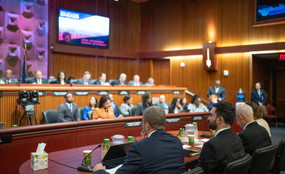
In a March hearing, City Councilmember Lincoln Restler pressed a city official to explain who in City Hall should be scrutinizing master agreements for potential overspending. The official, Mayor’s Office of Contract Services Director Kim Yu, acknowledged the problem but had no ready solution.

“I would welcome us to do a little bit of a deeper dive into this,” Yu said.

Late last year, the City Council’s technology and contracts committees were set to hold a joint oversight hearing on master agreements signed by OTI, but the hearing was scrapped due to scheduling conflicts. A spokesperson for the council’s new technology chair, Carmen De La Rosa, said this week that the committee has no immediate plans to reschedule the hearing but that conversations are ongoing with the Mamdani administration about the overall direction of the city’s tech agency. 

Although Mamdani announced in March that OTI will renegotiate some of its tech contracts, the effort appears to be small-scale, with projected savings of just over $1 million a year. The comptroller’s office says the time is ripe: The city is currently negotiating two new citywide IT contracts worth an estimated total of $2 billion.

At New York Focus, our central mission is to help readers better understand how New York really works. If you think this article succeeded, please consider supporting our mission and making more stories like this one possible.

New York is an incongruous state. We’re home to fabulous wealth — if the state were a country, it would have the tenth largest economy in the world — but also the highest rate of wealth inequality. We’re among the most diverse – but also the most segregated. We passed the nation’s most ambitious climate law — but haven’t been meeting its deadlines and continue to subsidize industries hastening the climate crisis.

As New York’s only statewide nonprofit news publication, our journalism exists to help you make sense of these contradictions. Our work scrutinizes how power works in the state, unpacks who’s really calling the shots, and reveals how obscure decisions shape ordinary New Yorkers’ lives.

In the last two decades, the number of local news outlets in New York has been nearly slashed in half, allowing elected officials and powerful individuals to increasingly operate in the dark — with the average New Yorker none the wiser.

We’re on a mission to change that. Our work has already shown what can happen when those with power know that someone is watching, with stories that have prompted policy changes and spurred legislation. We have ambitious plans for the rest of the year and beyond, including tackling new beats and more hard-hitting stories — but we need your help to make them a reality.

If you’re able, please consider supporting our journalism with a one-time gift or a monthly gift. We can't do this work without you.

Thank you,

Akash Mehta
Editor-in-Chief
A photo of Akash Mehta.
A photo of Nick Garber.
Nick Garber covers politics for New York Focus. He previously worked for Crain’s New York Business, where he covered city and state government, housing and real estate, and money in politics. He also covered neighborhood news in Manhattan and Queens for Patch, and got… more
Zachary Groz is a freelance journalist based in New York. He previously served as co-editor-in-chief of The New Journal, an investigative magazine at Yale University that during his tenure was named Best Student Magazine in America by the Society of Professional Journalists. He is… more
Also filed in New York City

A lawsuit accuses federal officials of ignoring evidence that the boy, born in Mexico, held US citizenship through his mother.

City budget gaps and an ambitious affordability agenda may require pressing Albany again for taxes and aid.

We’ve compiled information for the 450,000 New Yorkers who will lose health care coverage on July 1.