‘I Just Need to Hug Him’: Families Say New York Is Illegally Delaying Prison Transfers

The prison system often postpones or rejects incarcerated people’s requests to be closer to their children, jeopardizing family ties.

Indy Scholtens   ·   May 14, 2026
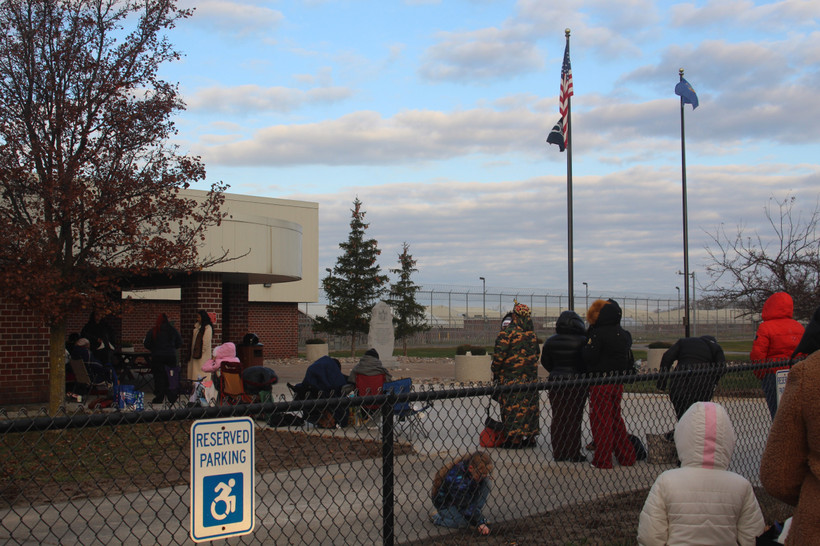
Visitors bundled up against the cold stand in line outdoors in the early morning before visiting starts at Five Points Correctional Facility, on Nov. 22, 2025.
Family members often travel for hours and line up early to visit their loved ones in prison. | Indy Scholtens/New York Focus

Sign up for Staying Focused, our newsletter keeping readers up to speed on New York politics.

When Shawna Moore’s husband, Artamion, was moved from Attica to Green Haven Correctional Facility after a disciplinary infraction, his family was punished too: Artamion was suddenly more than 300 miles from their children in Rochester. 

Under a 2021 law, an incarcerated person with minor children can request what’s called a “proximity transfer” to the closest appropriate prison to their home. Shawna and Artamion quickly filed for one to get him closer, but Moore said they didn’t hear anything back for months.

She learned in January 2025 that the request was approved, but now, more than a year later, Artamion is still in Green Haven. 

Moore’s experience isn’t unusual. Research by New York Focus found that the law’s implementation has slowed in recent years. The percentage of “proximity transfers” granted has dropped sharply, from nearly 40 percent of those requested in 2023 to just 20 percent last year.

One-third of the New York prison population has minor children. Research has found that regular visitation can reduce recidivism by as much as 26 percent, often by deepening family ties. It can also better the lives of children with incarcerated parents, reducing their feelings of abandonment and anxiety while improving their well-being, self-esteem, and school behavior.

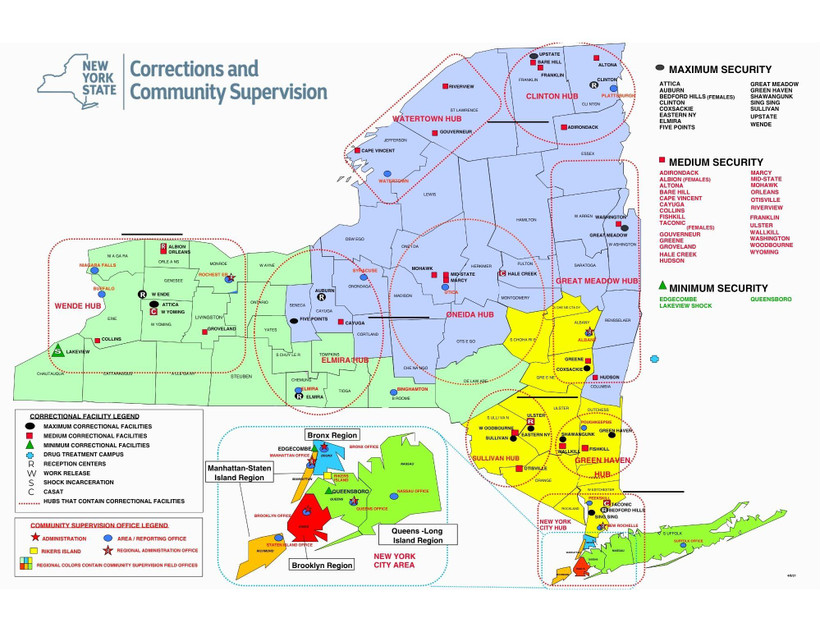
Map of prisons in New York
Green Haven Correctional Facility, where Artamion Moore is incarcerated, is over 300 miles from his children's home in Rochester. | Map: New York state Department of Corrections and Community Supervision
 

For Moore, the five-hour drive and overnight stay has made it hard to visit her husband, who is serving a lengthy sentence for murder in the second degree. She is self-employed and a driver for Uber and Lyft. She only gets to see her husband once every two months or so. Their 11- and 17-year old children haven’t seen their dad since November 2025. 

“They keep asking all the time when we’re going there, but it’s just such a hassle,” she said. “We’ve been waiting for over a year just to get him moved.”

Each time Moore calls the Department of Corrections and Community Supervision or his assigned counselor, she said she is told the same thing: DOCCS is waiting for a bed to open up. They can’t say if and where her husband will be moved.

Attica has the capacity to house 2,143 prisoners. As of late April, there were 1,846 people incarcerated there, according to DOCCS documents. Thomas Mailey, a spokesperson for DOCCS, said the agency “does not comment on individual transfer request cases” but added that staffing shortages may cause delays. The agency “closely monitors all available beds” and “makes every effort to process transfers as quickly as possible,” he said.

Meanwhile, many prisoners face involuntary transfers. Incarcerated people have described feeling insecurity and anxiety during these moves, which may take multiple days and include multiple stops, even for small distances. Out of 96 family members and loved ones of incarcerated individuals who shared their experiences with New York Focus through a survey, 41 said that their loved one had been transferred more than five times. Twenty-one said the repeated transfers made it harder to maintain contact as their loved one was moved further away from them. 

There’s no limit to the number of times a prisoner can be transferred in New York state. 

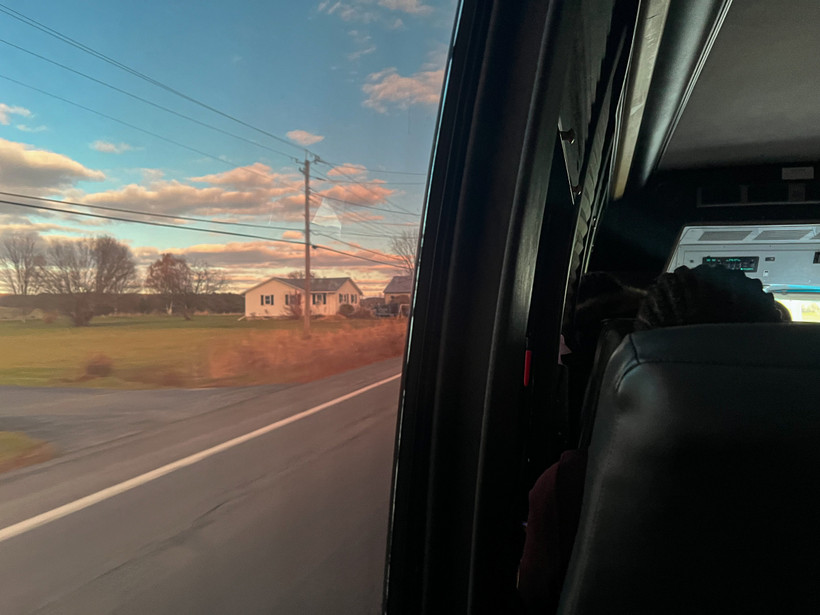
A private prison shuttle drives through upstate New York. For many families, there is no other way to visit loved ones incarcerated far from home. | Indy Scholtens/New York Focus
Also known as April’s Law, the 2021 Proximity Law was prompted in part by a teenager’s appeal to a Brooklyn lawmaker nearly a decade before. It requires DOCCS to consider the location of children when placing a parent in prison or conducting transfers. 

In the first year of the law’s implementation, the agency allowed more than 1,553 proximity transfers out of 5,987 requests. The number has plummeted since then. Between May 2024 and June 2025, only 870 incarcerated people with minor children were granted their proximity requests out of a total of 4,349 incarcerated people who applied. 

In its most recent report on the bill, DOCCS wrote that a corrections officers strike last year contributed to reduced and delayed transfer requests. Proximity requests can now take more than 18 months to process, depending on whether there is a bed available at the facility the person requests and a seat on the transport bus. 

Kevin Nelson, a staff attorney in the Family Matters Unit at Prisoners’ Legal Services of New York, a nonprofit legal services organization, said that online “incarcerated profile reports” often show open beds in the facilities to which people hope to transfer, even when DOCCS has said there aren’t any. “I see a lot of clients who would be going to the general population, who are still being told that available bed space is likely a factor delaying their transfer.” 

Mailey, the DOCCS spokesperson, said that while the agency monitors available beds, moving quickly isn’t always possible. “Due to staffing shortages and the ongoing state of emergency, which results in unstaffed beds, transfers between facilities are taking longer to complete,” he said. 

When the agency improves staffing levels, Mailey said, “facilities will be better positioned to facilitate transfers more efficiently.” He noted that “aggressive” recruiting efforts are in the works.

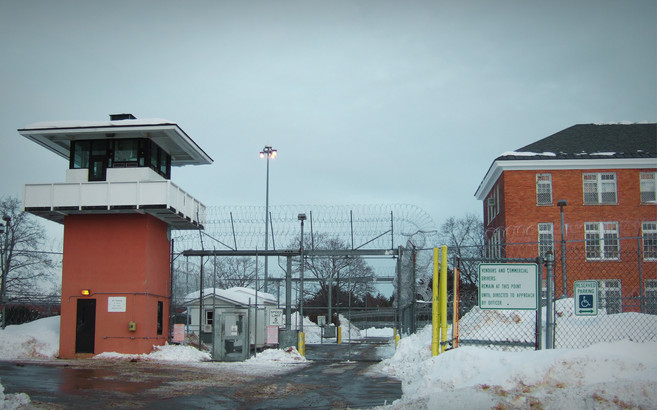
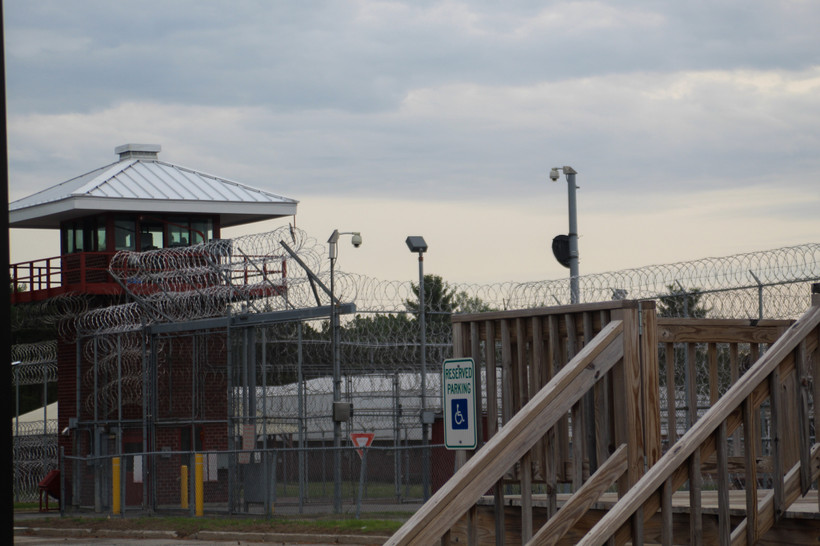
Franklin Correctional Facility in upstate New York is close to the Canadian border. | Indy Scholtens/New York Focus
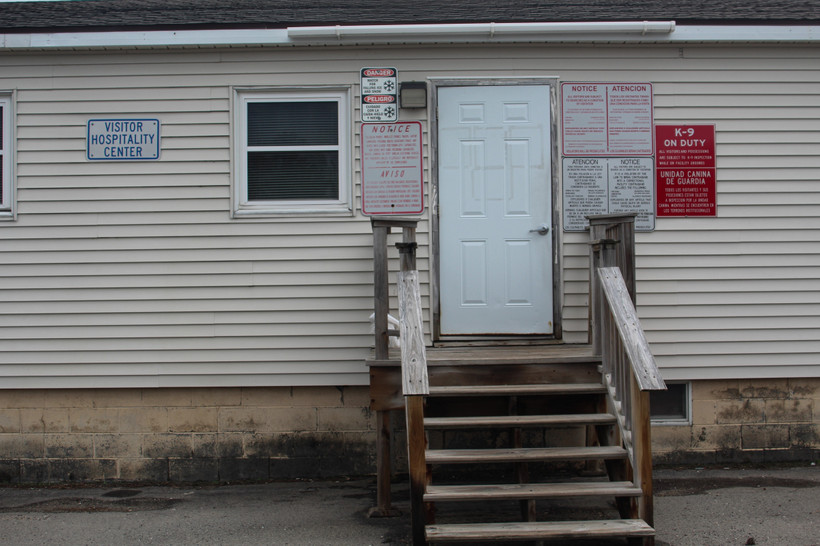
The "hospitality center" at Franklin Correctional Facility in May 2025. | Indy Scholtens/New York Focus
DOCCS reviews proximity requests on a case-by-case basis, considering factors such as facility capacity, security classification, programming needs, and the best interests of the child. Requests are denied if, for instance, there are any crimes against the child or children in question or an active order of protection involving the children or the custodial parent or guardian.

The incarcerated person can’t be serving a disciplinary confinement sanction or attending a specialized treatment program, and must be more than five months away from a scheduled parole board appearance or release.

In its 2025 report on the legislation, DOCCS broke down why it cancelled or rejected 275 proximity requests. Some requests were placed too close to a parole board hearing, for example, or were withdrawn by the requester. But for the remaining 3,200 people, no explicit reason was outlined. When asked to explain the missing information, Mailey said that “requests can remain pending for a number of reasons including incomplete information and a thorough evaluation of the interest of the children involved. Some of this information is confidential and cannot be shared publicly.”

Former Democratic state Senator David Carlucci, who co-sponsored April’s bill, called the data New York Focus shared “deeply troubling,” noting in an email that it’s “not what any of us who co-sponsored this legislation intended.”

“If DOCCS is approving fewer than one in five proximity requests and cannot account for why the vast majority are being denied,” Carlucci wrote, “that is a transparency failure and an accountability failure.”

Nelson at Prisoners’ Legal Services said he has received 212 complaints from prisoners regarding proximity transfers.

Some said they never received documents that the non-incarcerated guardian needed to sign, Nelson explained. In other cases, DOCCS wrongly used an expired order of protection as justification for rejecting a transfer. Even if a court has permitted visitation or contact with the child, the department may still deny a proximity transfer.

Under certain conditions, including significant disciplinary infractions, DOCCS can initiate a reverse transfer.

That’s what happened to Devon Callicutt, 35, who is serving a life sentence without parole at Elmira Correctional Facility for a murder during a robbery. His wife, Shinasha Bowen, lives in Albany, more than a three-hour drive from Elmira, which is close to the Pennsylvania border. Callicutt requested to be closer to Bowen and her children in November 2023. Within a month, he was transferred to Green Haven Correctional Facility, an hour-and-a-half away.

“It was everything,” Bowen said. “The fact that he was closer, so I didn’t have to wake up at the crack of dawn.” Bowen takes her children, 12, 17, and 18, with her to see him. “They love seeing him,” she said. “It’s important they see him.”

But after getting into a fight with a fellow prisoner, Callicutt was sent to Upstate Correctional Facility, then to Clinton Correctional Facility, and eventually back to Elmira. Now Bowen gets up at 2 a.m. to ensure she gets to the prison early enough to get a good spot in line. New York’s maximum security prisons used to allow daily visitation. Since last year’s wildcat strike, visits at most prisons in New York are still limited to one weekend day per incarcerated person.

After a reverse transfer, an incarcerated person has to wait at least a year for a proximity transfer. Callicutt requested another transfer in October 2025. He and his family are still waiting.

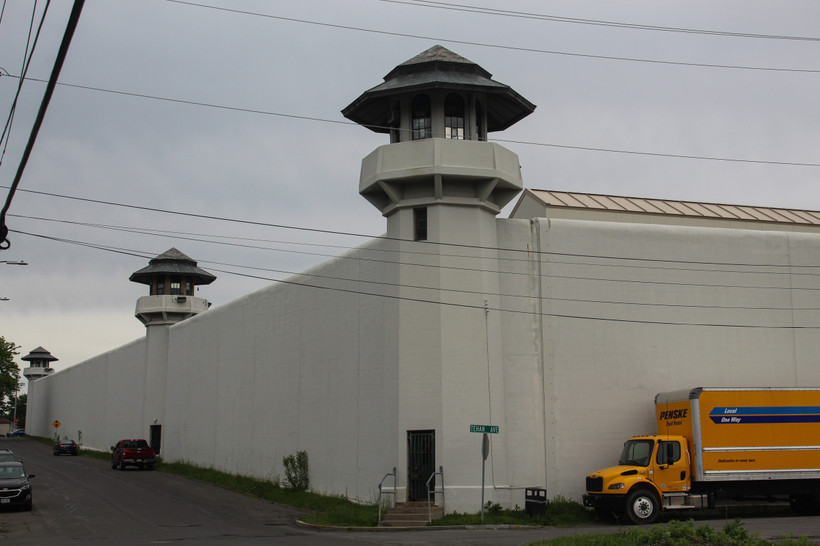
Auburn Correctional Facility, a maximum-security prison in New York.
Research has found that regular visitation can reduce recidivism by as much as 26 percent, often by deepening family ties. | Indy Scholtens/New York Focus
Visits can improve the lives of children with incarcerated parents, reducing their feelings of abandonment and anxiety. | Indy Scholtens/New York Focus
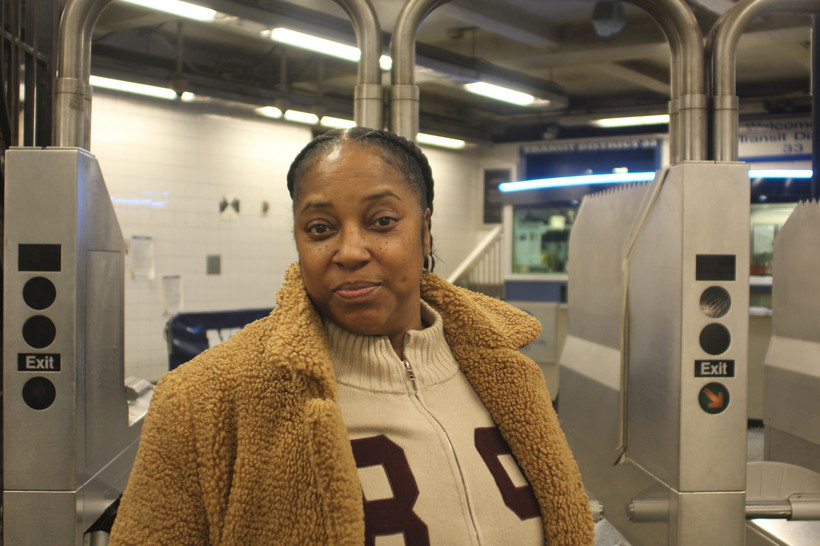
Transfers for involuntary reasons — such as disciplinary action, programming, or a prison’s staffing needs — often upend proximity requests. Only one transfer can be in process at any given time.

Proximity transfers are “just a drop in a very large bucket,” explained Iolanthe Brooks, a PhD candidate in sociology at Northwestern University who analyzed DOCCS transfer data from 2020 to 2022.

A prisoner in good standing may also request a “preference transfer.” Brooks’s analysis showed that requested transfers brought incarcerated New Yorkers an average of 147 miles closer to home, but transfers for other reasons moved incarcerated people an average of 29 miles farther away from their county of conviction.

“We see that for those transfers, on average, people are actually getting moved farther from home, which is the opposite, of course, of the intent of these closer-to-home laws,” Brooks said.

Nearly 65 percent of incarcerated people convicted in New York City are placed in prisons more than 100 miles from the city, according to a calculation by New York Focus. 

DOCCS has transferred Deione Gray’s 34-year-old son Unique at least 14 times over a six-year period. He was sentenced to 29 years-to-life for a murder during an attempted robbery in 2015.

Deione Gray returns from a visit with her son in November 2025. He was then incarcerated at Five Points Correctional Facility. She took a private shuttle to travel the more than 250 miles. | Indy Scholtens/New York Focus

Recently, Unique was transferred from Upstate Correctional Facility, a prison near the Canadian border, to Five Points, a maximum-security prison over 200 miles southwest. Each time he’s transferred, Gray has to find a new private shuttle that can take her to his prison; she doesn’t own a car and the prisons are hundreds of miles from her home in Brooklyn. Gray makes the trip as often as she can.

For Gray, the proximity law doesn’t apply — her son does not have minor children. The law does not allow transfers for incarcerated people seeking proximity to adult children, elderly parents, or other close relatives.

Proposed state legislation could provide a solution for this: It would create a pilot program for moving any incarcerated person, rather than just parents, closer to home.

“I just need to hug him,” Gray said. “I miss him so much.”

This story was published with the support of a grant from Columbia University’s Ira A. Lipman Center for Journalism and Civil and Human Rights, in conjunction with Arnold Ventures. Support for this story was provided by The Neal Peirce Foundation, a nonprofit organization dedicated to supporting journalism on ways to make cities and their larger regions work better for all people.

BEFORE YOU GO, consider: If not for the article you just read, would the information in it be public?

Or would it remain hidden — buried within the confines of New York’s sprawling criminal-legal apparatus?

I started working at New York Focus in 2022, not long after the outlet launched. Since that time, our reporters and editors have been vigorously scrutinizing every facet of the Empire State’s criminal justice institutions, investigating power players and the impact of policy on state prisons, county jails, and local police and courts — always with an eye toward what it means for people involved in the system.

That system works hard to make those people invisible, and it shields those at the top from scrutiny. And without rigorous, resource-intensive journalism, it would all operate with significantly more impunity.

Only a handful of journalists do this type of work in New York. In the last decades, the number of local news outlets in the state has nearly halved, making our coverage all the more critical. Our criminal justice reporting has been cited in lawsuits, spurred legislation, and led to the rescission of statewide policies. With your help, we can continue to do this work, and go even deeper: We have endless ideas for more ambitious projects and harder hitting investigations. But we need your help.

As a small, nonprofit outlet, we rely on our readers to support our journalism. If you’re able, please consider supporting us with a one-time or monthly gift. We so appreciate your help.

Here’s to a more just, more transparent New York.

Chris Gelardi
Justice Bureau Chief
A photo of Chris Gelardi
Indy Scholtens is a freelance journalist from the Netherlands. Her work focuses on social and criminal justice and has been published in Slate, NPR, and Documented, among others.
Also filed in Criminal Justice

A bill awaiting the governor’s signature would relax restrictions on who can qualify for victim compensation.

In May, state lawmakers passed a $269 billion budget after haggling for months over thousands of line items and policies affecting New Yorkers.

The legislation would make it easier for currently and formerly incarcerated people and child victims to sue the state over allegations of past abuse.

Also filed in New York State

At a Board of Regents meeting Monday, state officials proposed eliminating credit-based diploma requirements.

The last-minute influx, the biggest ever for a legislative primary, is boosting her opponent, Jessica González-Rojas.

City budget gaps and an ambitious affordability agenda may require pressing Albany again for taxes and aid.