Bill Seeks to Prevent Prisons From Turning Away Visitors After Scanners Pick Up Their Tampons

The bill follows reporting from New York Focus and other news outlets on prison staff mistaking menstrual and contraceptive products for hidden contraband.
Chris Gelardi and Raina Lipsitz   ·   March 19, 2026
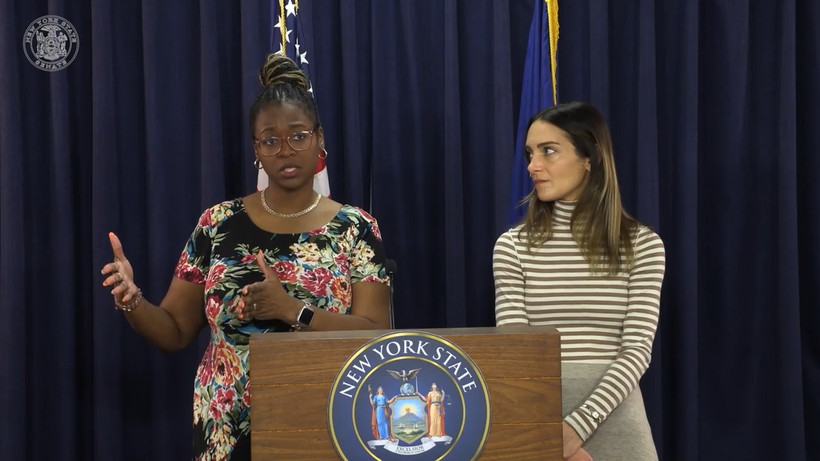
State Assemblymember Phara Souffrant Forrest and Senator Julia Salazar introduced a bill that aims to prevent state prisons from banning visitors based on faulty body scanner readings subject prison employees to security scans. | Screenshot: New York state Senate

Sign up for Staying Focused, our newsletter keeping readers up to speed on New York politics.

A new bill unveiled Wednesday aims to prevent state prisons from banning visitors based on faulty body scanner readings. The legislation would also subject prison employees to the same security scans required of visitors who wish to sit in a room with their loved ones. Currently, staff are allowed to opt out of the body scans, which the prison system has deployed to intercept drugs, weapons, and other banned items.

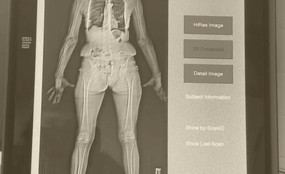
The bill follows New York Focus reporting that showed how prison employees have repeatedly barred people from visiting facilities after mistaking body scanner imaging of tampons, contraceptive products, anatomical features, and other anomalies for hidden contraband. The Department of Corrections and Community Supervision, or DOCCS, started requiring visitors to pass through body scanners when it resumed visitation after a three-week prison guard strike last March.

The body scanner policy was one of the striking officers’ demands, aimed at alleviating what they described as high numbers of visitors smuggling items into prisons. But soon after the department introduced the body scanners, visitors — particularly women — began complaining of being wrongfully kept out based on misread scanner readings, even though staff never recovered the contraband they alleged was being smuggled. In many cases, DOCCS barred the visitors from prisons for several months or indefinitely.

Prison staff have turned away some menstruating visitors using tampons because their scans showed anomalies in their vaginas, according to anecdotes and documents obtained by New York Focus, the Amsterdam News, and The New York Times. Others have received no details about their body scans, leaving them guessing as to what staff saw. DOCCS’s body scanner policy offers little guidance on how to read the images, and visitors and advocates have said that each employee interprets body scans differently. DOCCS told The New York Times that, between last March and December, it turned away 2,557 people from visiting facilities because of body scanning problems — about 2 percent of visitors.

Officers at Auburn Correctional Facility blocked Demarie Gumora from visiting her husband in October, she said, after a body scanner showed a “long object” and “unknown circular object” in her lower abdomen, though officers never found any contraband, she said. DOCCS said it was unable to comment on individual visitor cases.

DOCCS suspended Gumora from visiting for six months. She appealed the suspension, but last month, DOCCS denied the appeal, claiming that a body scan showed “an abnormality consistent with contraband” and that a DOCCS dog “alerted to her person,” according to a letter Gumora shared with New York Focus.

“The hardest part has been the lack of clarity around what happened and not having the opportunity to address that,” Gumora said.

Samantha Works, whose husband was incarcerated at Mohawk Correctional Facility, was also kept out. “They do what they want to do. They don’t have to answer to anybody,” she said.

DOCCS suspended Works from visits in April last year after officers saw something in the scanner they thought was contraband. She still doesn’t know what tripped the scanner; she has surgical hardware in her knee and was using a tampon at the time, she said. She went over nine months without visiting her husband and was only able to see him when he was released in January.

The separation almost destroyed her marriage, Works said. It was especially hard on her 7-year-old daughter. “She went from seeing her father every week to not being able to see him at all,” she said.

So far, DOCCS has offered no explanation or solutions for the widespread visitor complaints regarding officers’ use of body scanners.

“My office has communicated with DOCCS on many occasions about these incidents on an individual basis, and typically they simply cite the body scanner policy,” state Senator Julia Salazar, head of the Senate’s corrections committee and the sponsor of the new legislation, said at a press conference Wednesday.

“I think that underscores exactly why we have to change the law — in order to ensure that that policy is actually fair and that it’s enforced fairly,” she said.

In a lengthy statement, a department spokesperson told New York Focus that Commissioner Daniel Martuscello “has set clear goals and instituted new policies to both reduce violence and combat the infiltration of contraband within our facilities.” The statement did not address New York Focus’s questions about the widespread allegations of unjust visitation suspensions.

“We look forward to our continued partnership with the legislature to further improve safety and implement the prison reforms that recently took effect to help ensure a system that promotes safety and dignity for all,” the spokesperson said.

While some visitors are subjected to hair-trigger suspensions, DOCCS corrections officers — known to be frequent sources of contraband — are allowed to dodge the same security measures. State law allows anyone to refuse a body scan. The consequence for visitor refusal is a “no contact” visit, during which they must converse with their loved ones through a sheet of glass or plastic. Guards go to work either way.

“The hardest part has been the lack of clarity around what happened.”

—Demarie Gumora, visitor

Last May, Martuscello, the commissioner, testified to the state legislature that, while approximately 80–90 percent of visitors willingly passed through body scanners, 80–90 percent of staff refused. Those numbers haven’t budged in the last year.

“We’re still 90 percent or more of staff not going through body scanners,” Martuscello said at a hearing last month.

This week’s bill, introduced by Salazar and Assemblymember Phara Souffrant Forrest, would require all prison employees to pass through body scanners “or an alternate method of screening.”

The corrections officers’ union, the New York State Correctional Officers and Police Benevolent Association, did not respond to a request for comment before publication time.

The bill would also establish visitor body scanning procedures, which would, among other measures, allow those whose scans show abnormalities to appeal the scan to a prison supervisor and a facility radiologist.

In the meantime, incarcerated people’s family and friends continue to struggle with suspensions.

“It’s so exhausting — mentally, physically,” said Renette Moore. DOCCS banned her from visiting her fiancé at Upstate Correctional Facility, a nearly six-hour drive from her home, for six months over what she described as a bad body scanner reading. She suspected that guards mistook her surgical scars for contraband — a common experience, according to advocates and attorneys — and she sent DOCCS notes from her doctors explaining her anatomy.

Months later, the department overturned Moore’s suspension — only to ban her again earlier this month, claiming a cell phone left in a bathroom she and other visitors used was evidence of her trying to smuggle contraband, she said.

“This has to stop,” said Moore. “The families are suffering.”

Melissa Manno contributed reporting.

BEFORE YOU GO, consider: If not for the article you just read, would the information in it be public?

Or would it remain hidden — buried within the confines of New York’s sprawling criminal-legal apparatus?

I started working at New York Focus in 2022, not long after the outlet launched. Since that time, our reporters and editors have been vigorously scrutinizing every facet of the Empire State’s criminal justice institutions, investigating power players and the impact of policy on state prisons, county jails, and local police and courts — always with an eye toward what it means for people involved in the system.

That system works hard to make those people invisible, and it shields those at the top from scrutiny. And without rigorous, resource-intensive journalism, it would all operate with significantly more impunity.

Only a handful of journalists do this type of work in New York. In the last decades, the number of local news outlets in the state has nearly halved, making our coverage all the more critical. Our criminal justice reporting has been cited in lawsuits, spurred legislation, and led to the rescission of statewide policies. With your help, we can continue to do this work, and go even deeper: We have endless ideas for more ambitious projects and harder hitting investigations. But we need your help.

As a small, nonprofit outlet, we rely on our readers to support our journalism. If you’re able, please consider supporting us with a one-time or monthly gift. We so appreciate your help.

Here’s to a more just, more transparent New York.


A photo of Chris Gelardi
As New York Focus’s justice bureau chief, Chris Gelardi reports and edits work on the state’s criminal-legal and immigration systems. His writing on cops, jails, ICE, and the US military has appeared in more than a dozen other outlets, most frequently The Intercept… more
Raina Lipsitz is the author of The Rise of a New Left: How Young Radicals Are Shaping the Future of American Politics. Her work has appeared in The Appeal, The Atlantic, The Nation, and The New Republic, among other publications.
Also filed in Criminal Justice

In May, state lawmakers passed a $269 billion budget after haggling for months over thousands of line items and policies affecting New Yorkers.

The legislation would make it easier for currently and formerly incarcerated people and child victims to sue the state over allegations of past abuse.

It’s unclear whether the Correctional Association of New York will have to scale back its nascent reform initiatives.

Also filed in New York State

Millions in outside spending was a boon to Gov. Kathy Hochul’s 2022 opponent, Lee Zeldin, and influenced down-ballot races.

State leaders are expected to pass a bill that avoids resolving how much Resorts World New York City needs to pay.

New York state has pumped millions of taxpayer dollars into an online portal that vowed to make life easier for Rochester’s neediest, but critics say it’s fallen short.