New York’s Food Banks Brace for Triple Whammy of Federal Cuts, Tariffs, and Even Higher Costs

The Trump administration has dealt a blow to the state’s food bank network, which supports around 3 million New Yorkers.

Jie Jenny Zou   ·   May 14, 2025
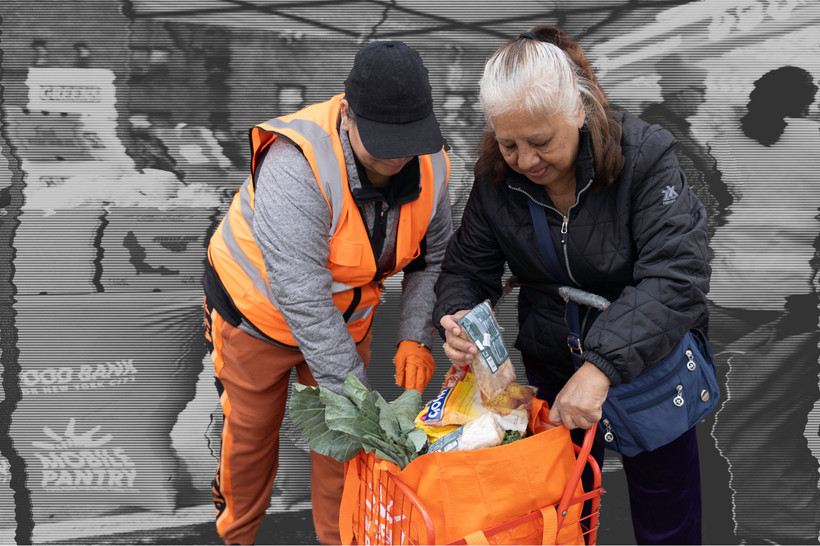
| Photo: Sai Mokhtari / Citybird Photo | Illustration: Leor Stylar

Sign up for Staying Focused, our newsletter keeping readers up to speed on New York politics.

A tiny storefront in Bensonhurst, Brooklyn, has been a lifeline for Marco Ramirez and his family of four.

Three years ago, the 56-year-old began visiting the food pantry operated by Reaching-Out Community Services after his hours as a restaurant cook were cut. Every two weeks, he stops by to select items from a computer kiosk and waits for staff to wheel out his order, free of charge.

On a recent Wednesday afternoon, Ramirez packed his bags with staples like rice, meat, cooking oil and juice. Without the pantry’s help, he said, his family wouldn’t be able to afford pricey items like eggs.

The pantry is part of a vast network supported by the Food Bank for New York City, which recently lost 75 tractor trailer loads of food — 2.5 million meals — due to cancelled shipments from the US Department of Agriculture following President Donald Trump’s abrupt cancellation of over $1 billion in nutrition funding in March.

“We’re the country’s largest USDA-supplied food bank, and anytime there’s a cut or a rollback or a pause, the impact to us is that much more exponential,” said president Leslie Gordon. The organization serves the New York City area, where a recent study estimated the poverty rate hit a new high of 25 percent.

For food banks across New York state, the state of emergency that began with the pandemic in 2020 never ended.

Already stretched thin from years of rising food costs and food insecurity, hunger relief organizations are now contending with a panoply of federal cuts and tariffs, which are expected to severely disrupt supply chains and further hike prices. Headlines about steep declines in port activity have renewed fears that shelves nationwide could go empty in a matter of weeks.

Trump’s cuts have derailed programs like the Local Food Purchase Assistance Cooperative Agreement Program (LFPA), which allowed food banks to purchase food from local farms, and the Emergency Food Assistance Program (TEFAP), which ships food directly to banks and helps cover operational costs. In recent years, the USDA has expanded TEFAP to meet increased demand from more Americans turning to pantries to stay afloat.

New York’s newly passed state budget provided little relief. For months, advocates had urged Governor Kathy Hochul to join the legislature in increasing funding for two state-run hunger programs as a way to cushion the blow of federal cuts.

But funding for both programs remained largely unchanged in the final deal released last week. Nourish New York will see a modest increase of $750,000 for a total of $55 million, while the Hunger Prevention and Nutrition Assistance Program will remain flat at $57.8 million. The legislature had proposed funding the programs at $75 million each.

In the wake of federal cuts, the Regional Food Bank will distribute 2 million less meals across 23 eastern New York counties, which span from just north of Westchester to the Canadian border — after opening a new 50,000-square-foot distribution center in Montgomery in December.

“These cuts mean families going hungry; kids, veterans, and seniors going hungry, and farmers going out of business,” said Congressman Pat Ryan after visiting the food bank last month.

“Trump needs to put country before politics, reverse these cuts immediately, and restore the food shipments to put money back in our farmers’ pockets and nutritious meals back on Hudson Valley families’ tables.”

Over 16 million pounds of food across the state will no longer be distributed due to federal cuts, according to Ryan Healy, advocacy manager of Feeding New York State, which represents 10 food banks across the state, including the ones interviewed for this story.

“Not only is the impact of these cuts felt by our food banks and community partners, it’s felt by the farmers and agricultural producers,” Healy said. In addition to USDA shipments, eight of the network’s food banks received LFPA funding, which has been a boon to local farms across the state.

“We had about a million pounds of food that were cancelled that we were expected to be distributing right about now,” said Ryan Brisk, vice president of operations and procurement at Feeding Westchester. “A million pounds is 25 tractor trailer loads of food.”

That particular shipment included what Brisk called the “most highly coveted items” sought by food pantry users, like fresh produce and frozen meat. TEFAP shipments have accounted for a quarter of the organization’s food supply.

In 2024, Feeding Westchester saw an average of 229,000 visits each month, including 80,000 children and 36,000 seniors. Many visits come from families where adults work multiple jobs, as well as veterans and seniors living on fixed incomes, Brisk said. That need has not tapered off since the onset of Covid-19: “It was the pandemic passing the torch to inflation.”

In Long Island’s Nassau and Suffolk counties, Island Harvest has doubled the amount of food it distributes since 2019. “The need for emergency food is greater now than it was during the pandemic,” said Gregory May, director of government and community relations. “The trends are really going in the wrong direction.”

Island Harvest relies heavily on donated food, which makes up roughly 75 percent of its stock. May worries whether those donations will continue as businesses feel the crunch of a tightening economy.

The situation could become even more grim if the federal government moves forward with cuts to the Supplemental Nutrition Assistance Program(SNAP), also known as food stamps, May said. Congressional Republicans are now considering a drastic overhaul of the program as a way to partially cover another round of Trump tax cuts for corporations and the wealthy.

“I don’t think a lot of people realize how connected they are to the emergency food system,” May said. “A cut to one program is really a cut to every program.”

Staff at FeedMore Western New York are still trying to make sense of how a variety of cuts — TEFAP, LFPA, and funding from the Federal Emergency Management Agency, which has also been paused — will impact their bottom line. Feedmore serves Erie, Niagara, Cattaraugus, and Chautauqua counties.

“We are being impacted in every way you can imagine by decisions being made by the federal government,” said public relations manager Catherine Shick.

Last year, the organization received nearly $15 million in federal support to operate its food bank network, provide SNAP outreach, deliver meals to the homebound, and supply community kitchens. FeedMore has increased the number of people it serves by 46 percent since 2021.

Tariffs add yet another “unknown” that FeedMore has to monitor, with some vendors warning of potential food price increases, Shick said.

Inflation was cited as a top affordability concern for Billi-Jo Mendez, a first-time pantry user in Brooklyn who was next in line to Ramirez on Wednesday.

“In all my years, I’ve never come to a pantry,” said Mendez, 52. “I came for extra help.”

Find Food Resources Near You:

Are you a New Yorker who receives public benefits? Fill out our survey to help us track programs across the state and monitor the impact of ongoing federal cuts. Or email our social services reporter, Jie Jenny Zou, at jenny@nysfocus.com.

Mendez said she and her husband have been making do on their own, but recently received custody of their three grandchildren. Her basket included sacks of apples and carrots, as well as cereal and baked chips for the kids. “It’s so sad,” Mendez said of federal cuts. “A lot of people are going to go hungry without assistance from a program like this.”

Gordon at Food Bank for New York City said it’s too soon to tell exactly what impact tariffs will have, but the the current situation is unlike past “rough patches.”

“There’s a lack of predictability that is causing things to be more upended than they have been before,” Gordon said. “We definitely have not seen this convergence of external factors to this degree, and all at once, impacting the good work we’re trying to do for people who need us.”

At New York Focus, our central mission is to help readers better understand how New York really works. If you think this article succeeded, please consider supporting our mission and making more stories like this one possible.

New York is an incongruous state. We’re home to fabulous wealth — if the state were a country, it would have the tenth largest economy in the world — but also the highest rate of wealth inequality. We’re among the most diverse – but also the most segregated. We passed the nation’s most ambitious climate law — but haven’t been meeting its deadlines and continue to subsidize industries hastening the climate crisis.

As New York’s only statewide nonprofit news publication, our journalism exists to help you make sense of these contradictions. Our work scrutinizes how power works in the state, unpacks who’s really calling the shots, and reveals how obscure decisions shape ordinary New Yorkers’ lives.

In the last two decades, the number of local news outlets in New York has been nearly slashed in half, allowing elected officials and powerful individuals to increasingly operate in the dark — with the average New Yorker none the wiser.

We’re on a mission to change that. Our work has already shown what can happen when those with power know that someone is watching, with stories that have prompted policy changes and spurred legislation. We have ambitious plans for the rest of the year and beyond, including tackling new beats and more hard-hitting stories — but we need your help to make them a reality.

If you’re able, please consider supporting our journalism with a one-time gift or a monthly gift. We can't do this work without you.

Thank you,

Akash Mehta
Editor-in-Chief
A photo of Akash Mehta.
A photo of Jie Jenny Zou.
Jie Jenny Zou covers social services and public benefits for New York Focus. She previously worked as an investigative reporter at the Los Angeles Times and the Center for Public Integrity where she delved into topics ranging from environmental health and worker safety… more
Also filed in New York State

A lobbyist who has been romantically linked to Assembly Speaker Carl Heastie led a rally opposing the legislation a week before the speaker declined to bring it to a vote.

In May, state lawmakers passed a $269 billion budget after haggling for months over thousands of line items and policies affecting New Yorkers.

Millions in outside spending was a boon to Gov. Kathy Hochul’s 2022 opponent, Lee Zeldin, and influenced down-ballot races.

Also filed in Social Services

New York state has pumped millions of taxpayer dollars into an online portal that vowed to make life easier for Rochester’s neediest, but critics say it’s fallen short.

We’ve compiled information for SNAP recipients in New York on the changing work requirements.

Despite last-ditch efforts by a coalition of lawmakers, the state failed to avert a health coverage cliff coming this summer.