AmeriCorps Cuts Leave New York Trails in Trouble

Some of downstate New York’s most used hiking trails are badly eroding. President Trump’s cuts have slashed the crews working to save them.

Sam Mellins   ·   December 11, 2025
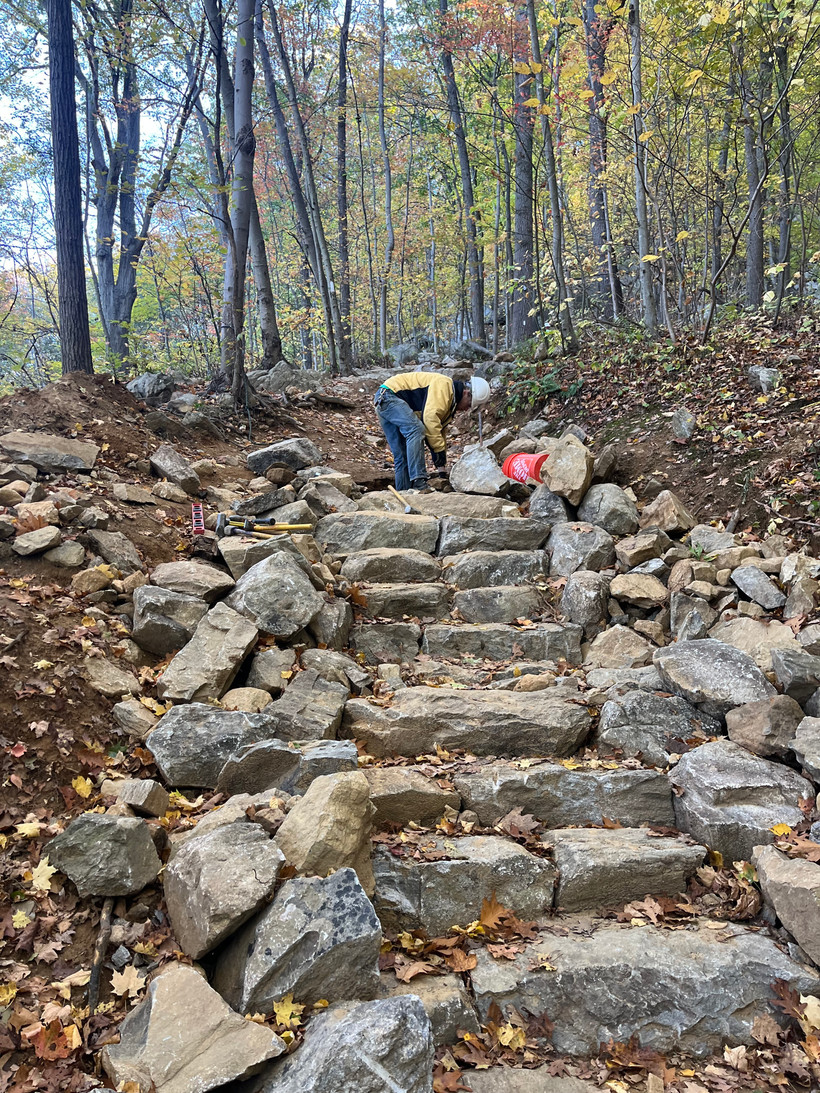
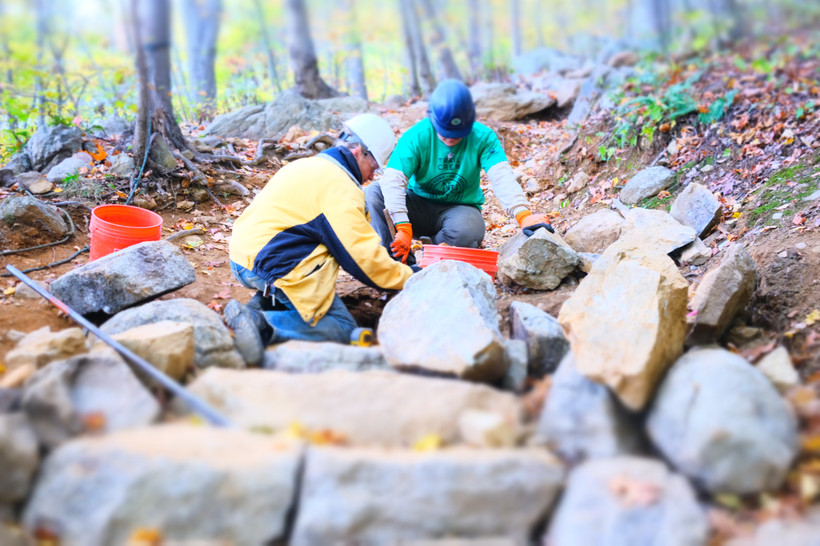
Two AmeriCorps members work on a stone staircase at Anthony’s Nose on Oct. 17, 2025. | Sam Mellins/New York Focus

Sign up for Staying Focused, our newsletter keeping readers up to speed on New York politics.

An hour’s train ride north of New York City, Anthony’s Nose looms over the Hudson River. Since the 1930s, the 900-foot peak has been part of Hudson Highlands State Park, which boasts many of downstate New York’s most beautiful vistas.

People come from all walks of life to hike to the peak. It’s an exercise spot for locals, a stop along the storied Appalachian trail for long-distance hikers, and prime leaf-peeping territory for city residents. Passersby on a Friday in October included a Spanish-speaking family and a group of Hasidic men.

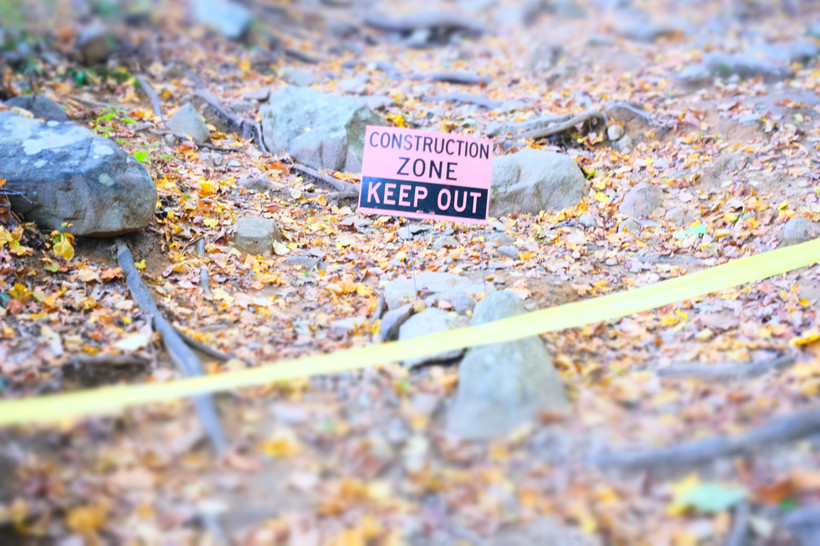
Due to its heavy use and naturally caused erosion, the path to Anthony’s Nose is crumbling. Caution tape and a “Keep Out” sign direct hikers to a detour around a stretch of trail that has almost completely washed out.

Members of AmeriCorps, the federal government’s national service agency for more than 30 years, have been fixing the trail under the direction of the nonprofit New York New-Jersey Trail Conference. AmeriCorps has worked with the Trail Conference since 2012, but due to President Donald Trump’s severe cuts to the program, they’ve accomplished far less this year than they had hoped — scaling back projects on Anthony’s Nose and other nearby trails, and curtailing plans for its invasive species management teams.

A sign directs hikers around a washed-out stretch of trailway at Anthony’s Nose on Oct. 17, 2025. | Sam Mellins/New York Focus


“We had already hired everybody. We had all the sites secured and the permissions from the parks,” said Hank Osborn, director of programs at the Trail Conference. “Then, all of a sudden, we had to hit stop.”

In April, the Trump administration, citing alleged fraud and waste, announced that it was cutting $400 million dollars from AmeriCorps’s budget, nearly half of the agency’s funding. The cuts affected over 30,000 corps members working on 1,000 different programs, and threatened projects across the country, from after-school programs in Alaska to storm recovery in North Carolina.

For the Trail Conference, the cuts meant eliminating 45 planned regional AmeriCorps positions. With private donations and state funding, the group was able to keep about half of those positions filled, rechristening the workers as a nonfederal Conservation Corps — though the Trail Conference is still about half a million dollars short of where it was at the beginning of the year.

That means fewer workers fixing the trails and fewer benefits for them. A $4,000 scholarship that was awarded to each Corps member had to be eliminated, among other cuts.

At Anthony’s Nose, the primary project for the remaining corps members is building a stone staircase into the side of the mountain where the trail has washed away. Though the section has been closed to hikers, its deterioration continues as rain and wind take their toll. The trail’s exposed tree roots are slowly dying and rotting, and when they go, so will the soil they’re holding in place. Massive rainfall in September 2023 carried away more tons of earth, causing further damage that still hasn’t been fixed.

A staircase along the trail at Anthony’s Nose is many yards short of where the conservation corps team hoped it would be by summer’s end, Oct. 17, 2025. | Sam Mellins/New York Focus


All around the trail, low-lying vegetation is beaten down, the result of hikers making their own paths to avoid the loose soil and stones of the official route. “Social trails,” as park workers call them, degrade the local environment and threaten the habitats of animals that live near them.

Building the staircase is hard work and requires skilled masonry. The stones are quarried a few dozen yards from the work site, moved to the trail with winches and pulleys, chiseled and hammered into shape, and individually fitted into the staircase, step by step. In theory, stone could be imported and brought to the trail with machines, but there isn’t funding for it.

So the work is slow going. By summer’s end, the small team had built about 10 steps — many yards short of where they were hoping to be by the end of the season. They’ll likely need to build several dozen more to replace the washed-out section of the trail and prevent further erosion. At this rate, it could take years.

An AmeriCorps-branded “Crew at work!” sign still hangs near the beginning of the trail.

“We couldn’t afford to replace the sign,” said Ben Sugar, a senior trail builder for the Trail Conference, looking somewhat rueful. “I may need to come and spray paint that out.”

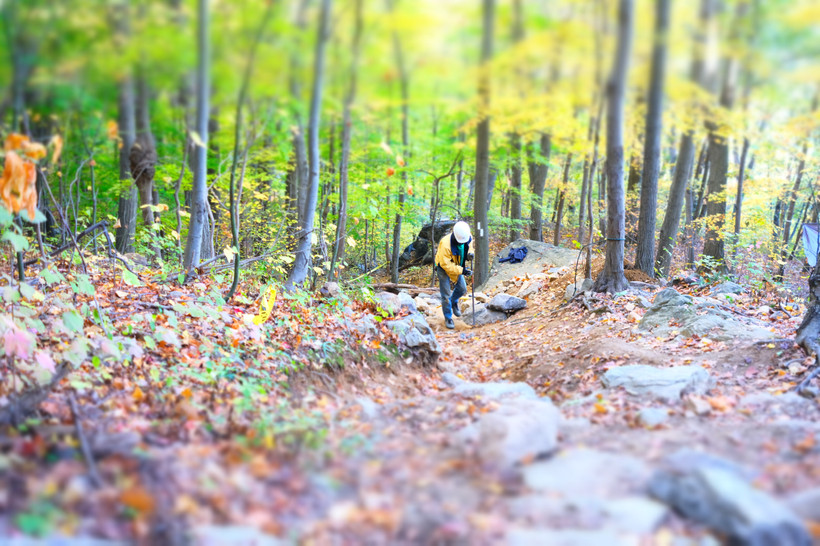
An AmeriCorps member works on a trail at Anthony's Nose on Oct. 17, 2025. | Sam Mellins/New York Focus


Anthony’s Nose isn’t the only site that’s feeling the strain from the federal cuts. In nearby Harriman State Park, upgrades were planned for a low-lying section of trail that turns into a swamp whenever rain falls. The trail is part of the Long Path, a hiking route running from New York City to near Albany. AmeriCorps crews were slated to quarry, cut, and place stepping stones, which would provide a way to traverse the path even in muddy conditions. But now that project has been postponed indefinitely.

Just over the New Jersey border, the Trail Conference maintains a boardwalk over the Pochuck Swamp. The National Park Service has historically supported that work, but with the agency facing severe cuts from the Trump administration, future funding is uncertain there, too.

At Anthony’s Nose, the work goes on. On an October Friday, as hikers looked on from the detour, a pair of gray-haired volunteers winched a stone into place, and a young Conservation Corps worker swung a sledgehammer over his head, shaping the stone one blow at a time.

“Even people who have been hiking all their lives think you just build a trail and that’s it,” said Zachary Cole, who organizes the Trail Conference’s work on the Appalachian Trail. “But it takes constant work.”

I hope this article helped you better answer the question that guides all of our journalism: Who runs New York? Before you click away, please consider supporting our work and making more stories like this one possible.

New York state is standing at a crossroads for climate action. After passing one of the nation’s most ambitious climate laws in 2019, the state is lagging far behind on its targets, struggling to meet deadlines to build renewable energy and clean up its buildings and roads. Other states are closely watching our progress, making decisions about their own climate plans based on New York’s ability to implement this legislation.

As New York’s only statewide nonprofit news publication, we’ve been scrutinizing the state’s climate progress. Our journalism exists to unpack how power works in New York, analyze who’s really calling the shots, and reveal how obscure decisions shape ordinary New Yorkers’ lives.

But we can't do this work without your help. We rely on reader donations to help sustain our outlet, and every gift directly allows us to publish more pieces like this.

Our work has already shown what can happen when those with power know that someone is watching, with my reporting prompting a state investigation and fine for a major corporation. I have more story ideas than I can count, but only limited resources to pursue all the leads that come across my desk.

If you’re able, please consider supporting our journalism with a one-time or monthly gift. Even small donations make a big difference.

Thank you for reading.

Colin Kinniburgh
Climate and Environmental Politics Reporter
A photo of Colin Kinniburgh.
A photo of Sam Mellins.
Sam Mellins is senior reporter at New York Focus, which he has been a part of since launch day. His reporting has also appeared in The San Francisco Chronicle, The Intercept, THE CITY, and The Nation. Reach him on Signal: mellins.613
Also filed in New York State

State leaders are expected to pass a bill that avoids resolving how much Resorts World New York City needs to pay.

New York state has pumped millions of taxpayer dollars into an online portal that vowed to make life easier for Rochester’s neediest, but critics say it’s fallen short.

Resorts World is floating legislation to avert more than $500 million in payments to the horseracing industry.

Also filed in Budget

Our searchable database breaks down the most consequential decisions Albany politicians made on climate, immigration, housing, schools, taxes, and more.

It’s unclear whether the Correctional Association of New York will have to scale back its nascent reform initiatives.

Advocates welcomed the additional funding but said it falls short of need and doesn’t do enough to support workers.

Also filed in Climate and Environment

Governor Kathy Hochul was successful in her bid to upend the Climate Leadership and Community Protection Act after legislators caved to finalize an overall budget deal.

The leader of Reinvent Albany discusses a data center subsidy in Rockland County that flew under the radar for years.

No other project in the country has gotten such a large subsidy to create so few jobs, according to watchdogs.