New York Counties Have Received Millions From Opioid Lawsuits, But Many Won’t Say How They’ve Spent It

Drug policy advocates are calling a new reporting mandate a missed opportunity for needed transparency and sustained action.

Jie Jenny Zou   ·   January 5, 2026
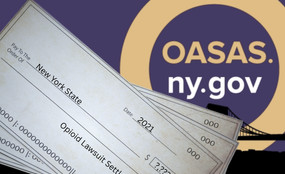
How New York state counties have spent opioid settlement funds remains a mystery in many cases. | Logo: OASAS; Check: Billion Photos | Illustration: Leor Stylar

Sign up for Staying Focused, our newsletter keeping readers up to speed on New York politics.

Tasers, virtual reality headsets, and a baby shower. These are just some of the ways New York counties spent their share of opioid settlement dollars this past year.

Over the past four years, counties have received over $330 million from legal settlements with pharmaceutical companies for their role in fueling the opioid crisis. But how counties have spent that money remains in many cases a mystery, despite a new mandate aimed at improving transparency.

Some counties don’t appear to have posted spending disclosures at all, despite a state requirement to do so that took effect in November.

At least 46 counties have posted disclosures. Some, like Seneca County, provided detailed breakdowns. Others reported only broad categories of spending. Onondaga County, home to Syracuse, reported spending over $1.4 million in 2024 across five spending areas, such as “treatment” and “special populations.” It didn’t provide further information, like who the money went to or for what programs.

“It really tells you nothing about where the money is going,” said Aliya-Begum Jessa, a policy research associate at Legal Action Center, a public health advocacy group. The money received by counties, in what are known as direct share allocations, is separate from other opioid settlement dollars overseen by the state’s Office of Addiction Services and Supports.

At least five counties reported spending $0 over the past year, including areas hard hit by overdoses just a few years ago, like Warren and Delaware counties. 

Last month, Jessa combed through each county’s website until she came across a webpage or document that looked like it might relate to the new reporting mandate. She shared her findings with New York Focus, which also conducted its own review.

The state mandate is vague. It requires local governments to annually post online “information regarding how such funding was utilized,” but doesn’t specify what information must be disclosed.

In an email, an OASAS spokesperson said the agency is planning to post a webpage containing links to available county reports by mid-January, but that it has no plans to review the submissions. “Our role is to collect and share information,” the spokesperson wrote. “We do not analyze spending or oversee the content of these reports.”

The spokesperson declined to comment on what steps the agency is taking to ensure counties comply with the reporting mandate.

In a November report, the Drug Policy Alliance urged the state for “measurable” standardized reporting, along with better planning to ensure local and state efforts don’t duplicate each other. “There is currently no coordinated, measurable state plan to reduce overdose deaths where the crisis is most severe,” the report noted.

Christine Khaikin, senior health policy attorney at Legal Action Center, is worried the lackluster spending and reporting could be a sign of waning urgency around the opioid crisis.

“There’s probably a sense that ‘We solved it,’ because rates have gone down a little bit,” she said of the state’s overall decrease in overdoses and deaths, particularly for white New Yorkers. “They’re still astronomically high and not going down for Indigenous communities and Black communities. … It’s still a crisis.”

When counties have reported more information, the disclosures have raised potential red flags.

Jessa commended Albany County for posting a detailed disclosure, but highlighted one line item: $6,165 for virtual reality headsets at Albany Medical College. Virtual reality therapy is being researched as an alternative to opioids for pain management, but has yet to yield solid evidence of effectiveness.

While settlement funds are intended to support communities battling addiction, much of the dollars that counties receive are unrestricted, allowing more general spending. In Essex County, expenditures included evidence-based treatment directly related to drug use, but also more general public health initiatives for infants such as a community baby shower.

In Sullivan County, almost 75 percent of the nearly $350,000 that officials spent from July 2024 to June 2025 went towards public service announcements, school-based prevention programs including an anti-vaping campaign, and various law enforcement line items such as surveillance cameras and $37,000 worth of taser guns.

“That’s really got nothing to do with serving the people who are impacted and struggling with overdose,” Khaikin said of the law enforcement line items. “It’s really bolstering the police department.”

“That’s really got nothing to do with serving the people who are impacted and struggling with overdose. It’s really bolstering the police department.”

—Christine Khaikin, Legal Action Center

Clinical support, previously the county’s single largest spending category, won’t be renewed in the upcoming year; the county will draw on other state funds for treatment programs, such as a new detox center. Nearly $1.7 million in settlement funds sits idle in the county’s coffers. 

Public service announcements and anti-drug campaigns at schools have been shown to have mixed results at best when it comes to deterring drug use.

In an email, Sullivan County’s health and human services commissioner John Liddle justified the spending as an “all of the above” approach that reflects the county’s continuing progress on reducing overdoses. Overdose deaths in the county have fallen to a fraction of 2022 levels, when it topped the state for most overdose deaths per capita.

Responding to advocates’ concerns over unspent funds, Liddle said the county has a long-term strategy. “We are shaping our expenditures so that funding will last long enough to support 5–10 additional years’ worth of effort on this issue,” he wrote.

Some counties did prioritize the types of programs advocates say deliver solid results. In Madison County, nearly $1 million has bolstered housing support and naloxone distribution. 

Funds went towards affordable mobile home units for six families struggling with addiction, the construction of four tiny homes as future transitional housing units, and a pot of money for repairs to compensate landlords who rent to tenants considered high-risk by the county. Naloxone distribution included the installation of 73 kits in public areas, as well as a staffer working full-time on naloxone training across the county. 


In the coming years, more settlement funds will pour into counties’ coffers. Without active oversight from OASAS, Khaikin said it’s unclear what role, if any, the Attorney General will play in ensuring these funds are spent properly.

The Attorney General’s office said it wouldn’t rule out the possibility of taking oversight actions in the future, but referred questions about county funds to OASAS.

“They went through a lot of trouble to get this money,” Khaikin said of the Attorney General’s settlements with drugmakers. “I hope we’re not the only people reading these [disclosures].”

At New York Focus, our central mission is to help readers better understand how New York really works. If you think this article succeeded, please consider supporting our mission and making more stories like this one possible.

New York is an incongruous state. We’re home to fabulous wealth — if the state were a country, it would have the tenth largest economy in the world — but also the highest rate of wealth inequality. We’re among the most diverse – but also the most segregated. We passed the nation’s most ambitious climate law — but haven’t been meeting its deadlines and continue to subsidize industries hastening the climate crisis.

As New York’s only statewide nonprofit news publication, our journalism exists to help you make sense of these contradictions. Our work scrutinizes how power works in the state, unpacks who’s really calling the shots, and reveals how obscure decisions shape ordinary New Yorkers’ lives.

In the last two decades, the number of local news outlets in New York has been nearly slashed in half, allowing elected officials and powerful individuals to increasingly operate in the dark — with the average New Yorker none the wiser.

We’re on a mission to change that. Our work has already shown what can happen when those with power know that someone is watching, with stories that have prompted policy changes and spurred legislation. We have ambitious plans for the rest of the year and beyond, including tackling new beats and more hard-hitting stories — but we need your help to make them a reality.

If you’re able, please consider supporting our journalism with a one-time gift or a monthly gift. We can't do this work without you.

Thank you,

Akash Mehta
Editor-in-Chief
A photo of Akash Mehta.
A photo of Jie Jenny Zou.
Jie Jenny Zou covers social services and public benefits for New York Focus. She previously worked as an investigative reporter at the Los Angeles Times and the Center for Public Integrity where she delved into topics ranging from environmental health and worker safety… more
Also filed in New York State

The legislation would make it easier for currently and formerly incarcerated people and child victims to sue the state over allegations of past abuse.

State leaders are expected to pass a bill that avoids resolving how much Resorts World New York City needs to pay.

New York state has pumped millions of taxpayer dollars into an online portal that vowed to make life easier for Rochester’s neediest, but critics say it’s fallen short.

Also filed in Health

Despite last-ditch efforts by a coalition of lawmakers, the state failed to avert a health coverage cliff coming this summer.

160,000 injured New Yorkers seek workers’ compensation each year — but in recent years, regulators have tilted the scales towards employers and insurers.

Amid abortion bans and rising digital surveillance, Albany lawmakers are revisiting an effort to stop companies from selling sensitive health information.

Also filed in Housing

Some of the city’s new aid will be canceled out by pension boosts.

A law designed to protect the environment will be partially rolled back to pave the way for much-needed homes.

After a New York Focus investigation, a Bronx charity distributed nearly $400,000 to survivors of a deadly 2022 fire.

Also filed in Social Services

We’ve compiled information for SNAP recipients in New York on the changing work requirements.

The Hochul administration now has a chance to relax New York’s child care staffing ratios — among the country’s strictest — after 26 years. But will it?

New rules could result in thousands of New Yorkers losing their food benefits this summer.