How New York’s Court System Intertwines With Party Politics

A foreclosure case in Brooklyn highlights ties between the courts and political party clubhouses.

Chris Bragg   ·   February 6, 2026
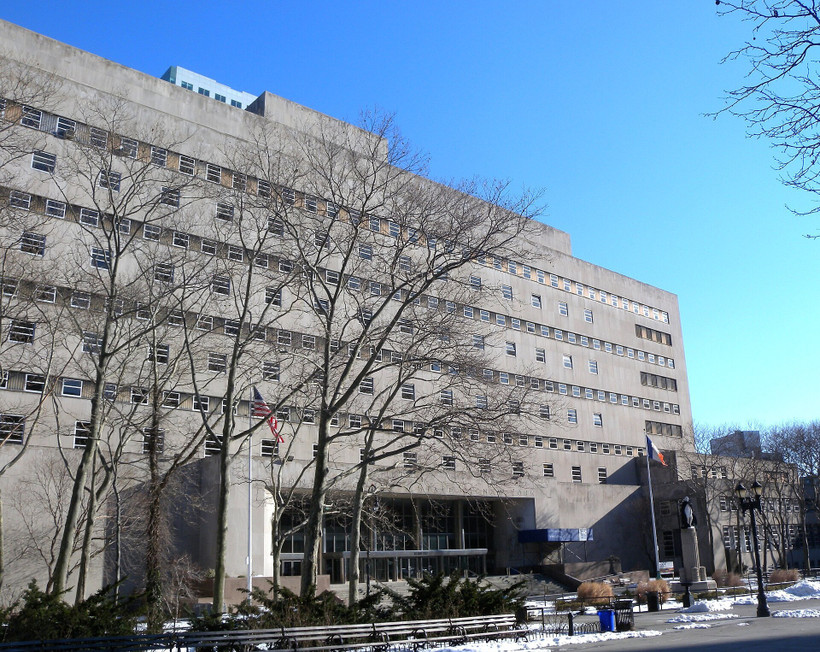
The Kings County Supreme Courthouse was the site of a foreclosure case featuring connections between the judge, court referee, and lawyers on both sides. | Beth Wilson/Flickr

Sign up for Staying Focused, our newsletter keeping readers up to speed on New York politics.

On Thursday, New York Focus reported on a Brooklyn foreclosure auction that ended with Emigrant Bank acquiring a Windsor Terrace home for $100 after an allegedly inflated minimum bidding price may have chilled the bidding.

The homeowner’s lawyer, Ravi Batra, filed a motion contesting the auction result. The motion was denied by Brooklyn’s former longtime chief administrative judge, Lawrence Knipel — whose ruling was premised on the false notion that the home had sold for $1.7 million.

Records show that a number of major players in the case — the judge, court referee, and bank’s law firm — had ties to the local political machine, and to each other. No government agency has accused them of wrongdoing related to the case, and Knipel believes the result will be upheld on appeal. But such connections may color litigants’ perceptions of whether justice is being carried out impartially.

“New York City’s court system is intertwined with the kind of party politics that should not exist in courthouses,” said Ben Weinberg, director of public policy at the government reform group Citizens Union.

Late last year, Knipel retired from the bench. His retirement party was a reminder of his ties to a political party responsible for making him a judge. According to the Brooklyn Daily Eagle, the event was “officiated” by the former longtime chairman of the Brooklyn Democratic Party, Frank Seddio — and organized, in part, by Michael D. Benjamin, a longtime party regular.

A year earlier, in his capacity as Knipel’s hand-picked court referee, Benjamin had conducted the bidding in the Emigrant case where the price was allegedly inflated. Benjamin declined to answer questions about how closely he scrutinized interest calculation documents submitted to him by Emigrant’s attorney before signing off, or about his ties to Knipel.

New York’s court system has long had a patronage problem. In New York City’s heavily Democratic boroughs, county political party machines play a decisive role in determining which state Supreme Court judges are elected. In turn, judges often appoint people associated with county political parties to serve as court referees charged with double-checking lenders’ interest calculations in foreclosure cases, along with other paying, court-appointed roles. The result, critics of the system argue, is that case appointments are based on connections, not competence.

Benjamin is a veteran officer of Brooklyn’s long-influential Thomas Jefferson Democratic Club. Soon after graduating from law school in 1977, he began landing a series of jobs in the state
legislature, spanning much of the past five decades, primarily for Brooklyn lawmakers.

Benjamin, an attorney, was disbarred in 1994 over 15 charges of professional misconduct, mostly related to a lack of diligence on behalf of clients. (Benjamin has said that he’d suffered from a debilitating addiction to marijuana.) Yet the disbarment did not curb Benjamin’s ability to land local government jobs.

In 2002, while working part-time for the state legislature, Benjamin began simultaneously holding a second job — this one full-time — working for a Brooklyn city councilmember long associated with the same political club. In 2007, he was hired by the Council speaker —- a job the councilmember later implied was offered as a “favor” to him.

In 2015, Benjamin successfully sought the reinstatement of his law license in New York. He has since landed hundreds of appointments from Knipel to serve as a court referee, charged with ensuring funds from foreclosure sales are properly distributed.

For more than three decades, Judge Knipel’s wife, Lori Knipel, had served as a district leader in the Brooklyn Democratic Party and led a different Brooklyn Democratic political club. Lori Knipel long controlled a campaign account associated with the club, to which Benjamin and family members have donated $2,850. Since 2010, Benjamin has received far more court referee appointments from Judge Knipel — 301 — than any other person.

Emigrant’s law firm, Borchert & LaSpina, has its own connections to the Brooklyn Democrats: One former partner was the longtime party attorney, while another former partner is the party’s recent law chair. Meanwhile, the firm’s Helmut Borchert, Gregory LaSpina, and the firm itself have donated a combined $9,200 to the campaign account controlled by Lori Knipel.

Even as Borchert & LaSpina represents banks before Knipel, the judge has appointed Borchert to serve as a neutral court referee 135 times, making Borchert the judge’s second most frequent appointee since 2010. LaSpina has received 59.

The attorney representing the foreclosed homeowner in the Emigrant case has had close ties to the Brooklyn Democrats himself. Those ties were scrutinized by The New York Times in 2003. Decades ago, Ravi Batra took himself off the list of those eligible to receive court appointments. He donated $2,000 to Lori Knipel’s campaign fund in 2002 and has since donated a total of $600, according to state records.

Judge Knipel said his approach to making judicial appointments was “not political.”

To take a “stranger’s name off the [appointment] list that you don’t know — that you’ve never heard of — I don’t think anybody really does that,” Knipel told New York Focus. “I’ve appointed many, many people who I know for a fact have nothing to do with politics, or they’re involved in Republican politics.” Knipel noted the Brooklyn Democratic Party has factions, and that his wife’s political club had long been at odds with Benjamin’s.

Knipel said he doesn’t “know or care about the people who contributed to any campaign committees.”

State election law bars spending campaign dollars strictly for the candidate’s personal benefit, and Lori Knipel has recently faced media questions about her campaign spending.

Between 2022 and 2023, for instance, the account controlled by Lori Knipel reported 14 transactions totaling over $1,700 at a hotel in Pennsylvania and spent $1,600 more at the hotel restaurant. She did not respond to New York Focus’s questions about how these expenses related to being a Brooklyn political party official.

As first reported by the New York Post, even after retiring as a district leader last year, Lori Knipel continued spending thousands in campaign funds on expenses ranging from meals at restaurants to multiple cell phone plans.

Lori Knipel told the Post that some of the Pennsylvania meals were with members of her political club in Brooklyn, but reportedly refused to offer names. She reportedly stated that any spending was related to the Brooklyn political club and incurred by “either myself or somebody else in the club.”

Correction 2/7: A photo of Brooklyn Borough Hall was replaced with a photo of the Kings County Supreme Court. A description of when attorney Ravi Batra  removed himself from a list of people eligible to receive court appointments was clarified.

At New York Focus, our central mission is to help readers better understand how New York really works. If you think this article succeeded, please consider supporting our mission and making more stories like this one possible.

New York is an incongruous state. We’re home to fabulous wealth — if the state were a country, it would have the tenth largest economy in the world — but also the highest rate of wealth inequality. We’re among the most diverse – but also the most segregated. We passed the nation’s most ambitious climate law — but haven’t been meeting its deadlines and continue to subsidize industries hastening the climate crisis.

As New York’s only statewide nonprofit news publication, our journalism exists to help you make sense of these contradictions. Our work scrutinizes how power works in the state, unpacks who’s really calling the shots, and reveals how obscure decisions shape ordinary New Yorkers’ lives.

In the last two decades, the number of local news outlets in New York has been nearly slashed in half, allowing elected officials and powerful individuals to increasingly operate in the dark — with the average New Yorker none the wiser.

We’re on a mission to change that. Our work has already shown what can happen when those with power know that someone is watching, with stories that have prompted policy changes and spurred legislation. We have ambitious plans for the rest of the year and beyond, including tackling new beats and more hard-hitting stories — but we need your help to make them a reality.

If you’re able, please consider supporting our journalism with a one-time gift or a monthly gift. We can't do this work without you.

Thank you,

Akash Mehta
Editor-in-Chief
A photo of Akash Mehta.
A photo of Chris Bragg.
Chris Bragg is the Albany bureau chief at New York Focus. He has done investigative reporting on New York government and politics since 2009, most recently at The Buffalo News and Albany Times Union.
Also filed in New York State

A lobbyist who has been romantically linked to Assembly Speaker Carl Heastie led a rally opposing the legislation a week before the speaker declined to bring it to a vote.

In May, state lawmakers passed a $269 billion budget after haggling for months over thousands of line items and policies affecting New Yorkers.

Millions in outside spending was a boon to Gov. Kathy Hochul’s 2022 opponent, Lee Zeldin, and influenced down-ballot races.

Also filed in New York City

Resorts World is floating legislation to avert more than $500 million in payments to the horseracing industry.

Some of the city’s new aid will be canceled out by pension boosts.

The Department of Justice has terminated more than 100 immigration judges since last year as it has pressured courts to order more deportations.