Mamdani’s Small Business Czar Wants Economic Justice for Workers

As Small Business Services commissioner, Kenny Minaya will be charged with slashing fees and helping street vendors.

Nick Garber   ·   March 2, 2026
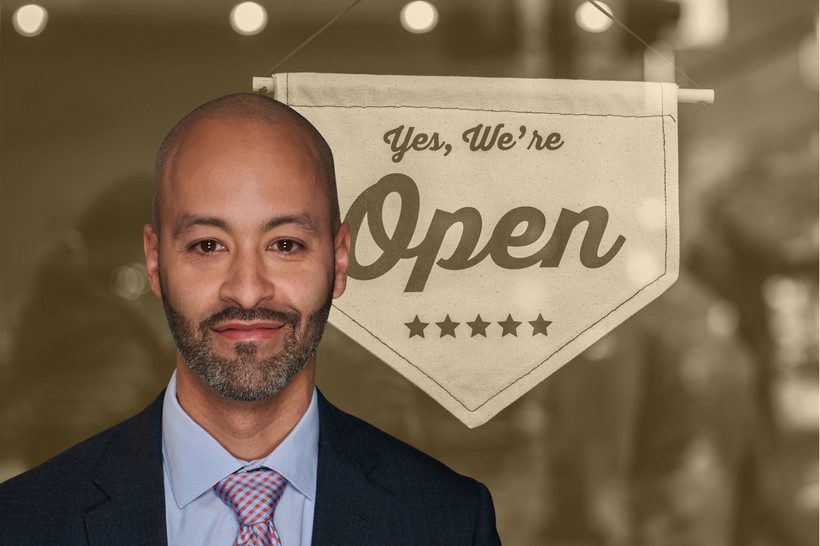
Mayor Zohran Mamdani will appoint Kenny Minaya as commissioner of the Department of Small Business Services on Monday. | Photos: NYC Mayor's Office; Tim Mossholder/Pexels | Illustration: New York Focus

Sign up for Staying Focused, our newsletter keeping readers up to speed on New York politics.

The Reporter’s Notebook features bite-sized stories and updates from New York Focus reporters on the topics they cover.

New York City Mayor Zohran Mamdani will appoint Kenny Minaya, a lawyer and longtime city official, as commissioner of the Department of Small Business Services on Monday, New York Focus has learned. 

With a roughly $140 million budget, the 300-person agency gives out grants to small businesses, helps them navigate the city bureaucracy, and oversees the city’s 78 business improvement districts — nonprofits that charge fees to businesses and landlords in certain neighborhoods in exchange for security and sanitation services.

SBS isn’t the highest profile agency, but it will be key to Mamdani’s pledge to reduce fines and fees on small businesses by 50 percent. In a January executive order, Mamdani charged SBS with finding ways to streamline the city’s permitting processes by mid-March. He’s hardly the first mayor to embark on such an effort, but he’s made it especially central to his agenda.

Much of that work will fall to Minaya, who was most recently first deputy commissioner at the Department of Consumer and Worker Protection. A graduate of the City College of New York and the CUNY School of Law, Minaya began his career as a housing attorney and joined DCWP in 2016. He spent the ensuing decade at DCWP, except for a six-month stint at the immigrants’ and workers’ rights nonprofit Make the Road, where he was head of government affairs in 2022.

Minaya said he plans to take a “whole-of-government approach” to make it easier to start and grow small businesses in the city.

“Small businesses are key to creating thriving communities, and everything we do at SBS should have that as a focal point,” he told New York Focus.

There are signs that Mamdani’s SBS will put more emphasis on workers. In a notable early shift, Mamdani put the department and several others under the portfolio of Julie Su, the newly created deputy mayor for economic justice. Under previous mayors, SBS reported to the deputy mayor for housing and economic development, a position that Mamdani has dismantled as he pursues a pro-worker agenda.

“When we talk about the smallest businesses in New York and all small businesses, a lot of the folks that own those businesses are workers themselves,” Minaya said. “It was very intentional to name the economic justice portfolio, and to include SBS within that portfolio, because small businesses are not excluded from an economic justice message.”

That shift has sparked concern among some of the city’s corporate titans, who worry that Mamdani will abandon the familiar playbook of tax breaks and incentives aimed at encouraging growth in favor of more stringent regulations to guarantee workers’ rights. Minaya suggested those concerns are misplaced.

“I think the recent executive order issued by the mayor suggests that’s not the approach,” he said. “That we’re really looking to see how government can not be a hindrance, but be a help to small businesses.”

Also on Minaya’s to-do list: Implementing the major reforms to the city’s street vending system that will take effect in the coming months, thanks to a set of bills approved by the City Council in January despite former Mayor Eric Adams’ initial vetoes. One bill will significantly expand licenses for both food and merchandise vendors, and charges SBS with training vendors on how to comply with the law. Another bill taking effect in July will create a new Division of Street Vendor Assistance within the department.

Mamdani also campaigned on creating a “mom-and-pop czar” to serve the smallest businesses. The mayor plans to appoint another person to that role, City Hall spokesperson Cassio Mendoza said.

Mamdani said in a statement that small businesses are the city’s “lifeblood.”

“They’re where working people build dreams — and for too long, City Hall has made that harder than it needs to be, burying storefronts in red tape while corporate chains get the fast lane. That ends now,” Mamdani said. “With Kenny Minaya as Commissioner of Small Business Services, we’ll cut the bureaucracy and make it easier to start and run a small business.”

The city’s street vendors are overwhelmingly foreign-born, and about half of the city’s business owners are immigrants. Mamdani has made those New Yorkers central to his coalition — filming a memorable early campaign video in which he argued that the broken street-vending system had forced halal carts to raise their prices, a phenomenon he dubbed “halalflation.” 

In addition to his stint at Make the Road, Minaya has worked as a housing attorney at the nonprofit Catholic Migration Services. His parents, who emigrated from the Dominican Republic, have owned and operated a bakery in Inwood for 42 years. Growing up, Minaya got an early education in city bureaucracy as he helped his parents hire expediters to secure licenses or defend themselves against the occasional summons.

“These are cost drivers for small businesses,” he said. “And the affordability agenda applies to them as well.”

At New York Focus, our central mission is to help readers better understand how New York really works. If you think this article succeeded, please consider supporting our mission and making more stories like this one possible.

New York is an incongruous state. We’re home to fabulous wealth — if the state were a country, it would have the tenth largest economy in the world — but also the highest rate of wealth inequality. We’re among the most diverse – but also the most segregated. We passed the nation’s most ambitious climate law — but haven’t been meeting its deadlines and continue to subsidize industries hastening the climate crisis.

As New York’s only statewide nonprofit news publication, our journalism exists to help you make sense of these contradictions. Our work scrutinizes how power works in the state, unpacks who’s really calling the shots, and reveals how obscure decisions shape ordinary New Yorkers’ lives.

In the last two decades, the number of local news outlets in New York has been nearly slashed in half, allowing elected officials and powerful individuals to increasingly operate in the dark — with the average New Yorker none the wiser.

We’re on a mission to change that. Our work has already shown what can happen when those with power know that someone is watching, with stories that have prompted policy changes and spurred legislation. We have ambitious plans for the rest of the year and beyond, including tackling new beats and more hard-hitting stories — but we need your help to make them a reality.

If you’re able, please consider supporting our journalism with a one-time gift or a monthly gift. We can't do this work without you.

Thank you,

Akash Mehta
Editor-in-Chief
A photo of Akash Mehta.
A photo of Nick Garber.
Nick Garber covers politics for New York Focus. He previously worked for Crain’s New York Business, where he covered city and state government, housing and real estate, and money in politics. He also covered neighborhood news in Manhattan and Queens for Patch, and got… more
Also filed in New York City

The citizens assembly model, used for public decision-making around the world, is gaining traction in New York.

Resorts World is floating legislation to avert more than $500 million in payments to the horseracing industry.

Some of the city’s new aid will be canceled out by pension boosts.

Also filed in Affordability

In May, state lawmakers passed a $269 billion budget after haggling for months over thousands of line items and policies affecting New Yorkers.

We’ve compiled information for SNAP recipients in New York on the changing work requirements.

Despite last-ditch efforts by a coalition of lawmakers, the state failed to avert a health coverage cliff coming this summer.