New York City Had a Chance to Ease Its Staffing Crisis. It Quietly Gave Up.

Civil service exams can slow down government hiring by months or even years. New York City is one of the only areas of the state that hasn’t opted into a program to bypass the process.

Nick Garber   ·   February 11, 2026
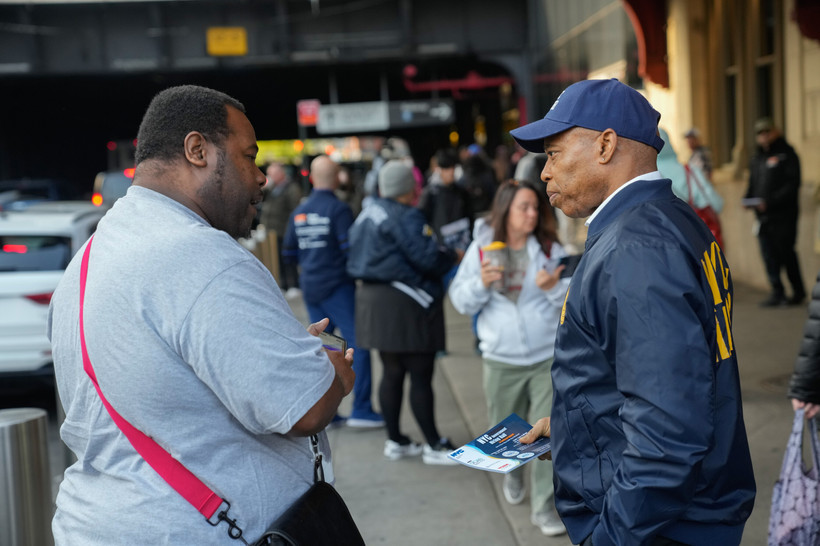
Eric Adams hands out fliers for a hiring hall in Queens on Thursday April 27, 2023. | Michael Appleton/Mayoral Photography Office
  • New York City’s civil service exam ​p​rocess adds months or years to government hiring, and ​could constrain Mayor Zohran Mamdani’s ​ability to r​ebuild staffing ​at key agencies.
  • Much of the rest of ​t​he state has sidestepped that bottleneck by using NY HELPS, a state program that lets agencies fill many positions without exams.
  • Mayor Eric Adams briefly tried to bring the city into the program​. ​Unions blocked the move​, arguing it would open the door to patronage and discrimination.

Sign up for Staying Focused, our newsletter keeping readers up to speed on New York politics.

A program making it easier to hire government workers has helped fill more than 50,000 jobs across New York state. But Mayor Eric Adams’s administration quietly abandoned a brief attempt to join the program in the face of union opposition — leaving a raft of vacancies in New York City government that now threatens to hobble the agenda of Mayor Zohran Mamdani.

In 2023, reeling from an exodus of public sector workers, Governor Kathy Hochul took a radical step: allowing state agencies to hire many employees without undergoing the many-months-long civil service exam process. The following year, her administration allowed local governments to opt into the emergency effort, called NY HELPS, and the vast majority of counties took her up on it.

New York City tried to opt in, too. It was a prime candidate: Vacancies in the city’s 300,000-person government have hovered around 4.5 percent since 2024 — more than double the pre-pandemic level. Agencies have reported that a lack of staff has prevented them from inspecting housing and restaurants, administering public benefits, upholding environmental standards, and more.

In September 2024, under then-Mayor Eric Adams, the city proposed a list of 51 different job titles it wanted to exempt from exam rules under NY HELPS, corresponding to hundreds of government jobs. The list was diverse, including everything from electricians and X-ray technicians to building inspectors and school-lunch supervisors.

Have experience with government hiring in New York?

We’re reporting on staffing issues in New York state and local government. If you’re a public employee, hiring manager, or job applicant with a story to tell, we’d like to hear from you. Email reporter Nick Garber at nick@nysfocus.com or message him on the Signal messaging app at @garber.01.

But the proposal was nipped in the bud thanks to resistance from organized labor, which argued that the program could let unqualified hires sneak in through nepotism or by lying on their resumes, and be unfair to existing government workers who were hired under the old system. Weeks after the proposal, a slew of city unions sued the city to block NY HELPS.

“The system they were proposing — although it has some merits — the downside is, what about the individuals that studied for years to take these exams?” said Joseph Colangelo, president of the auto workers’ union Local 246, which signed onto the lawsuit along with powerhouse unions DC37, the United Federation of Teachers, and Teamsters Local 237. “The beauty of the system is it gives everyone an equal opportunity for employment.”

The city relented quickly. Less than a month after the suit was filed, in November 2024, the city told the unions it “would no longer proceed with its proposal,” according to a court filing by the unions. Citing that promise, the unions dropped their suit in January 2025. The case and its resolution received little public notice at the time.

The agreement doesn’t legally bar Mamdani from taking another look at NY HELPS, which is set to expire in June. It’s far from certain that he will, given his close political ties to DC37 and other unions. But persistent short-staffing could severely impede his agenda. The city’s Housing Preservation and Development department, which would be charged with financing the 200,000 affordable homes that Mamdani wants to build in a decade, has a whopping 13 percent vacancy rate that has slowed project reviews and made it more expensive to build, experts say.

Other short-staffed agencies include the Department of Buildings, which will play a key role in the coming years implementing policies like the carbon-emissions law Local Law 97, which Mamdani strongly supports. The Department of Social Services, which administers benefits to the low-income New Yorkers at the center of Mamdani’s affordability agenda, has come under severe strain as it copes with a 12 percent vacancy rate, or more than 1,500 positions, New York Focus and THE CITY reported in December.

Even the agency that oversees hiring is short-staffed. The Department of Citywide Administrative Services, which administers and scores the city’s civil service exams, is nearly 17 percent vacant.

“It shouldn’t take more than 18 months from the time you take a civil service exam to receiving a start date or getting a promotion. But that’s what happens essentially every single time,” City Council member Lincoln Restler said during a 2024 hearing on the city’s vacancy crisis. “This is not how hiring should work in the 21st century.”

Mamdani’s top aides have acknowledged the need to speed up hiring — especially after his transition received an influx of more than 70,000 resumes from would-be government workers following his November victory.

“How you hire, how we speed that up, how we make sure agencies are delivering services where they haven’t been allowed to hire up — those are all things that we need to do immediately,” Mamdani’s First Deputy Mayor Dean Fuleihan told reporters at a December event.

Asked whether the new administration would be open to changing civil-service rules, Fuleihan said he was “willing to have conversations with everyone, including union partners, about how we improve the system.”

Reached for comment, the mayor’s office deferred to the Department of Citywide Administrative Services, which acknowledged Adams’ decision to drop NY HELPS but did not address whether Mamdani might revisit it.

“Part of our mission is to ensure that city agencies have pools of qualified candidates to serve vital roles—we are always open to exploring new avenues to meet recruitment needs,” DCAS spokesperson Dan Kastanis said in a statement. “After meetings and discussions about the proposal, we ultimately decided not to continue pursuing the NY HELPS program.”

As of last month, state agencies had hired 38,362 workers through NY HELPS — equal to more than 20 percent of the state’s current workforce, though not all are necessarily still employed. City and county governments had hired another 14,295 people. Fifty-two of the 57 counties outside the city opted in, as have cities including Albany, Rochester, Troy, Kingston, and Ithaca.

“It’s helped out tremendously with titles that we just had such a difficulty filling,” said Michael Lalli, Director of Operations of Albany County, which has made about 1,500 hires through the program.

“You had this red tape bureaucratic process of getting people to sign up for an exam, wait a couple weeks [or] months, take the exam, wait a few more months, get their score,” Lalli said. “And it turned it basically into, ‘hey, do you meet the minimum qualifications of the position? Can you show that, whether through experience or education?’ And we’ll put you in the job in a week.”

“It’s helped out tremendously with titles that we just had such a difficulty filling.”

—Michael Lalli, Albany County

New York City has a similarly sluggish civil service system, which leaves candidates for city jobs stuck in years-long limbo. For the 80 percent of city jobs that require an exam, people must apply to take one of more than 100 different tests, sometimes wait years for the relevant agency to schedule an exam, usually pay a fee, then wait about a year for the city to release lists of people who did well enough on the exam to apply for jobs. City agencies then have to consider the top-three scoring applicants for each job, before moving down the list.

Gabe Paley, a former technology adviser to Hochul, is among the experts who have urged Mamdani to take a hard look at that process. Paley, who has praised the HELPS program, said that Mamdani will struggle to hire many of the ambitious people flocking to join his administration without changes to the current exam-based regime.

“The whole system is designed to uphold principles of merit and fitness, and it’s just not doing that right now,” Paley said.

Labor leaders disagree. Henry Garrido, executive director of DC37, the city’s largest municipal union, told New York Focus that he is proud of his union’s efforts to kill the HELPS program. Rather than blame the civil service system, Garrido attributed the city’s staffing crisis to uncompetitive wages, strict oversight of hires by the city’s budget office, and the hiring freeze imposed by Adams in 2023 to save money during a budget crunch — which remains partially in effect under a “two-for-one” model that only lets a position be filled once two employees have left.

“We here at DC37 believe the civil service system is a path for upward mobility that doesn’t discriminate,” Garrido said.

The future of NY HELPS is unclear, with the statewide program set to expire in June unless it is renewed. Hochul made no mention of it in her January executive budget, except to highlight how it has helped the state’s workforce grow by more than 3,000 people since last year. Mamdani has limited power to change hiring rules on his own, since much of the city’s civil service system is structured by state law.

But the state is in the midst of another more lasting shift in how it hires for government jobs. The state’s Department of Civil Service is phasing out its traditional multiple-choice exam in favor of questionnaires about each applicant’s background and work history. Those “Training & Experience” exams currently make up about 40 percent of all tests the department administers, but T&Es are set to replace nearly all traditional civil-service tests under a “transformation” plan that lacks a firm timeframe. It wouldn’t make a difference in New York City, however, since the change would apply only to state government jobs and to local governments that rely on the state to administer their exams.

The state aims for the revamped hiring process to eventually take just “a couple of weeks,” Timothy Hogues, commissioner of the state Department of Civil Service, told New York Focus last year. Besides being much quicker to process, T&Es could help make the state’s workforce more diverse. In an initial pilot at some state agencies, candidates of color have scored better on T&Es compared to traditional civil service exams, according to a 2023 state-commissioned report by the SUNY Rockefeller Institute of Government.

But state-level unions have begun sounding the alarm about the shift. The Public Employees Federation, which represents some 55,000 state workers, cautiously supported NY HELPS when it was first proposed in 2023, saying it would help its members who were being overworked at short-staffed agencies. But PEF has come out against the move to T&Es, arguing it would let applicants exaggerate their qualifications and potentially disadvantage marginalized groups who lack college degrees.

Colangelo, the city auto workers’ union leader, said he considers T&Es to be “NY HELPS on steroids.”

“In my opinion, we’re going back over 100 years to the spoils system,” he said.

Akash Mehta contributed reporting.

At New York Focus, our central mission is to help readers better understand how New York really works. If you think this article succeeded, please consider supporting our mission and making more stories like this one possible.

New York is an incongruous state. We’re home to fabulous wealth — if the state were a country, it would have the tenth largest economy in the world — but also the highest rate of wealth inequality. We’re among the most diverse – but also the most segregated. We passed the nation’s most ambitious climate law — but haven’t been meeting its deadlines and continue to subsidize industries hastening the climate crisis.

As New York’s only statewide nonprofit news publication, our journalism exists to help you make sense of these contradictions. Our work scrutinizes how power works in the state, unpacks who’s really calling the shots, and reveals how obscure decisions shape ordinary New Yorkers’ lives.

In the last two decades, the number of local news outlets in New York has been nearly slashed in half, allowing elected officials and powerful individuals to increasingly operate in the dark — with the average New Yorker none the wiser.

We’re on a mission to change that. Our work has already shown what can happen when those with power know that someone is watching, with stories that have prompted policy changes and spurred legislation. We have ambitious plans for the rest of the year and beyond, including tackling new beats and more hard-hitting stories — but we need your help to make them a reality.

If you’re able, please consider supporting our journalism with a one-time gift or a monthly gift. We can't do this work without you.

Thank you,

Akash Mehta
Editor-in-Chief
A photo of Akash Mehta.
A photo of Nick Garber.
Nick Garber covers politics for New York Focus. He previously worked for Crain’s New York Business, where he covered city and state government, housing and real estate, and money in politics. He also covered neighborhood news in Manhattan and Queens for Patch, and got… more
Also filed in New York State

A bill awaiting the governor’s signature would relax restrictions on who can qualify for victim compensation.

We’ve compiled information for the 450,000 New Yorkers who will lose health care coverage on July 1.

A lobbyist who has been romantically linked to Assembly Speaker Carl Heastie led a rally opposing the legislation a week before the speaker declined to bring it to a vote.

Also filed in New York City

The citizens assembly model, used for public decision-making around the world, is gaining traction in New York.

Resorts World is floating legislation to avert more than $500 million in payments to the horseracing industry.

Some of the city’s new aid will be canceled out by pension boosts.

Also filed in Labor

In May, state lawmakers passed a $269 billion budget after haggling for months over thousands of line items and policies affecting New Yorkers.

160,000 injured New Yorkers seek workers’ compensation each year — but in recent years, regulators have tilted the scales towards employers and insurers.

The leader of Reinvent Albany discusses a data center subsidy in Rockland County that flew under the radar for years.