After 15 years on the job, a New York City social service worker found himself lugging his laptop to choir practice at night, forced to work overtime for the first time in his career.
The staffer was eventually kicked out of the group last year, because he kept having to work during rehearsal. “I didn’t want to do overtime but they told us we had no choice,” he said.
Another eligibility specialist at a Brooklyn unit processing Supplemental Nutrition Assistance Program (SNAP) applications said many of her colleagues have retired or quit during the pandemic, and the agency has made few hires to replace them. As a result, she often works overtime.
“The city needs to have enough staff to handle all these new cases,” said the 13-year agency veteran. Both civil servants requested anonymity to discuss work conditions.
Their stories capture the strain at the city’s Department of Social Services (DSS), where overtime has surged as a shrunken staff scrambles to process a rising tide of benefit applications.
The agency has faced one trial after another in recent years: rising caseloads tied to the pandemic, the influx of migrants seeking asylum, housing instability, and rising poverty. To make things worse, it will soon have to implement the Trump administration’s new work requirements for SNAP — a momentous undertaking for staff, who must track compliance, verify documentation, and help recipients find employment.
Yet there are fewer hands to handle all that work. Nearly 12 percent of positions at DSS are vacant; in October, the not-quite-11,000-strong agency had 1,455 job openings, making it one of the emptiest departments in city government.
As a result, the agency has had to ask more of its existing staff. Overtime pay at the Human Resources Administration — the wing of the Department of Social Services that handles benefits — has more than tripled since 2014, from less than $22 million to nearly $75 million in the most recent fiscal year. (The peak was in 2024, at $110 million.)
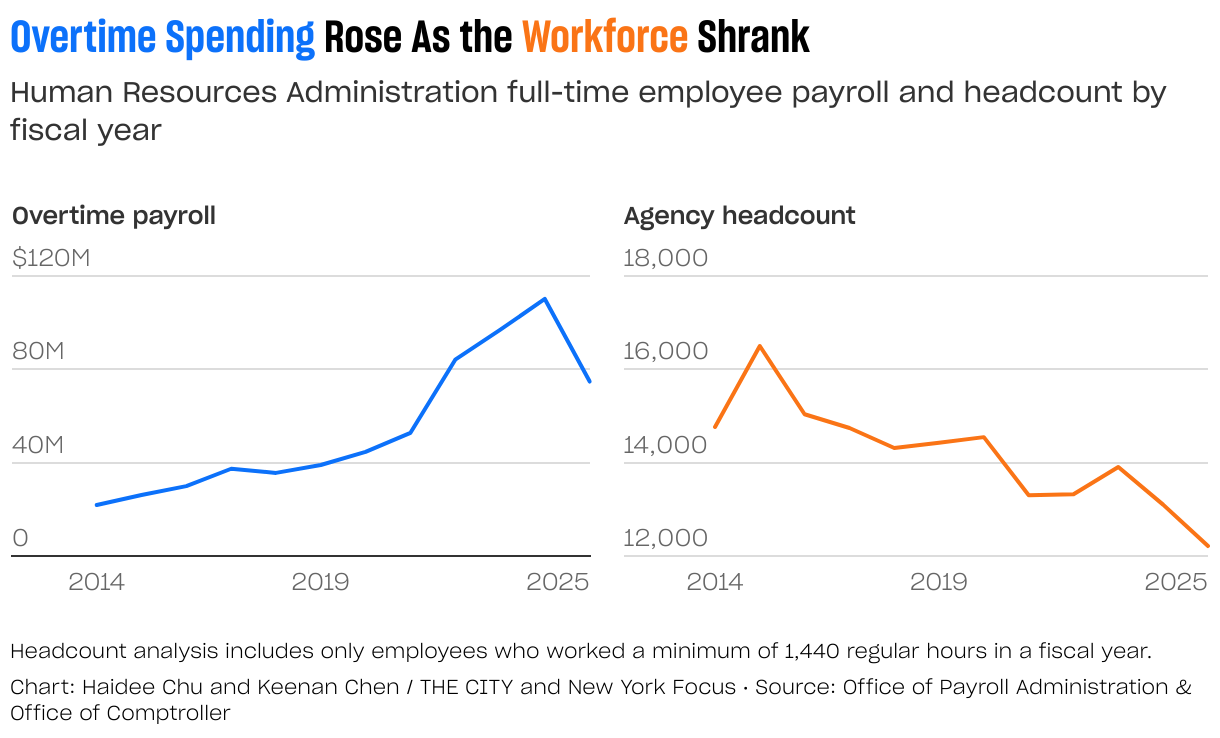
Regular pay only increased by 14 percent over that period — well under the rate of inflation.
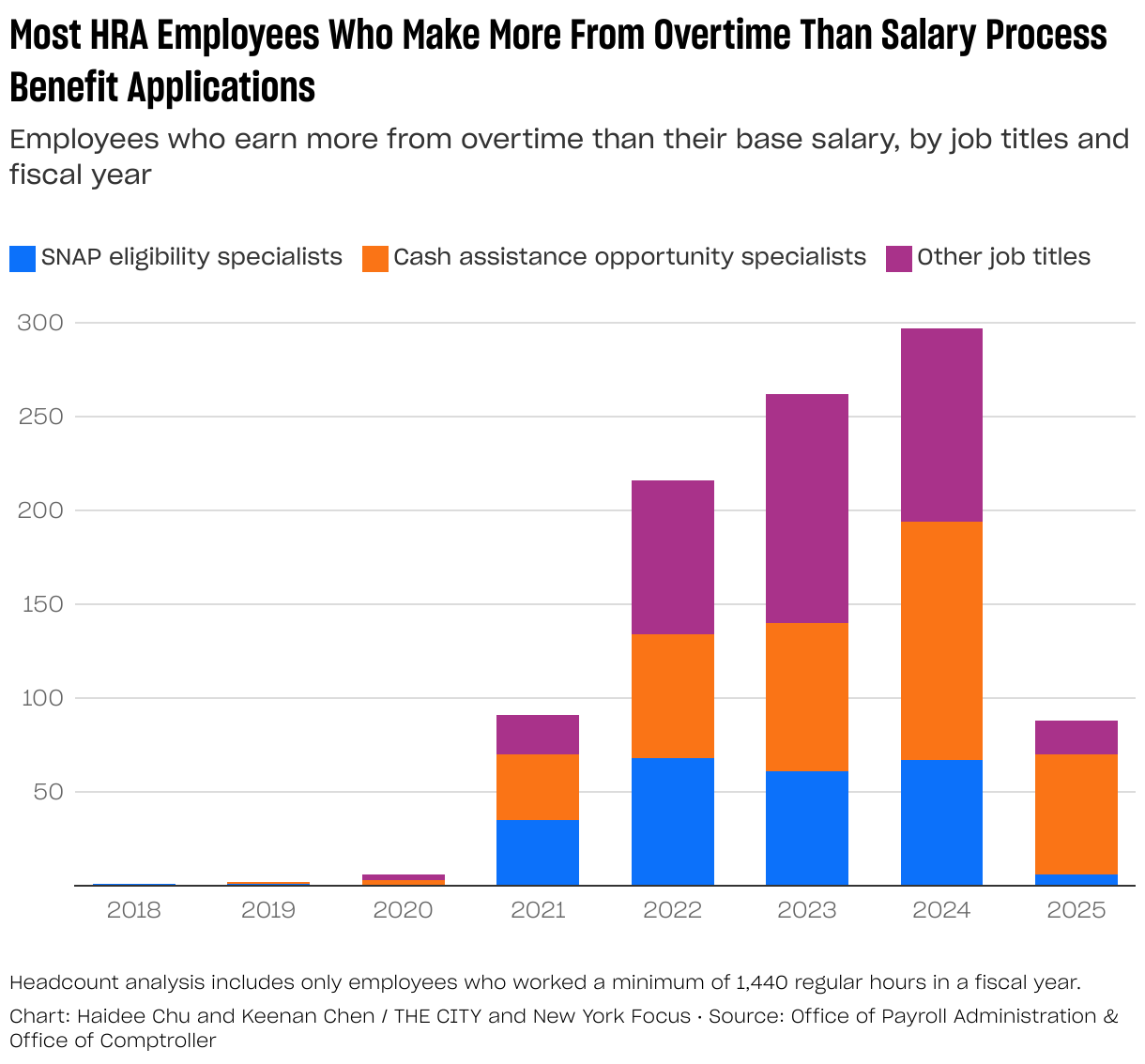
Agency officials required rank-and-file eligibility specialists to work at least four hours of mandatory overtime each week last year. Many worked far more: in the most recent fiscal year, 87 DSS employees earned as much or more in overtime as they did in base salary. Forced overtime can cause burnout and lead staffers to quit, deepening the shortages that necessitated overtime in the first place.
Staffing challenges have bedeviled many city agencies, not just DSS — a reality set to confront the incoming administration of Mayor-Elect Zohran Mamdani, which has pledged ambitious new programs across city government.
But their consequences are on particularly stark display in the social services agency. As Mayor Eric Adams and other city leaders tout balanced budgets and post-pandemic recovery, the reliance on overtime at the Department of Social Services tells a different story — one of a workforce running out of hours to give to New Yorkers most in need.
Among the agency’s frontline staff are eligibility specialists, who are charged with making sure new and current applicants qualify for the public benefits.
In a February report, the city’s Independent Budget Office noted that the HRA had lost hundreds of eligibility specialists since 2019. And last October, the IBO found that more than 40 percent of the active eligibility specialists processing cash assistance or SNAP applications had less than three years of experience.
Eligibility specialists are expected to get through each new case in roughly an hour, the Brooklyn staffer said, and supervisors closely monitor how many they process.
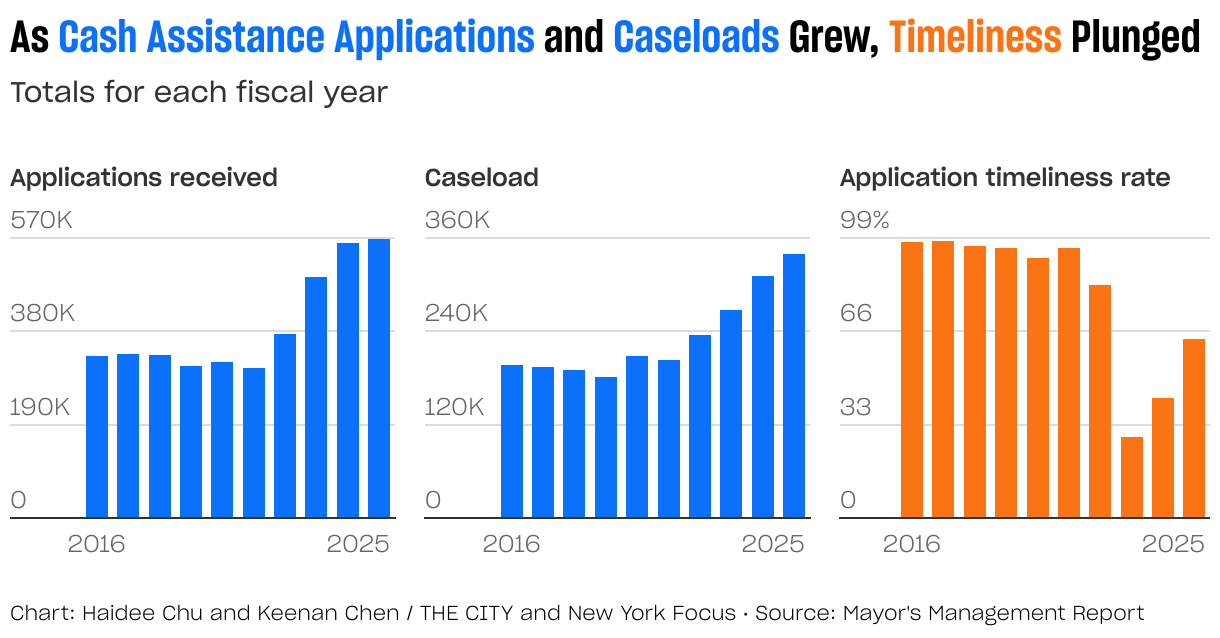
The number of city residents receiving SNAP rose slightly over the last year and remains at near-record levels. The number receiving cash assistance in June was up 8 percent from just a year earlier.
The department has struggled to process those applications within the federally required 30 days. SNAP timeliness rates have largely recovered from their nadir in 2023, due in part to a lawsuit and court order that the Adams administration agreed to settle earlier this week. However, the department continues to miss its deadline on more than a third of cash assistance cases.
At a City Council budget hearing earlier this year, some benefit recipients said they faced delays in getting their benefits because their applications weren’t recertified in time.
“When I tried to call HRA to address the issue in 2023, I waited on hold for four to five hours but only to be hung up on,” said Diana Ramos, an activist with the Safety Net Project and a SNAP recipient. “In September 2024, I received my SNAP benefits late again,” she said. She later learned that her recertification application “was just sitting on someone’s desk waiting for approval.”
Fewer frontline staff, less experience, lawsuits over
delayed benefits — all these challenges have contributed to the
department’s heavy reliance on overtime.
Benefits opportunity
specialists, who process cash assistance applications, averaged about
seven hours of overtime in 2025, roughly double the pre-Covid level,
payroll data shows.
City officials have long argued that it’s cheaper to pay overtime than to hire new staff who are entitled to health benefits and pensions.
“First, the city can claim that employee counts are lower than they otherwise would be,” said Thad Calabrese, a finance professor at NYU’s Wagner School of Public Service. “Second, if the government pays an employee overtime rather than hiring a new one, it keeps fringe benefit costs — for health insurance, pensions, etc. — from growing, at least in the near term.”
While there’s a cap on the amount of overtime earnings that can be used to calculate an employee’s pension benefits, Calabrese said rising overtime spending can still drive up pension costs down the road.
Some experts see the ballooning overtime as a reflection of poor management.
“When overtime balloons, it’s generally not a good sign,” said Bill Hammond, a senior researcher at the Empire Center for Public Policy. “Unless there are external reasons, like a pandemic, overtime should be a short-term phenomenon. It shouldn’t be an ongoing way of doing business.”
Ana Champeny, vice president for research at the Citizens Budget Commission, tied the overtime surge to the city’s broader challenges in delivering services.
“Many city services aren’t doing a good job,” Champeny said, citing her organization’s survey finding large declines in residents’ satisfaction with city government. “Understaffing is one of the reasons, but poor management is also an important factor.”
She added that the city’s hiring system is “incredibly bureaucratic” and often slow to fill vacancies.
Henry Garrido, executive director of District Council 37, the city’s largest public-sector union, blamed the persistent staffing shortages on the Mayor’s Office of Management and Budget, known as OMB.
The union leader said the city’s budget office was leaving vacancies open to save money and offset costs from new labor deals. He recalled cases in which agencies had made job offers to candidates that were later rescinded or delayed by OMB, often citing a lack of qualifications.
OMB did not respond to requests for comment from THE CITY and New York Focus.