‘Blindsided’ Counties Struggle to Implement Trump’s SNAP Work Rules

Hundreds of thousands of New Yorkers could lose their food benefits due to new SNAP work requirements, after the Trump administration phased them in months earlier than expected.

Jie Jenny Zou   ·   November 10, 2025
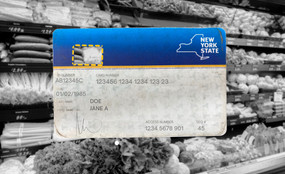
Nearly 3 million New Yorkers are enrolled in SNAP, with the average household receiving $376 per month in benefits. | Photo: Atstock / Canva | Illustration: Leor Stylar

Sign up for Staying Focused, our newsletter keeping readers up to speed on New York politics.

Strained social service departments across the state are scrambling to implement new work rules that suddenly went into effect this month for New Yorkers who rely on food assistance.

The requirements — which were enacted as part of a sweeping federal bill passed in July, but went into effect months earlier than expected — could result in hundreds of thousands of New Yorkers losing their access to the Supplemental Nutrition Assistance Program, also known as SNAP or food stamps.

The rushed rollout comes at a chaotic time for food assistance.

Federal funding for SNAP was frozen on November 1 after President Donald Trump’s administration reneged on a pledge to keep the program running during the government shutdown. Last week, a court ordered Washington to fully fund the program after New York and other states sued the administration, and New York began releasing people’s full SNAP benefits. But on Friday night, the US Supreme Court granted Trump’s request to pause the court order. On Saturday, the administration told states to return benefits they had distributed.

The shutdown has also frozen funding for a slew of other public benefit programs, creating a logistical nightmare for social service departments that have long struggled with understaffing, brain drain and application backlogs.

“The pressure being ratcheted up on local social services departments across the country this last month is difficult to understand,” said Eric Tower, special assistant to Erie County’s social service commissioner.

The new rules, which require certain SNAP recipients to certify they spent up to 80 hours each month working, in school, or volunteering, will remain in effect long past the shutdown. Counties had planned on the rules taking effect in the spring, but Tower said they were “blindsided” in early October when the Trump administration abruptly announced an accelerated timeline.

An estimated 10,000 New Yorkers in Erie County, home to Buffalo, could be subject to the new rules. Erie County is getting in touch with those residents, an undertaking that includes scheduling in-person group orientations and follow-up compliance meetings as well as sending out mass mailings of required notices.

The department is creating a team from existing staff to track monthly work rule compliance, as well as training employment counselors to connect SNAP recipients with workforce development programs that could help them meet the new requirements.

December will mark the first full month that SNAP recipients are expected to begin certifying their compliance, and recipients who fail to meet the requirements for longer than three months will have their benefits terminated. This means New Yorkers could be kicked off SNAP as a result of the new rules as soon as March 2026.

“The timeline we’ve been given is quite aggressive and unrealistic.”

—Scott French, NYC Human Resources Administration

House Republicans who backed the new law described work rules as a way to reduce waste and fraud in SNAP and to drive down unemployment. But research has found that work requirements don’t improve employment or household income. Meanwhile, recipients could end up losing their benefits even if they meet the requirements, because of processing errors and the difficulty keeping up with paperwork to prove eligibility.

In Onondaga County, home to Syracuse, it’s estimated anywhere from 4,000 to 6,000 residents could be subject to the work requirements. County spokesperson Justin Sayles said staff are working with CNY Works to refer SNAP recipients to local workshops and job search activities. The county asked the federal government for permission to use its artificial intelligence chatbot to help notify SNAP recipients, but was denied.

That undertaking is magnified in New York City, where an estimated 230,000 residents could be subject to the requirements.

“The timeline we’ve been given is quite aggressive and unrealistic,” said Scott French, who heads the Human Resources Administration, which oversees SNAP benefits across the five boroughs. “There’s not an insignificant amount of forms that need to be created, translated, programmed. These types of things often take us quite a few months to be able to do and do correctly.”

In a court filing challenging the rushed rollout, the city’s social service commissioner said staff are currently translating notices into 15 languages and updating over four different software systems. The agency estimated it would need “at least four months” to upgrade its tech to track monthly compliance.

French said that tight deadline has meant making do with existing staff and resources. He anticipates the agency will need to “play catch up” after November and reassess staffing levels as it adjusts to the new volume of paperwork created by the ongoing monthly requirements. “Overtime is the first thing we will utilize and look at,” he said.

Throughout November, the agency is scheduling appointments to connect certain SNAP recipients with pre-approved workforce development programs to satisfy the monthly requirement. They’re also directing SNAP recipients to fill out a new medical exemption form if they anticipate being unable to meet the new rules.

The new form allows health providers to provide broad reasons for why their patients may be unable to meet the work requirement, such as physical and mental health barriers. Unlike disability benefits, the form does not require specific diagnoses for approval. New York City residents without access to health providers will be connected with WeCARE, a network of contracted vendors that can provide free clinical assessments.

“That’s our leading goal and mission in everything we’re setting up here, to make sure folks have every possibility to keep their benefits,” said French, noting that the agency will approve all medical exemption forms so long as they are properly filled out by an approved health provider. “We don’t do further assessment of that form.”

Monroe County, home to Rochester, has posted a similar medical exemption form and is connecting SNAP recipients with existing local workforce development programs. It is also directing SNAP recipients to a screening tool to see if they are exempt from the new requirement.

Advocates at the Empire Justice Center said efforts to streamline exemptions, provide proactive warnings about noncompliance, and offer remote options for eligible training and volunteer activities can help mitigate the impact of the new requirements, but that results will likely vary.

“Some counties contract with workforce development programs and they already have a mechanism in place to make effective referrals,” said Susan Antos, managing attorney at Empire Justice. “The scope of those contracts varies from county to county.”

Smaller, rural counties may struggle to offer sufficient volunteer and work opportunities, and their residents may lack access to the transportation and technology needed to take advantage of them.

It’s unclear if the state has any plans to offer centralized workforce development programs.

The state’s Office of Temporary and Disability Assistance (OTDA), which supervises local social service departments, did not respond to questions about its efforts to help counties comply with the new rules or provide county-level data on how many New Yorkers will be impacted by the policy change.

At New York Focus, our central mission is to help readers better understand how New York really works. If you think this article succeeded, please consider supporting our mission and making more stories like this one possible.

New York is an incongruous state. We’re home to fabulous wealth — if the state were a country, it would have the tenth largest economy in the world — but also the highest rate of wealth inequality. We’re among the most diverse – but also the most segregated. We passed the nation’s most ambitious climate law — but haven’t been meeting its deadlines and continue to subsidize industries hastening the climate crisis.

As New York’s only statewide nonprofit news publication, our journalism exists to help you make sense of these contradictions. Our work scrutinizes how power works in the state, unpacks who’s really calling the shots, and reveals how obscure decisions shape ordinary New Yorkers’ lives.

In the last two decades, the number of local news outlets in New York has been nearly slashed in half, allowing elected officials and powerful individuals to increasingly operate in the dark — with the average New Yorker none the wiser.

We’re on a mission to change that. Our work has already shown what can happen when those with power know that someone is watching, with stories that have prompted policy changes and spurred legislation. We have ambitious plans for the rest of the year and beyond, including tackling new beats and more hard-hitting stories — but we need your help to make them a reality.

If you’re able, please consider supporting our journalism with a one-time gift or a monthly gift. We can't do this work without you.

Thank you,

Akash Mehta
Editor-in-Chief
A photo of Akash Mehta.
A photo of Jie Jenny Zou.
Jie Jenny Zou covers social services and public benefits for New York Focus. She previously worked as an investigative reporter at the Los Angeles Times and the Center for Public Integrity where she delved into topics ranging from environmental health and worker safety… more
Also filed in New York State

City budget gaps and an ambitious affordability agenda may require pressing Albany again for taxes and aid.

A bill awaiting the governor’s signature would relax restrictions on who can qualify for victim compensation.

We’ve compiled information for the 450,000 New Yorkers who will lose health care coverage on July 1.

Also filed in Social Services

In May, state lawmakers passed a $269 billion budget after haggling for months over thousands of line items and policies affecting New Yorkers.

New York state has pumped millions of taxpayer dollars into an online portal that vowed to make life easier for Rochester’s neediest, but critics say it’s fallen short.

We’ve compiled information for SNAP recipients in New York on the changing work requirements.

Also filed in Affordability

Despite last-ditch efforts by a coalition of lawmakers, the state failed to avert a health coverage cliff coming this summer.

Governor Kathy Hochul was successful in her bid to upend the Climate Leadership and Community Protection Act after legislators caved to finalize an overall budget deal.

The Hochul administration now has a chance to relax New York’s child care staffing ratios — among the country’s strictest — after 26 years. But will it?