SNAP Is Set To Be Frozen in November. Here’s What New Yorkers Need to Know.

The federal government shutdown and new work requirements will throw New York’s food stamps program into chaos.

Jie Jenny Zou   ·   October 30, 2025
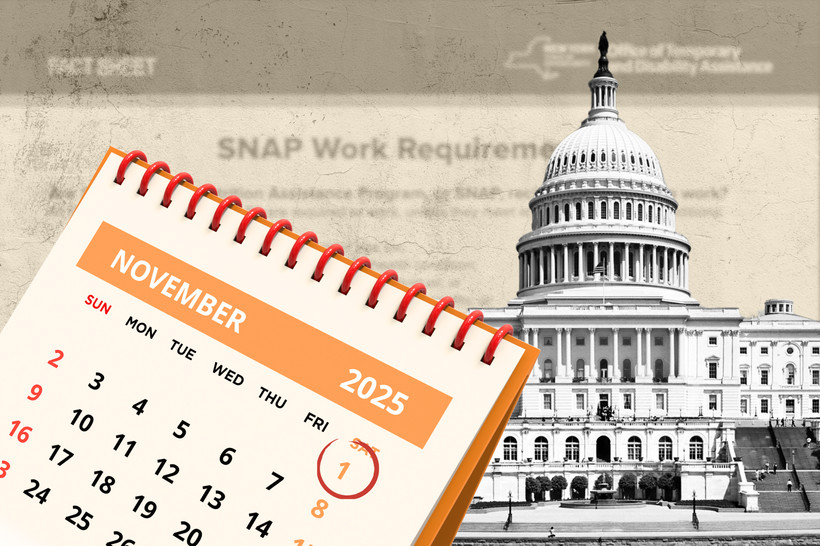
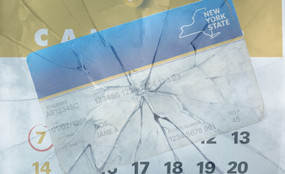
A calendar with November 1 circled, in front of a photo of the United States Capitol and a document showing the new SNAP work rules.
It's likely that people enrolled in SNAP will see a delay or not receive benefits for the month of November due to the ongoing government shutdown. | Photos: Ottojula/Wikimedia Commons; Oba San/Canva | Illustration: Leor Stylar

Sign up for Staying Focused, our newsletter keeping readers up to speed on New York politics.

Last updated on Friday, November 7.

If you’re one of the nearly 3 million New Yorkers currently enrolled in the Supplemental Nutrition Assistance Program, you are likely to see delays in your food benefits as a result of the ongoing federal government shutdown. You may also be subject to new work requirements, which could cause hundreds of thousands of New Yorkers to lose their benefits.

That could trigger a hunger crisis. The average enrolled New York household receives $376 per month from the program, which is also a significant source of revenue for the state’s retailers and farmers. Governor Kathy Hochul is facing calls to fund food benefits during the shutdown, but she has so far said the state can’t afford to.

Here’s what you need to know.

Will I receive my November SNAP benefits?

SNAP benefits for November have been delayed due to the government shutdown. The federal government has been shut down since October 1 over disagreements in Washington, D.C., over skyrocketing health insurance premiums.

On November 6, a federal judge ordered the Trump administration to fully fund SNAP benefits by November 7 after a coalition of states — including New York — filed a lawsuit. The Trump administration has asked an appeals court to halt that order. It’s unclear how soon New Yorkers could see the funds deposited on their benefit cards.

Where can I get help with groceries?

For the latest SNAP developments, check this state website. The latest announcements for WIC can be found here. To locate your nearest food pantry or food bank, use this website. Local mutual aid groups in New York City and elsewhere in the state may also be offering assistance.

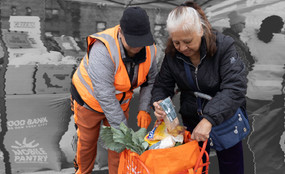
West Side Campaign Against Hunger in New York City is among several local organizations that will be providing more food to their clients in anticipation of SNAP disruptions. It has also expanded its delivery program in light of increased fears over immigration raids.

Local politicians’ offices may also be able to connect residents with local feeding resources and programs. You can look up your elected officials using this website.

“The value of SNAP is exponentially bigger than all the emergency feeding work that happens in NYC combined,” said Greg Silverman, who heads the West Side Campaign Against Hunger. “Food pantries are not a substitute for SNAP. They never have been and they can’t be.”

Silverman also urged the public to contact their representatives and demand action.

Amie Parikh, chief executive officer for the Hudson Valley Care Coalition, agreed that there is no substitute for SNAP, but urged New Yorkers to tap into other existing programs they may not be aware of. As part of an ongoing state initiative, the Hudson Valley Social Care Network is currently screening Medicaid recipients in the region to connect them with free food and assistance with energy bills.

Many Medicaid recipients are enrolled in SNAP but may not be aware they qualify for this separate stream of nutritional assistance, which is funded through Medicaid, Parikh said. The program covers free, delivered medically tailored meals, cooking supplies and pantry items for certain Medicaid recipients.


What is New York doing in response?

New York is among 25 states suing the Trump administration for failing to use emergency contingency funds to keep SNAP running during the shutdown. (The administration had previously said it would keep SNAP benefits flowing during a shutdown, but has not done so.)

Hochul declared a state of emergency Thursday and committed over $106 million to support various food programs across the state that are expected to see increased demand while SNAP benefits are paused. The money includes a mix of new funding and fast-tracked grants that were already allocated to food providers for the upcoming calendar year.

Hochul plans to deploy student volunteers to help distribute food aid and has called on businesses to donate what they can. “This is a moment for our community to rise up and respond to something that can only be described as a moral crisis,” she said at a press conference Thursday.

Greg Silverman, who heads the West Side Campaign Against Hunger in New York City, urged city and state leaders to devise a more robust emergency plan to get aid directly to New Yorkers and support frontline food providers.

Hundreds of organizations are calling on state leaders to fully cover the funding loss — roughly $650 million in lost SNAP benefits per month — using New York’s sizable surplus or fiscal reserves. The Fiscal Policy Institute, a left-leaning think tank, points out the state could try to secure a deal with Congress to have these funds reimbursed by the federal government later.

“This is exactly what reserves should be used for,” said FPI economist Emily Eisner. “This will not put New York state in financial distress to cover the benefits.” She called on state lawmakers to convene in Albany immediately for an emergency session.

Other states have already stepped up.Virginia and Delaware have committed to covering SNAP benefits for their residents after declaring states of emergency. New Mexico will do the same for at least 10 days. California is pouring $80 million into its food bank network and has enlisted the help of the National Guard to keep facilities running, as it did during the pandemic.

“They need to come together and come up with a solution that is cash-based,” he said. “We need our elected officials to step up and not just show up to some Thanksgiving turkey giveaway.”

Hundreds of organizations are calling on state leaders to fully cover the funding loss — roughly $650 million in lost SNAP benefits per month — using New York’s sizable surplus or fiscal reserves. The Fiscal Policy Institute, a left-leaning think tank, points out the state could try to secure a deal with Congress to have these funds reimbursed by the federal government later.

“This is exactly what reserves should be used for,” said FPI economist Emily Eisner. “This will not put New York state in financial distress to cover the benefits.” She called on state lawmakers to convene in Albany immediately for an emergency session.

Other states have already stepped up.Virginia and Delaware have committed to covering SNAP benefits for their residents after declaring states of emergency. New Mexico will do the same for at least 10 days. California is pouring $80 million into its food bank network and has enlisted the help of the National Guard to keep facilities running, as it did during the pandemic.

What about the SNAP work requirements I’ve been hearing about?
Starting November 1, some SNAP recipients will also be subject to new work rule requirements signed into law by President Donald Trump earlier this year.

The announcement came as a surprise to states like New York, which originally had until next year to begin implementing the new requirements. Counties are now scrambling to communicate these changes to SNAP recipients, and it’s possible you may encounter some delays and confusion as agency staff adjust to the new guidelines.

Will I be subject to the work requirements?

The new rules may apply to you if you meet the following conditions:

  • Are an adult aged 18 to 64

  • Do not live with dependents or children under age 14

  • You aren’t disabled

  • You aren’t pregnant

The new mandate will also apply to veterans, the homeless, and aging foster youth who have been historically exempt from work requirements. To see a full list of who is exempt from the new requirements, check this state website.

Your county social service department should contact you soon if they determine you are subject to the new work rule requirements. Mailed notices for those living in New York City have begun going out and will outline the next steps you need to take. Other counties like Oswego and Erie are scheduling in-person orientations to notify residents of the changes, while those residing in Onondaga County may also receive automated calls in addition to formal notices.

To maintain SNAP benefits under the new work requirements, you’ll have to prove that you spent 80 hours each month working, in school or volunteering. (The monthly time requirement may be lower, based on the amount of SNAP benefits your household receives. See below for more detail.)

If you’re unable to comply with these requirements for more than three months, your SNAP benefits could be terminated.


How can I keep my SNAP benefits under the new work requirements?

While the new work rules go into effect on November 1, the first month that will count toward the three-month limit starts on December 1. This means that your SNAP benefits cannot be canceled due to the new three-month time limit before March 1, 2026.

The state has instructed county social service departments to connect SNAP recipients with local programs that could help them meet the 80-hour monthly requirements, which could take the form of various workforce training programs or volunteer activities. New York is one of the few states that delegates SNAP administration to counties, so offerings may differ based on your county.

Your monthly time requirement may be less than 80 hours. The state’s Office of Temporary and Disability Assistance (OTDA) notes that the number of hours you need to participate in community service or volunteer work is based on your SNAP benefit divided by the state minimum wage. They cite an example of a household receiving $300 in monthly SNAP benefits with a minimum hourly wage of $16.50 would need to complete 18 hours of approved community service or volunteer work each month.

OTDA has also provided this blank medical exemption form that SNAP recipients may be able to complete and send to their local county social service agency. The forms can be filled out by a wide variety of health providers who can provide broad, non-specific reasons for why patients may be unable to meet the new SNAP work rules, such as temporary or permanent physical or mental health barriers. (It does not require a specific diagnosis, unlike disability benefits.)

Scott French, who heads New York City’s Human Resources Administration, said his agency is doing all it can to ensure New Yorkers across the five boroughs are able to comply with the new requirements. “That’s our leading goal and mission in everything we’re setting up here, to make sure folks have every possibility to keep their benefits.”

The agency is in the process of scheduling appointments throughout November for New York City residents who are subject to the new work rules. The appointments will connect SNAP recipients with pre-approved workforce development programs that will help them satisfy the monthly requirement. Here’s a link to NYC’s medical exemption form.

If you’re a New York City resident without access to health care providers, the Human Resources Administration will connect you with professionals who can assess you for medical exemptions, French said.

Does my immigration status affect my eligibility for SNAP?

The new law passed in July restricts SNAP eligibility to “legally present” immigrants.

This means that refugees and asylum-seekers may no longer be eligible for SNAP benefits. This includes New Yorkers who are trafficking victims and those with temporary protected status.

Legal permanent residents, such as green card holders, remain eligible for SNAP, but may be subject to a five-year waiting period before they can receive benefits.

An estimated 41,000 New Yorkers could lose their SNAP benefits as a result of eligibility changes based on immigration status.

How will the shutdown affect my other benefits?

The shutdown could also affect the Women, Infants, Children program, or WIC, which provides nutritional assistance for nearly half a million pregnant women, new mothers, and their babies in New York.

Earlier this month, the White House tapped into special funds for a second time to keep WIC running after the program faced a funding cliff in early October. It’s unclear how long this infusion will last, but advocates predict benefits could run through mid to late November. The administration has not yet said whether it will continue to replenish the funds if the shutdown continues past November.

If you rely on the Low Income Home Energy Assistance Program, or HEAP, to heat your home, you could see those benefits delayed or missing due to the shutdown. HEAP has been in limbo since earlier this year, when all federal staff for the program were let go. Many New Yorkers are enrolled in both SNAP and HEAP.

Medicaid and Medicare benefits will continue during the shutdown, though reduced federal staffing maymake it harder to get help with tasks like eligibility verification.

Can I still apply for benefits?

Yes. All county agencies across the state are still processing applications, including renewals, for SNAP, WIC, and HEAP. Officials and advocates are urging New Yorkers to stay up to date on their renewals for these programs, despite the pause in payouts, to ensure they receive their benefits once the federal government reopens.

Update: October 31, 2025 — This article was updated with news of a federal judge ordering the Trump administration to to come up with a plan to fund SNAP during the government shutdown.

Update: November 7, 2025 — This article was updated after a federal judge ordered the Trump administration to fully fund SNAP benefits on November 6 and the administration requested that an appeals court halt that order on November 7.

At New York Focus, our central mission is to help readers better understand how New York really works. If you think this article succeeded, please consider supporting our mission and making more stories like this one possible.

New York is an incongruous state. We’re home to fabulous wealth — if the state were a country, it would have the tenth largest economy in the world — but also the highest rate of wealth inequality. We’re among the most diverse – but also the most segregated. We passed the nation’s most ambitious climate law — but haven’t been meeting its deadlines and continue to subsidize industries hastening the climate crisis.

As New York’s only statewide nonprofit news publication, our journalism exists to help you make sense of these contradictions. Our work scrutinizes how power works in the state, unpacks who’s really calling the shots, and reveals how obscure decisions shape ordinary New Yorkers’ lives.

In the last two decades, the number of local news outlets in New York has been nearly slashed in half, allowing elected officials and powerful individuals to increasingly operate in the dark — with the average New Yorker none the wiser.

We’re on a mission to change that. Our work has already shown what can happen when those with power know that someone is watching, with stories that have prompted policy changes and spurred legislation. We have ambitious plans for the rest of the year and beyond, including tackling new beats and more hard-hitting stories — but we need your help to make them a reality.

If you’re able, please consider supporting our journalism with a one-time gift or a monthly gift. We can't do this work without you.

Thank you,

Akash Mehta
Editor-in-Chief
A photo of Akash Mehta.
A photo of Jie Jenny Zou.
Jie Jenny Zou covers social services and public benefits for New York Focus. She previously worked as an investigative reporter at the Los Angeles Times and the Center for Public Integrity where she delved into topics ranging from environmental health and worker safety… more
Also filed in New York State

A bill awaiting the governor’s signature would relax restrictions on who can qualify for victim compensation.

We’ve compiled information for the 450,000 New Yorkers who will lose health care coverage on July 1.

A lobbyist who has been romantically linked to Assembly Speaker Carl Heastie led a rally opposing the legislation a week before the speaker declined to bring it to a vote.

Also filed in Budget

In May, state lawmakers passed a $269 billion budget after haggling for months over thousands of line items and policies affecting New Yorkers.

State leaders are expected to pass a bill that avoids resolving how much Resorts World New York City needs to pay.

Resorts World is floating legislation to avert more than $500 million in payments to the horseracing industry.

Also filed in Social Services

New York state has pumped millions of taxpayer dollars into an online portal that vowed to make life easier for Rochester’s neediest, but critics say it’s fallen short.

We’ve compiled information for SNAP recipients in New York on the changing work requirements.

Despite last-ditch efforts by a coalition of lawmakers, the state failed to avert a health coverage cliff coming this summer.

Also filed in Affordability

Governor Kathy Hochul was successful in her bid to upend the Climate Leadership and Community Protection Act after legislators caved to finalize an overall budget deal.

The Hochul administration now has a chance to relax New York’s child care staffing ratios — among the country’s strictest — after 26 years. But will it?