New York Immigrants Weigh Health and Hunger Against Deportation Risk

Trump’s immigration crackdown is having a chilling effect on New Yorkers’ access to public benefits.

Jie Jenny Zou   ·   September 3, 2025
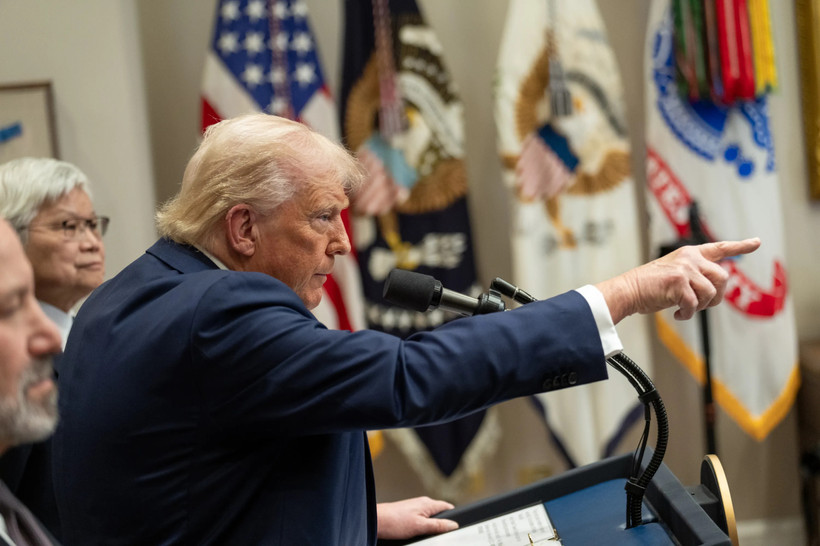
Trump at a press conference
President Trump's immigration enforcement agency was quietly granted access to sensitive Medicaid enrollment information. | The White House

Sign up for Staying Focused, our newsletter keeping readers up to speed on New York politics.

For years, Susanna Saul has been reassuring some of her clients that it’s safe to apply for public benefits, even if they’re not citizens. Now, she isn’t sure what to say.

Saul directs legal programs at Her Justice, a Manhattan-based nonprofit that provides free legal assistance to impoverished women and their children. Its clients include victims of trafficking and domestic violence who, unlike most undocumented people, are eligible for Medicaid under decades-old federal exceptions.

“They’ve always been worried about the immigration consequences of accessing public benefits, even before Trump won,” she said. “They always ask us if that’s going to hurt their ability to pursue a pathway to legal status. We’ve always said, ‘no.’”

But as President Donald Trump’s administration has ramped up immigration enforcement, she has more often found herself having to say, “I can’t answer that question, because I don’t know.”

Jie Jenny Zou is reporting on New Yorkers' access to public benefits. Do you have a story to share? Reach out at jenny@nysfocus.com; we won't use your name without permission.

This summer, US Immigration and Customs Enforcement was quietly granted access to sensitive Medicaid enrollment information as part of the agency’s efforts to root out “the location of aliens.” Federal officials have also begun collecting more detailed information from households enrolled in the Supplemental Nutrition Assistance Program, or SNAP, including immigration status.

New York and other states are challenging the new data-sharing policies in court, arguing that “if members of our community cannot trust that the government will keep their medical history and other personal data safe, they will think twice about going to the doctor when needed.”

Advocates say they’re seeing a chilling effect, with immigrants across the state delaying or avoiding health care to protect themselves — or others in their households — from immigration enforcement.

“This is literally about life and death,” Saul said. “We have clients who are cancer survivors who are in active treatment. We have clients caring for children who have special needs.”

“Nobody’s gotten a single letter from the government or anyone, really, about what’s coming.”

—Meera Venugopal, Asian American Federation

Saul shared the story of one long-time client who has lived in the US for decades and is working toward a green card. The client reported intimate partner violence to the police and has undergone several surgeries as a result of the abuse. Her injuries require ongoing physical therapy, which is covered by Medicaid because she’s a domestic violence survivor — but she’s stopped going to appointments, out of fear of being detained by ICE.

“She basically doesn’t go anywhere,” Saul said. “She stopped going to church. She relies on her son, who is a US citizen, for a lot of things. She relies on neighbors.”

Adding to the uncertainty, hundreds of thousands of immigrants could soon lose their health coverage. In July, Trump signed a bill enacting over $1 trillion in cuts to Medicaid and SNAP. Starting January 1, the federal government will rescind support for certain legal immigrants enrolled in the state’s free Essential Plan. Over 200,000 immigrants could go uninsured as a result.

Trump also issued an executive order that would cut off access for many immigrants — including Deferred Action for Childhood Arrival recipients and people granted temporary protected status — to a wide array of federally funded social services, from mental health clinics to substance abuse treatment to child care. The Trump administration paused enforcement of the new policy pending a court challenge led by New York State Attorney General Letitia James; a judge is expected to rule in that case soon.

Governor Kathy Hochul and state legislators have so far declined to say how they plan to deal with federal cuts to public benefits, and have tabled the matter until next year.

Meera Venugopal, communications director for the Asian American Federation, said rampant misinformation coupled with a lack of proactive communication from state leaders has fostered extreme uncertainty.

“We are in a low-information environment while people are completely panicked and anxious,” she said of benefit recipients concerned about changes to eligibility, new work rule requirements, and increased immigration enforcement.

Her organization represents nonprofits serving the state’s 2.1 million Asian residents, 63 percent of whom are foreign-born. It’s estimated that 24 percent of the state’s unauthorized immigrants are from Asia.

“Nobody’s gotten a single letter from the government or anyone, really, about what’s coming,” Venugopal said. “We are always the intermediary, and we don’t have the staff or capacity to handle all the people coming to our doors.”

Venugopal is urging state leaders to communicate a clear path forward about how they plan to handle federal cuts so that community organizations — which serve as hubs for public benefit recipients with limited English proficiency and poor digital access — can adequately prepare.

Meanwhile, some organizations are afraid they could be swept up in the immigration crackdown themselves.

The Trump administration has signaled increased interest in investigating nonprofits and has issued a flurry of executive orders canceling grants and contracts, as well as directing federal agencies to block funding for sanctuary cities. In New York, Republican Congressmembers have urged the IRS to investigate prominent nonprofits for pushing a statewide sanctuary bill, among other actions the lawmakers said may aid unlawful residents.

A director from one Queens nonprofit that works closely with immigrant groups said that his organization is “laying low” and asked to not be identified in this story for fear of reprisal.

Earlier this month, his organization made its annual round of calls reminding clients of the upcoming deadline to renew their Medicaid coverage. The routine calls were met with suspicion, even from longtime clients.

“Three people just hung up.… One of them turned off their cell phone,” he said. Many had questions they haven’t had before: “‘What are you going to do with my information? Is my information safe? Should I recertify?’”

More clients are requesting home-delivered groceries, he said, fearing that ICE agents could be waiting for them at the organization’s food distribution line.

People on the Essential Plan have questions he can’t answer about what will happen to their coverage next year, like one client undergoing dialysis.

“What happens to this individual?” he asked.

At New York Focus, our central mission is to help readers better understand how New York really works. If you think this article succeeded, please consider supporting our mission and making more stories like this one possible.

New York is an incongruous state. We’re home to fabulous wealth — if the state were a country, it would have the tenth largest economy in the world — but also the highest rate of wealth inequality. We’re among the most diverse – but also the most segregated. We passed the nation’s most ambitious climate law — but haven’t been meeting its deadlines and continue to subsidize industries hastening the climate crisis.

As New York’s only statewide nonprofit news publication, our journalism exists to help you make sense of these contradictions. Our work scrutinizes how power works in the state, unpacks who’s really calling the shots, and reveals how obscure decisions shape ordinary New Yorkers’ lives.

In the last two decades, the number of local news outlets in New York has been nearly slashed in half, allowing elected officials and powerful individuals to increasingly operate in the dark — with the average New Yorker none the wiser.

We’re on a mission to change that. Our work has already shown what can happen when those with power know that someone is watching, with stories that have prompted policy changes and spurred legislation. We have ambitious plans for the rest of the year and beyond, including tackling new beats and more hard-hitting stories — but we need your help to make them a reality.

If you’re able, please consider supporting our journalism with a one-time gift or a monthly gift. We can't do this work without you.

Thank you,


A photo of Jie Jenny Zou.
Jie Jenny Zou covers social services and public benefits for New York Focus. She previously worked as an investigative reporter at the Los Angeles Times and the Center for Public Integrity where she delved into topics ranging from environmental health and worker safety… more
Also filed in New York State

In May, state lawmakers passed a $269 billion budget after haggling for months over thousands of line items and policies affecting New Yorkers.

Millions in outside spending was a boon to Gov. Kathy Hochul’s 2022 opponent, Lee Zeldin, and influenced down-ballot races.

The legislation would make it easier for currently and formerly incarcerated people and child victims to sue the state over allegations of past abuse.

Also filed in Health

Despite last-ditch efforts by a coalition of lawmakers, the state failed to avert a health coverage cliff coming this summer.

160,000 injured New Yorkers seek workers’ compensation each year — but in recent years, regulators have tilted the scales towards employers and insurers.

Amid abortion bans and rising digital surveillance, Albany lawmakers are revisiting an effort to stop companies from selling sensitive health information.

Also filed in Immigration

The Department of Justice has terminated more than 100 immigration judges since last year as it has pressured courts to order more deportations.

The legislation comes after months of haggling over how best to protect New Yorkers from President Trump’s immigration crackdown.

Footage published by New York Focus sparked a debate over deputies’ practice of calling Border Patrol on Spanish-speaking drivers.

Also filed in Social Services

New York state has pumped millions of taxpayer dollars into an online portal that vowed to make life easier for Rochester’s neediest, but critics say it’s fallen short.

We’ve compiled information for SNAP recipients in New York on the changing work requirements.

The Hochul administration now has a chance to relax New York’s child care staffing ratios — among the country’s strictest — after 26 years. But will it?