Trump’s Assault on Social Services Is Taking Aim at New York’s Elderly

Poverty rates among New York’s aging population are rising as the federal government pares back support for longstanding social service programs.

Jie Jenny Zou   ·   August 7, 2025
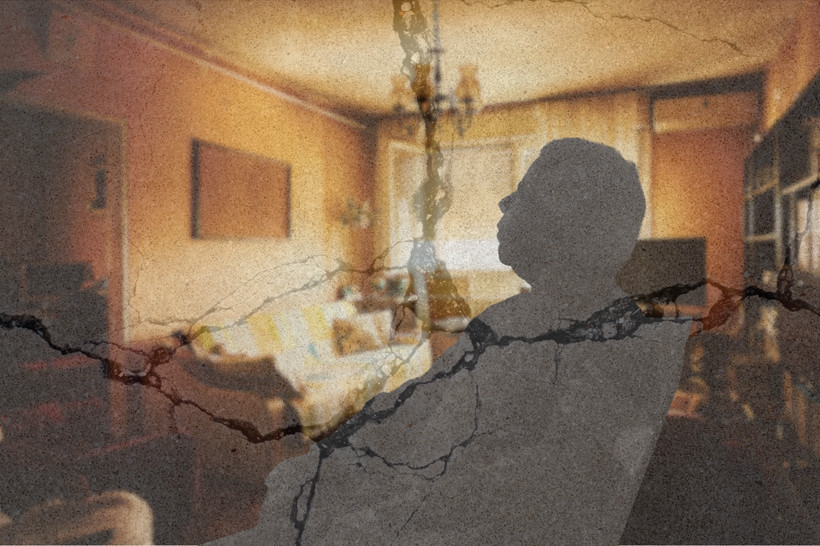
A silhouette of an elderly person sitting alone in a chair in a warm living room. Cracks appear over the image, indicating precarity.
Federal cuts to a variety of social service programs could be particularly harmful to seniors, who tend to be cross enrolled in several programs at once and tend to live on a fixed income. | Photos: dejankrsmanovic; chrismcfall/Getty Images; Kampus Production/Pexels | Illustration: Leor Stylar

Sign up for Staying Focused, our newsletter keeping readers up to speed on New York politics.

Retirement isn’t working out as Sherlea Dony planned.

Last year, a scam decimated the 74-year-old’s savings from decades of working as an American Sign Language interpreter and a copy editor.

“I didn’t have to worry a lot about my future until this past year,” said Dony, who lives in Rochester with her cat, Peaches. “I’m worried for myself and my friends. I could see myself potentially on the street.”

Like many struggling seniors, Dony relies on a variety of social services to stay afloat. Medicaid helps pay for her Medicare premiums and reduces her medical bills. The Supplemental Nutrition Assistance Program (SNAP) covers some of her groceries. This summer, the Low Income Home Energy Assistance Program (LIHEAP) paid for a new air conditioner in Dony’s rental apartment, while federal block grants support her senior center and the nonprofit that helps her apply for benefits.

Federal support for all these programs is now under threat by Congressional Republicans, jeopardizing a delicate network of lifeline support for the state’s growing aging population.

In July, lawmakers enacted over $1 trillion in cuts to Medicaid and SNAP as part of a fast-track measure to guarantee tax breaks for America’s wealthiest. In September, they will return to Washington to deal what could be a fatal blow to long-running programs like LIHEAP as part of President Donald Trump’s agenda to root out government waste and fraud.

Sherlea Dony, from Rochester, NY, relies on several public assistance programs in retirement. | Courtesy of Sherlea Dony

New York’s affordability crisis has hit seniors hard. Nearly one of every five New Yorkers is now 65 or older, and the number of them in poverty has surged by nearly 50 percent over the past decade. More than half of the seniors in Buffalo, Rochester, and Syracuse reported having no retirement income in 2022. Those numbers were even worse across New York City’s boroughs — home to over 1.3 million seniors.

To combat this trend, the Center for an Urban Future, a nonprofit think tank, recommended state leaders boost the same programs now at risk of being scaled back or eliminated at the federal level. Those include home-delivered meals, utility assistance, workforce development and supportive housing.

Ann Marie Cook, president of Lifespan of Greater Rochester, which helps Dony and others apply for benefits, pointed to the recent closures of several supportive housing buildings for Rochester seniors due to financial challenges. The settings provided meals, housekeeping, transportation, and personal care, allowing residents to live fairly independently. Nonprofit providers across the state have struggled to stay in business, and the federal cuts are likely to lead to more closures.

Cook said displaced residents could wind up hospitalized or in nursing homes at a much higher cost to the state. “I fear it may be the tip of the iceberg.”

“I could see myself potentially on the street.”

—Sherlea Dony

“It’s so much cheaper to provide these services to help people remain in their communities than [to pay for] the crisis situations that could happen if this funding goes away or is reduced,” she said.

Joe Stelling, associate state director of advocacy at AARP NY, said his organization is encouraging lawmakers at the state and federal levels to ensure funding for critical services.

“It’s very far from a done deal,” he said.

“A Bad Dream”

Life for Kim Hinson and her two grandsons in Staten Island is already too expensive.

“It’s getting tight,” said the 69-year-old who used to work for New York City’s Housing Authority until an on-the-job injury rendered her disabled and ushered in a host of chronic health challenges.

In addition to managing her diabetes and treatment for early-stage breast cancer, Hinson is also the primary caregiver for her teenaged grandsons, one of whom struggles with a learning disability. It’s estimated that over 130,000 grandparents in New York are the primary caregivers for their grandchildren — a growing national trend.

She and her grandsons are enrolled in SNAP, Medicaid and LIHEAP. But Hinson said it’s still not enough to keep pace with skyrocketing utility rates and rising inflation. “The rich get richer and the poor get poorer,” she said of Trump’s “Big Beautiful Bill Act.”

Kim Hinson, from Staten Island, NY, is the primary caregiver for her two teenage grandsons, pictured here. | Courtesy of Kim Hinson

Food costs have been a particular challenge. Hinson said she is no longer physically capable to wait in lines at food pantries to supplement what SNAP benefits won’t cover. As a result, she and other community members are now trying to see if the local senior center will set up a delivery system for senior meal boxes.

Seniors who live with their grandchildren are much more likely to report difficulty covering household food costs. Seniors of color also report higher levels of food insecurity overall compared to white seniors.

Earlier this year, the Trump Administration abruptly cancelled shipments to food banks across the country, amounting to a loss of 16 million pounds of food in New York state. Officials have also proposed eliminating a program that provides meal boxes to 36,000 low-income seniors aged 60 and older in New York City and Long Island.

New York leaders haven’t provided details on how they plan to deal with forthcoming federal cuts to Medicaid and SNAP. The changes to SNAP will freeze monthly benefits for all enrolled households and shift a portion of the financial responsibility to states for the first time in the program’s history, which dates back to 1964. Lawmakers will need to decide whether the state will cover the decreased federal support for SNAP — or slash monthly benefits for recipients.

Both Hinson and Dony aren’t just concerned about program cuts. They also worry about the impact of policy changes to eligibility, renewal, and overall administration.

Hinson said that she was having trouble accessing summertime food benefits for her grandchildren. Children who receive SNAP are usually automatically enrolled in the state program, which provides additional food assistance during the summer months when school is not in session and children miss out on school lunches.

Dony likened staying enrolled in her current benefit programs to a full-time job, requiring constant paperwork. She said her SNAP benefits were recently discontinued due to administrative errors, and she’s currently waiting for a fair hearing to be scheduled.

“I’m grateful for the programs, but they really test your wits,” she said.

Senior advocates like Cook said the new federal changes will mean more administrative paperwork for everyone involved with fewer resources. Federal staffing across several agencies has been reduced or, in the cases of programs like LIHEAP, eliminated entirely.

“Our agency exists in large part because these rules are so complicated,” she said of Lifespan. “There’s no way the average person can navigate these systems without help.”

“I really am not a hateful person, but I really hate our government right now,” said Dony. “It’s like a bad dream that I can’t get out, that we can’t get out of.”

At New York Focus, our central mission is to help readers better understand how New York really works. If you think this article succeeded, please consider supporting our mission and making more stories like this one possible.

New York is an incongruous state. We’re home to fabulous wealth — if the state were a country, it would have the tenth largest economy in the world — but also the highest rate of wealth inequality. We’re among the most diverse – but also the most segregated. We passed the nation’s most ambitious climate law — but haven’t been meeting its deadlines and continue to subsidize industries hastening the climate crisis.

As New York’s only statewide nonprofit news publication, our journalism exists to help you make sense of these contradictions. Our work scrutinizes how power works in the state, unpacks who’s really calling the shots, and reveals how obscure decisions shape ordinary New Yorkers’ lives.

In the last two decades, the number of local news outlets in New York has been nearly slashed in half, allowing elected officials and powerful individuals to increasingly operate in the dark — with the average New Yorker none the wiser.

We’re on a mission to change that. Our work has already shown what can happen when those with power know that someone is watching, with stories that have prompted policy changes and spurred legislation. We have ambitious plans for the rest of the year and beyond, including tackling new beats and more hard-hitting stories — but we need your help to make them a reality.

If you’re able, please consider supporting our journalism with a one-time gift or a monthly gift. We can't do this work without you.

Thank you,

Akash Mehta
Editor-in-Chief
A photo of Akash Mehta.
A photo of Jie Jenny Zou.
Jie Jenny Zou covers social services and public benefits for New York Focus. She previously worked as an investigative reporter at the Los Angeles Times and the Center for Public Integrity where she delved into topics ranging from environmental health and worker safety… more
Also filed in New York State

State leaders are expected to pass a bill that avoids resolving how much Resorts World New York City needs to pay.

New York state has pumped millions of taxpayer dollars into an online portal that vowed to make life easier for Rochester’s neediest, but critics say it’s fallen short.

Resorts World is floating legislation to avert more than $500 million in payments to the horseracing industry.

Also filed in Social Services

We’ve compiled information for SNAP recipients in New York on the changing work requirements.

Despite last-ditch efforts by a coalition of lawmakers, the state failed to avert a health coverage cliff coming this summer.

The Hochul administration now has a chance to relax New York’s child care staffing ratios — among the country’s strictest — after 26 years. But will it?