Pension Fund Litigators Donated Heavily to New York Comptroller’s Campaign

Comptroller Tom DiNapoli’s Democratic primary opponents say they’d refuse law firm donations if elected.

Chris Bragg   ·   May 8, 2026
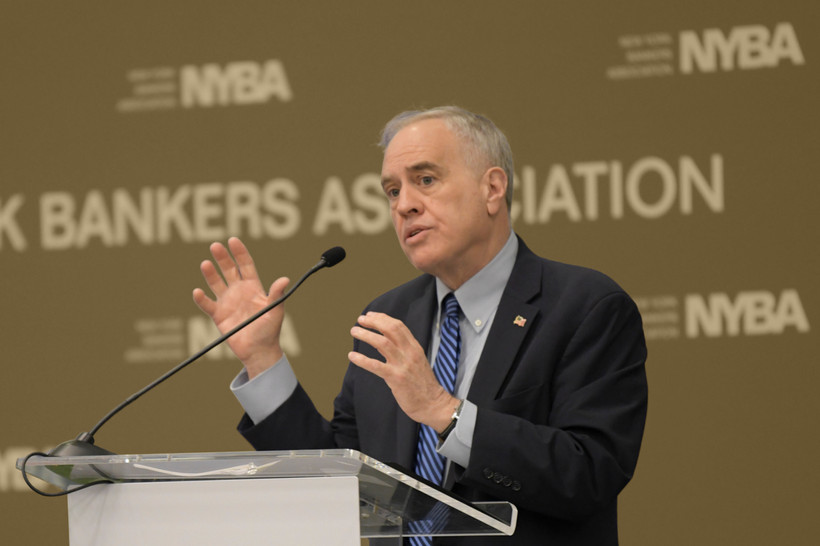
Comptroller Tom DiNapoli speaks at a podium, gesticulating with his hands.
New York Focus has found that a number of firms DiNapoli’s office chose to litigate on behalf of the pension fund have also contributed to his campaigns. | Photo: NYS Comptroller's Office | Illustration: New York Focus

Sign up for Staying Focused, our newsletter keeping readers up to speed on New York politics.

In his two decades as New York’s comptroller, Tom DiNapoli has filed lawsuits securing hundreds of millions of dollars in settlements from corporations he’s accused of defrauding the state’s main pension fund. 

The main beneficiaries of DiNapoli’s litigation are retired government workers whose pensions are supported by the fund. But the cases are also big business for law firms that can earn multi-million-dollar fees from a single successful case. 

Now, a New York Focus analysis of public records has found that a number of firms DiNapoli’s office chose to litigate those cases have also contributed to his campaigns.

The comptroller has accepted about $840,000 in campaign contributions since 2008 from lawyers at 13 law firms specializing in bringing lawsuits on behalf of pension funds and other investors. Almost three-quarters of that total came from eight law firms DiNapoli has tapped to litigate on behalf of the state pension fund since he assumed the office in 2007. 

The campaign contributions are legally permissible. But DiNapoli faces a competitive election this year, and three of his opponents say the donations represent a conflict of interest and pledge to curb or refuse them.

DiNapoli’s office said he had set the “highest ethical bar for the office and the state’s pension fund,” noting that a recent independent fiduciary review found he’d managed the fund “with the highest ethical, professional, and conflict of interest standards.’” DiNapoli’s litigation has achieved major corporate reforms, ranging from increased airline safety at Boeing to greater protection from sexual harassment at the hotel and casino company Wynn Resorts. 

DiNapoli’s predecessor as comptroller, Alan Hevesi, pled guilty to accepting free travel and other benefits from the principal of a private equity firm that received $18 million in management fees from the pension fund.

Early in his tenure, DiNapoli voluntarily barred investment advisers that donated to a comptroller campaign from managing pension fund assets for two years. (The federal Securities and Exchange Commission was simultaneously moving to adopt a similar nationwide restriction). 

At times, DiNapoli has refused to accept donations from the law firms that seek to bring litigation on behalf of the pension fund. A 90-day contribution blackout occurs around the period, roughly every four years, when law firms submit bids seeking to be part of a “pool” that is eligible to represent the fund. There are currently 18 law firms in the pool.

For the law firms, pool selection is only the first step towards a major payday. These firms must then convince DiNapoli’s office to hire them for a lawsuit against a publicly traded company or its officers. During this process, there is no contribution blackout period, and DiNapoli has accepted donations around the time firms have been hired.

DiNapoli has taken steps to clean up the scandal-plagued office. But in a state elections system dominated by big money, there were limits to the campaign finance restrictions he could unilaterally impose on himself, he said.

“I’ve gone further than anybody else in this office to limit the opportunity for money to be a key factor in what we’re doing, but it’s not the perfect solution,” DiNapoli told The New York Times in 2009. “Unless we have public financing, I’m going to do the best I can with the limits I’ve put forward.”

New York does now have a publicly funded elections program, which matches small donations with public dollars, and DiNapoli is enrolled. Still, he has continued to take large donations from lawyers that seek to represent the pension fund, including $25,000 in March from partners at the powerful law firm Bernstein Litowitz Berger & Grossmann.

Attorneys from the firm have given at least $211,000 in total to DiNapoli — more than any other firm — and also have represented the pension fund. 

This June, DiNapoli is facing his first Democratic primary challenge since assuming the office.

One of his primary challengers, Drew Warshaw, said he would refuse all donations from lawyers that do business with the fund. He said the limitation should apply to all candidates for the office, and called DiNapoli’s ban on law firm contributions during the every-four-year bidding process a “smoke screen.”

“If you believe there should be a ‘blackout period’ — because you’re concerned about undue influence — it follows that you wouldn’t allow this money to come in at all,” Warshaw said. 

Another Democratic primary challenger, Raj Goyle, charged that DiNapoli was engaged in “a longtime pay-to-play scandal.” Goyle also said he would refuse all campaign donations from lawyers who seek to represent the fund. A comptroller’s decisions about whether to sue a company should be made on the merits, he said, and not about a “pipeline where law firms are pitching cases and then, in return, giving financial contributions to a campaign.”

Joseph Hernandez, the Republican nominee and a longtime Wall Street investor, has highlighted the Bernstein Litowitz donations as an example of “pay-to-play.” Any law firm that donated to the Hernandez campaign would not be allowed to do business with the pension fund under his leadership for two years, he said. Echoing a longtime criticism lodged by Republicans and business leaders, Hernandez called law firms that specialize in bringing such lawsuits “public markets ambulance chasers.”

DiNapoli spokesperson Matthew Sweeney said that for nearly 20 years, DiNapoli had led by example by imposing his own restrictions on donations to his campaign beyond what the law requires and “not taken any improper donations.”

“Claims that campaign contributions influence the Fund’s litigation decisions are baseless — they ignore a staff-driven, competitive procurement process and rigorous, multi-layered, expert case evaluation,” Sweeney said. “This is an independent, merit-based system, fully insulated from politics.”

Valued at nearly $300 billion, the New York State Common Retirement Fund is an investment pool that supports pension payments to retired state and local government workers. 

The law firms that seek to represent it compete in a world that is competitive, risky, and lucrative. They look for drops in the stock prices of companies owned by the fund that could be linked to corporate fraud that misled investors, or instances where corporate officers may have breached fiduciary duties, then pitch potential lawsuits to the comptroller’s office. 

They are not paid with tax dollars and instead work on a contingency fee, fronting substantial litigation costs and betting on winning a major settlement or verdict, for which they would earn a percentage of the payout. 

Because of its size, the state pension fund is often chosen by judges as “lead plaintiff” in class action cases it chooses to pursue — a designation crucial to its law firms’ prospects of landing a major payday.

During the competitive bidding process for selecting New York’s “pool” of law firms, responses are scored by legal staff who have “no knowledge of any political contributions,” according to DiNapoli’s office. DiNapoli has no role in this selection, according to the office, which said law firms in the pool are subject to “strict fee limits” lower than typical fee arrangements in the industry.

When law firms within the pool pitch specific ideas for litigation, the proposals are first vetted by legal staff, and any recommendation to move forward must then be approved by DiNapoli’s counsel, the office said. If his staff recommends pursuing a lawsuit, proposals are reviewed by a committee composed of a handful of senior staff from the office and pension fund  — and DiNapoli only provides his approval after the committee members make the final recommendation. 

According to DiNapoli’s office, he has “never” overruled the recommendation of the selection committee. 

The office has been selective, filing only 11 cases since 2007, but when such a case does go forward, the settlements — and payouts to his office’s lead outside counsel — can be massive.

Bernstein Litowitz knows this well. The Manhattan-based law firm has obtained many of the largest monetary recoveries in history — over $40 billion on behalf of investors across the country — and itself achieved significant corporate governance reforms.

It also has a long track record of making campaign donations to New York state comptrollers.

Before former Comptroller Carl McCall tapped the firm for a major case against the company Worldcom, founding partner Max Berger donated $12,500 to McCall’s re-election bid. 

In a 2005 interview with Bloomberg, Berger reportedly said such campaign donations were about “getting a foot in the door.” (Bernstein Litowitz told New York Focus that Berger denies making the statement attributed to him in the 2005 Bloomberg article and said “would never have used such language” in that context. No correction has been made to the 21-year-old article concerning the quote.) Berger remains at the firm and donated to DiNapoli as recently as March.

In the Worldcom lawsuit, Bernstein Litowitz accused the telecommunications company of rampant accounting fraud. The case ultimately settled for more than $6 billion. The judge reportedly awarded about $335 million for legal fees, calling the firm’s work “superb.” As co-lead counsel, Bernstein Litowitz was entitled to a significant chunk.

Under DiNapoli, the firm’s donations have continued. Attorneys with the firm donated $5,000 to his campaign in June 2024. Three months later, DiNapoli applied to be lead plaintiff in a case against the cybersecurity company CrowdStrike with Bernstein Litowitz as lead counsel. Several months later, attorneys at the firm donated an additional $25,000. 

Before being selected for that litigation, Bernstein Litowitz was required to provide a significant amount of information regarding the merits of the case and the firm’s qualifications, and undergo detailed interviews with DiNapoli’s counsel, according to the law firm. This was the first time during DiNapoli’s long tenure that Bernstein Litowitz had been selected to represent the pension fund in securities or derivatives litigation. 

Bernstein Litowitz had unique qualifications to be selected in this case: In 2023, it won a $26 million settlement, paid out by a software company called SolarWinds, which allegedly failed to tell investors about security vulnerabilities before a massive cyberattack. That case unfolded in the courtroom of a Texas federal judge Robert L. Pitman. 

The CrowdStrike case concerned similar subject matter — and was also to be heard in Pitman’s courtroom. But this time, the result was very different. In January, Pitman dismissed the case. In March, law firm partners donated another $25,000 to DiNapoli. 

John Rizio-Hamilton, a partner at Bernstein Litowitz, told New York Focus that “law firms across the country — whether representing defendants, plaintiffs, or both — routinely make political contributions to candidates who share their values.” 

He said Bernstein Litowitz “proudly supports candidates like Comptroller DiNapoli who share our commitment to protecting victims of corporate wrongdoing.”  

Before its appointment in the CrowdStrike case, another battle involving Bernstein Litowitz spilled into public view.

In 2019, New York City’s main pension fund accused two law firms within its own pool — Bernstein Litowitz and another firm — of using access to the fund’s confidential trading data to help a different client be appointed lead plaintiff in a class action lawsuit.

The firms argued that the information was not subject to attorney-client privilege. When an Illinois federal judge issued a ruling, he did not comment on the alleged ethical lapse but did approve of the firms as co-lead counsel in the case. The law firms later struck a settlement for their client and were awarded $90 million in attorneys’ fees.

In a different state, Bernstein Litowitz’s work for another pension fund client also drew notice. During the late 2000s, the Mississippi attorney general’s office frequently appointed Bernstein Litowitz as lead counsel in lawsuits, while the firm donated heavily to Mississippi Attorney General Jim Hood’s campaign. 

Hood’s office also requested that Bernstein Litowitz retain Mississippi-based law firms during litigation, including one sole practitioner who was married to an official in the attorney general’s office. In a court filing, Hood’s office said the hirings were part of a policy to promote the hiring of “qualified minority attorneys.”

Lawyers at another major plaintiff’s firm, Lieff Cabraser Heimann & Bernstein, have donated $120,000 to DiNapoli since 2008. 

And while Bernstein Litowitz has been tapped by DiNapoli’s office to bring only one case during his tenure, Lieff Cabraser has been selected for four.

In January 2020, the firm’s attorneys donated $15,000, and five months later, the firm filed a lawsuit against Boeing’s board of directors and officers on behalf of DiNapoli and the pension fund. 

A judge approved a $237 million settlement in March 2022 — money that in this instance was paid back to Boeing itself — and Lieff was awarded $18.2 million along with the other lead co-counsel. Firm attorneys donated another $15,000 seven months later. DiNapoli’s office said the settlement “stands as a landmark for settlement value, corporate governance reform and increased passenger safety.”

Steven Fineman, managing partner of Lieff Cabraser, said the firm never discussed its request for proposal responses with DiNapoli or his campaign staff, and that during the course of the four lawsuits, it never had any communication with DiNapoli and instead dealt with the pension fund’s legal department.

“Lieff Cabraser and its partners have proudly supported Comptroller DiNapoli’s campaigns, just as we have dozens of other state, federal, and local candidates for elected office throughout the country who share our values and priorities,” Fineman said. The firm rejects “any connection between contributions to the campaigns of Comptroller DiNapoli and our representation of the New York State Common Retirement Fund.”  

Three years before being tapped for the Boeing case, a court-appointed special master found Lieff Cabraser and two other firms had submitted an inflated fee request after reaching a $300 million settlement on behalf of an Arkansas pension fund.

A Massachusetts judge reduced the firm’s collective fees from $75 million to $60 million. He found the firms had committed “misconduct,” although Lieff to a lesser extent than the other two. An appeals court upheld the sanction.  

Fineman emphasized that Lieff was not lead counsel in the case and had simply agreed to a fee brief signed and filed by a different firm.

“Importantly, the court did not impose any monetary fine on LCHB, and no LCHB attorney was sanctioned,” Fineman told New York Focus. 

He said the issues in the Massachusetts case, which the firm disclosed to DiNapoli’s office, were unrelated to the firm’s longstanding work for New York’s pension fund.

“We assume that [the New York pension fund’s] legal department was more interested in the firm’s track record of work for the Fund, not to mention the firm’s 53-year history of success and exemplary professionalism,” Fineman said.  

For its part, DiNapoli’s office declined to say whether these past issues related to Bernstein Litowitz or Leiff Cabraser were disclosed or considered during competitive bidding or lead plaintiff selection processes. 

Some firms have been donors, but haven’t scored appointments. Kaplan Fox attorneys, for instance, have thrown at least seven campaign fundraisers for DiNapoli between 2013 and 2023 and given $72,000, according to records. But during DiNapoli’s tenure, the firm does not appear to have been tapped to lead securities or derivatives litigation for the state pension fund. 

At New York Focus, our central mission is to help readers better understand how New York really works. If you think this article succeeded, please consider supporting our mission and making more stories like this one possible.

New York is an incongruous state. We’re home to fabulous wealth — if the state were a country, it would have the tenth largest economy in the world — but also the highest rate of wealth inequality. We’re among the most diverse – but also the most segregated. We passed the nation’s most ambitious climate law — but haven’t been meeting its deadlines and continue to subsidize industries hastening the climate crisis.

As New York’s only statewide nonprofit news publication, our journalism exists to help you make sense of these contradictions. Our work scrutinizes how power works in the state, unpacks who’s really calling the shots, and reveals how obscure decisions shape ordinary New Yorkers’ lives.

In the last two decades, the number of local news outlets in New York has been nearly slashed in half, allowing elected officials and powerful individuals to increasingly operate in the dark — with the average New Yorker none the wiser.

We’re on a mission to change that. Our work has already shown what can happen when those with power know that someone is watching, with stories that have prompted policy changes and spurred legislation. We have ambitious plans for the rest of the year and beyond, including tackling new beats and more hard-hitting stories — but we need your help to make them a reality.

If you’re able, please consider supporting our journalism with a one-time gift or a monthly gift. We can't do this work without you.

Thank you,

Akash Mehta
Editor-in-Chief
A photo of Akash Mehta.
A photo of Chris Bragg.
Chris Bragg is the Albany bureau chief at New York Focus. He has done investigative reporting on New York government and politics since 2009, most recently at The Buffalo News and Albany Times Union.
Also filed in Elections

The last-minute influx, the biggest ever for a legislative primary, is boosting her opponent, Jessica González-Rojas.

Millions in outside spending was a boon to Gov. Kathy Hochul’s 2022 opponent, Lee Zeldin, and influenced down-ballot races.

Hakeem Jeffries urged Albany to avoid maps that aggressively boosted Democrats, sources told New York Focus.

Also filed in New York State

City budget gaps and an ambitious affordability agenda may require pressing Albany again for taxes and aid.

A bill awaiting the governor’s signature would relax restrictions on who can qualify for victim compensation.

We’ve compiled information for the 450,000 New Yorkers who will lose health care coverage on July 1.