New York Is Funding Private Equity’s Real Estate Buying Spree

The Carlyle Group’s effort to buy up rental housing has gotten a $578 million boost from the city and state.

Nick Garber   ·   April 16, 2026
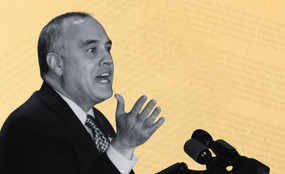
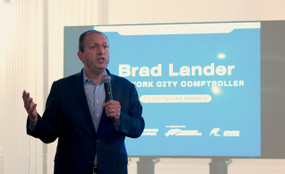
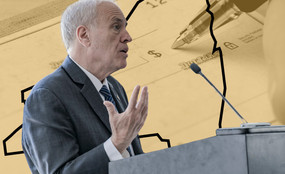
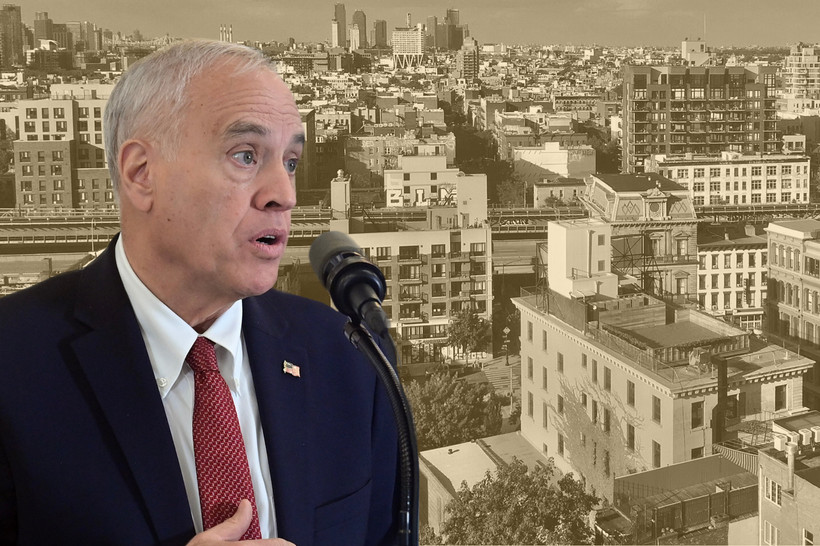
New York’s partnership with the Carlyle Group was overseen by State Comptroller Thomas DiNapoli. | Photos: Metropolitan Transit Authority; Andre Carrotflower/Wikimedia Commons

Sign up for Staying Focused, our newsletter keeping readers up to speed on New York politics.

One of the world’s largest private equity firms has bought up hundreds of apartment buildings across Brooklyn and Queens in the last few years, part of a trend that state leaders have sought to curb. As the firm, the Carlyle Group, gears up for a new buying spree, it will be fueled in part by a notable investor: the state’s own pension fund.

New York’s Common Retirement Fund announced in August 2024 that it would invest $400 million in Carlyle Realty Partners X, a fund focused on residential and commercial properties. In recent years, Carlyle has put such funds toward its buyup of New York City real estate — purchasing well over 200 buildings worth more than $800 million since 2021, according to reporting by Crain’s New York Business.

New York’s investment was reported at the time by a handful of trade publications, but attracted little notice otherwise. It stands out now, as political leaders from Governor Kathy Hochul to President Donald Trump try to curb private equity’s influence on the housing market — and as the politicians who manage the retirement savings of government workers try to pursue good returns without working against their own policy goals.

“Public pension funds [need] to generate substantial enough returns that they pay for a growing number of pensions, while also not undermining the public purpose,” said Samuel Stein, a housing policy analyst for the nonprofit Community Service Society. “That’s where all sorts of interesting contradictions end up arising.”

New York’s partnership with Carlyle was overseen by state Comptroller Thomas DiNapoli. In a statement, a spokesperson emphasized DiNapoli’s legal obligation to act in the best interest of the 1.2 million members and beneficiaries of the state’s retirement fund.

“The comptroller does not base investment decisions on external policy considerations unless those considerations are material to the fund’s fiduciary evaluation of risk and return,” spokesperson Mark Johnson said. “Real estate is a key component of the fund’s diversified portfolio and is important to meeting its long-term return target.”

The Carlyle Group declined to comment.

An “Attractive” Housing Market

Real estate investments are nothing new for New York’s pension fund, which controls nearly $300 billion. The state has about $28 billion invested in private equity real estate funds, including more than $2 billion controlled by Blackstone, which invests in projects around the world.

But Carlyle is notable for its activity within New York City and its focus on small properties where it can easily raise rents.

Carlyle’s purchases have been largely three- and four-story walk-ups in gentrifying neighborhoods like Bushwick, Greenpoint, Ridgewood, and Crown Heights, Crain’s reported. They also tend to be non-rent-stabilized, giving the new landlord more room to take advantage of the city’s squeezed housing market and jack up rents. Carlyle’s acquisitions are usually smaller than 10 units, which means the company tends to pay less in property taxes than bigger buildings.

New York state’s Common Retirement Fund has invested in at least two previous Carlyle funds focused on real estate since 2008, according to public disclosures. Carlyle’s four most recent real estate funds all produced positive returns for investors after accounting for the fees Carlyle charged, according to the company’s most recent earnings report. (These “internal rates of return” can be unreliable and subject to manipulation by private equity firms, experts have warned.)

When Carlyle closed fundraising on its newest real estate arm last August, it signaled that it would continue investing in residential, self-storage, and industrial properties that have “attractive supply-demand dynamics,” while putting no money into office, hotel, or retail.

Since the start of 2026, Carlyle’s purchases have included a 13-story rental building in Gowanus and two Park Slope rowhouses, according to reports and public records. (Carlyle’s purchases are typically made through linked shell companies, which makes it unclear which specific fund made each acquisition.)

A clear picture of Carlyle’s behavior as a landlord is still emerging, given how recently its buying spree began. Some anecdotes involving the company’s earlier purchases have been critical: Tenants of newly acquired Carlyle buildings in Bushwick and Bedford-Stuyvesant told The New York Times in 2023 that their new landlords were far less responsive and proposed new leases with steeper rent increases and faster lease terminations than previous owners had.

“When my lease expired in November, my new landlord told me they needed to reevaluate my rent based on the market bouncing back. They suggested nearly a 50 percent increase from what I had been paying,” one Carlyle tenant, Aneta Molenda, told a US Senate housing committee hearing in 2022. (Molenda said she ultimately negotiated a smaller rent increase.)

Greenbrook Partners, a real estate firm that has partnered with Carlyle on at least 262 Brooklyn and Queens buildings, reached a settlement with the state attorney general in 2022 after being accused of harassing tenants. The settlement did not mention the Carlyle Group.

A Carlyle spokesperson told the Times in 2023 that it was committed to investing in high-quality housing, adding that the company would “provide residents with premium level services, reduce energy consumption and create a better experience for current and future tenants.”

New York state’s $400 million investment in Carlyle Realty Partners X was second only to the $500 million invested by California’s state pension fund, according to data compiled by Bloomberg. New York City also put in a combined $178 million in 2024 through three of its five pension funds, overseen by then-city Comptroller Brad Lander.

Lander left office this year and was replaced by Mark Levine. DiNapoli, meanwhile, is facing a rare challenge in the June Democratic primary from three candidates: Drew Warshaw, a nonprofit executive and former Port Authority official; Raj Goyle, an entrepreneur and former Kansas lawmaker; and Adem Bunkeddeko, a former congressional candidate. All three have said they would ramp up pension fund investments in affordable housing construction, and Warshaw has said he’d move funds away from investment managers who come with high fees, like private equity, and toward low-cost index funds.

Ludovic Phalippou, an economist at the University of Oxford who studies private equity, said New York’s investments with Carlyle could result in a “strange equilibrium,” where workers’ retirement money pays for real estate deals that could ultimately hurt them.

“Workers’ savings are used to fund strategies that extract value from assets those same workers depend on — including their housing. Some of that value is returned to them in the form of pension performance, but much of it is absorbed along the way through fees,” Phalippou said in an email, referring to the high fees that the firms often charge their investors.

“People may get slightly better pensions, but face higher rents, lower service quality, and greater financial fragility in their daily lives,” he said.

Johnson, the DiNapoli spokesperson, said the state’s investment in the latest Carlyle fund was made through the office’s typical process, which included evaluation by staff, review by a dedicated Real Estate Advisory Committee, and final consideration by the comptroller.

“Investments are assessed based on their strategic fit within the portfolio, expected risk-adjusted returns, diversification benefits, the manager’s experience and track record. Investments are also evaluated and recommended by independent consultants,” Johnson said. “Carlyle is an established institutional real estate manager with a long history of investing across market cycles and a broad base of sophisticated investors, including major public pension plans.”

Bad Landlords or Scapegoats?

Political leaders have grown increasingly concerned about the rise of institutional investors in the housing market, blaming the trend for exacerbating housing costs locally and nationally — although some experts are dubious.

In last year’s state budget, Governor Hochul pushed through a set of new laws aimed at investors who own 10 or more single- or two-family homes. The laws require these investors to wait 90 days after a single- or two-family home is listed for sale before making an offer, and limit the tax deductions they can take on those homes. (DiNapoli did not take a public position on Hochul’s proposals.)

Meanwhile, President Trump issued an executive order in January that seeks to end federal support for large investors’ purchases of single-family homes. And Congress is currently contemplating a housing package that would ban any investor from buying more than 350 single-family homes.

Those policies might have a limited impact on Carlyle, given its focus on multifamily rental buildings. And some experts argue that institutional investors receive outsized attention in a housing crisis driven mainly by a lack of construction. Rather than worsen the housing crisis, private equity firms can be a positive force because they have the capital needed to renovate deteriorating homes and sometimes build new ones, some scholars have suggested.

A study published in November by New York University’s Furman Center found that corporate landlords filed more evictions and charged higher asking rents than non-corporate owners in New York City. But the differences between the two groups shrunk by half after the authors controlled for other factors like how recently a building was renovated.

“Our findings show that many of the accusations about corporate landlords may be overstated,” wrote the authors. “But they also suggest some differences and underscore the importance of transparency and accountability in rental housing ownership.”

At New York Focus, our central mission is to help readers better understand how New York really works. If you think this article succeeded, please consider supporting our mission and making more stories like this one possible.

New York is an incongruous state. We’re home to fabulous wealth — if the state were a country, it would have the tenth largest economy in the world — but also the highest rate of wealth inequality. We’re among the most diverse – but also the most segregated. We passed the nation’s most ambitious climate law — but haven’t been meeting its deadlines and continue to subsidize industries hastening the climate crisis.

As New York’s only statewide nonprofit news publication, our journalism exists to help you make sense of these contradictions. Our work scrutinizes how power works in the state, unpacks who’s really calling the shots, and reveals how obscure decisions shape ordinary New Yorkers’ lives.

In the last two decades, the number of local news outlets in New York has been nearly slashed in half, allowing elected officials and powerful individuals to increasingly operate in the dark — with the average New Yorker none the wiser.

We’re on a mission to change that. Our work has already shown what can happen when those with power know that someone is watching, with stories that have prompted policy changes and spurred legislation. We have ambitious plans for the rest of the year and beyond, including tackling new beats and more hard-hitting stories — but we need your help to make them a reality.

If you’re able, please consider supporting our journalism with a one-time gift or a monthly gift. We can't do this work without you.

Thank you,

Akash Mehta
Editor-in-Chief
A photo of Akash Mehta.
A photo of Nick Garber.
Nick Garber covers politics for New York Focus. He previously worked for Crain’s New York Business, where he covered city and state government, housing and real estate, and money in politics. He also covered neighborhood news in Manhattan and Queens for Patch, and got… more
Also filed in New York State

The last-minute influx, the biggest ever for a legislative primary, is boosting her opponent, Jessica González-Rojas.

City budget gaps and an ambitious affordability agenda may require pressing Albany again for taxes and aid.

A bill awaiting the governor’s signature would relax restrictions on who can qualify for victim compensation.

Also filed in New York City

A lawsuit accuses federal officials of ignoring evidence that the boy, born in Mexico, held US citizenship through his mother.

We’ve compiled information for the 450,000 New Yorkers who will lose health care coverage on July 1.

The citizens assembly model, used for public decision-making around the world, is gaining traction in New York.

Also filed in Housing

In May, state lawmakers passed a $269 billion budget after haggling for months over thousands of line items and policies affecting New Yorkers.

Some of the city’s new aid will be canceled out by pension boosts.

A law designed to protect the environment will be partially rolled back to pave the way for much-needed homes.