Will New York City Drop BlackRock Over Climate?

Outgoing Comptroller Brad Lander wants the city’s pension funds to reconsider $42 billion in investments with the firm, but it may fall to his successor to take action.

Colin Kinniburgh   ·   December 15, 2025
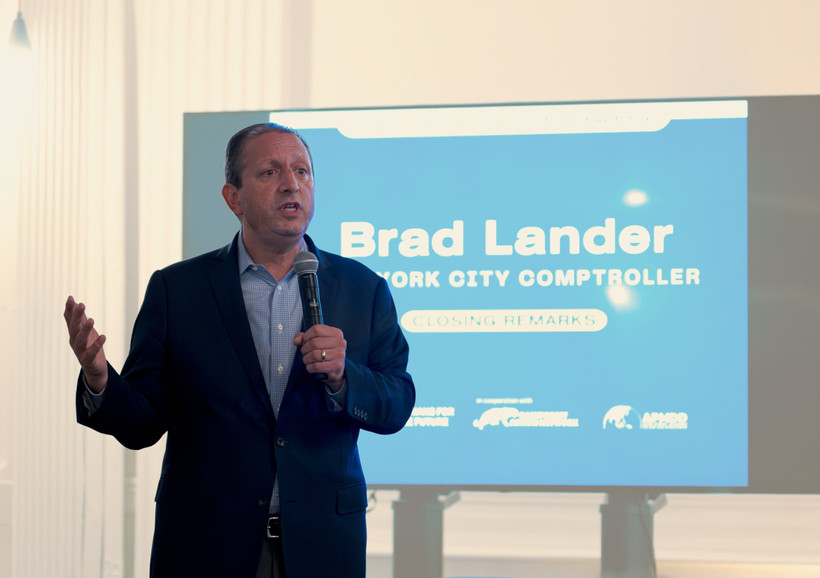
New York City Comptroller Brad Lander has long spoken about aligning finance with net-zero climate targets, like at this event in 2024. | Erik McGregor via Rainforest Action Network / Flickr | Illustration: New York Focus

Sign up for Staying Focused, our newsletter keeping readers up to speed on New York politics.

Update: December 18, 2025 — At their December 17 meeting, New York pension fund trustees tabled Comptroller Brad Lander’s proposal to rebid a contract with BlackRock, leaving the potential $42 billion move up to his successor.

New York City Comptroller Brad Lander has a message for the world’s biggest investment firm: Clean up your act, or lose our money.

Just before Thanksgiving, the outgoing comptroller — and now congressional candidate — published a letter to the trustees of the city’s largest pension funds, recommending that they rebid $42 billion worth of investments entrusted to BlackRock, the world’s largest money manager. The firm, which manages roughly one-fifth of the city’s $300 billion pension systems, has failed to live up to the funds’ net-zero climate standards, Lander said.

Climate groups have for years been calling on Lander to cut ties with Blackrock unless it cleans up its portfolio, charging that it is one of the largest investors in fossil fuel infrastructure in the world. The company announced ambitious climate plans in 2020 and 2021, but has since downplayed its ability to force corporate action and this year left a major net zero finance group after blowback from US Republican officials.

“The systemic risk of the climate crisis threatens the long-term value of New York City’s pension funds,” Lander said in a statement accompanying the November proposal.

Lander’s proposal would be an ambitious step toward aligning the city’s pension investments with its climate goals — if the pension boards approve it. The funds’ last board meeting of the year, and of Lander’s tenure, is scheduled for Wednesday, December 17. None of the trustees have publicly committed to a vote.

The comptroller’s office says he supports an immediate vote, after initially suggesting he was ready to pass the baton on the issue. Some climate activists are pushing hard to make it happen.

Lander “has made a huge and great proposal to clean the pension funds and give money from dirty money managers to cleaner money managers,” said Pete Sikora, who leads climate campaigns at the advocacy group New York Communities for Change, or NYCC. “He has to assemble the votes to pass that proposal in December as he goes out the door. Otherwise, it’s just more hot air.”

NYCC has pressed Lander to divest from BlackRock for years, at times cheering him and at others hounding him at public events with chants of “BlackRock Brad.”

The firm, meanwhile, has bemoaned Lander’s recent proposal as “another instance of the politicization of public pension funds, which undermines the retirement security of hardworking New Yorkers.”

So what exactly is Lander proposing, why does it matter, and what could happen next?

New York City’s pension power

New York City has one of the largest pension systems in the world, rivaling those of entire countries. Its five funds — pooling the retirements of current and former teachers, police, firefighters, and countless other city employees — together hold more than $300 billion.

The city comptroller and the trustees are charged with investing that money to guarantee steady returns for pension holders. The comptroller, specifically, oversees the full pension system and serves on each fund’s board, guiding them on major investment and policy decisions. That includes contracting with asset management firms, who steward the pension money day to day.

As a major investor, the city can exert pressure on the world’s largest corporations, directly or indirectly, by moving its money or voting as a shareholder.

Almost five years ago, under former Mayor Bill de Blasio and Comptroller Scott Stringer, the city dropped $4 billion worth of the pension funds’ investments in fossil fuel companies, arguing that it was in the city’s financial interest to protect itself from climate change. In 2023, under Lander, three of the five city pension funds — excluding police and firefighters — adopted plans to zero out all emissions from their portfolios by 2040.

Blackrock’s climate record

Climate hawks said the only way to achieve a net-zero emissions portfolio would be to put pressure on the outside firms managing the funds’ investments. The largest share — more than $50 billion — is managed by BlackRock.

This year, Lander reviewed each of the city’s money managers for their compliance with the funds’ net-zero plans. In November, he found that BlackRock and two other firms were falling short. (The other two firms, Fidelity and PanAgora, manage a much smaller share of the city funds, around $400 million each. They have not responded publicly to Lander’s letter.)

BlackRock owns a 5 percent or larger stake in some 2,800 companies, by Lander’s count. They include some of the world’s largest fossil fuel companies, such as ExxonMobil and Chevron, as well as utilities and other polluting businesses. As a major stakeholder, the firm has massive financial leverage to press big corporations to cut pollution; climate groups and the comptroller say the firm has failed to do so, despite its promises five years ago.

BlackRock has disputed this characterization. “Setting, executing, and overseeing strategy are the responsibility of management and [a company’s] board,” the firm said in a report this year. “As one of many minority shareholders on behalf of our clients, BlackRock does not direct a company’s strategy or its implementation.” The firm has called the clean energy transition a “mega force” shaping the global economy, and says it provides sustainable investment options to all of its clients.

Brad Lander’s proposal

Lander proposed rebidding the pension funds’ core BlackRock investments — $42 billion worth — meaning the city would decline to renew BlackRock’s contract and instead start a process where any firm could vie for it. That would give the firm a chance to prove it can go green, or open the door to one of its competitors.

In his November letter, Lander wrote that the firm has decided that it will not exercise its full shareholder voting powers because of a “conservative interpretation” of rules issued by President Donald Trump’s administration early this year.

Those rules aimed to crack down on sustainable or “ESG” — or, as Republicans have called it, “woke” — investing. Red states pulled several billion dollars from BlackRock in 2022 on the grounds that the firm was being too proactive on climate and other issues, and more recently a group of Republican state attorneys general sued the firm for similar reasons.

In late November, BlackRock called Lander’s divestment proposal part of the same politicization. The firm said it could offer an investment program to all of the city’s pension funds that could meet their sustainability standards, and suggested that it would likely seek out a new contract to manage the city funds if the proposal were to advance. (A BlackRock spokesperson declined to comment further.)

Sikora said rebidding the pension holdings could have a huge impact.

“Our goal is to clean up the industry,” Sikora said. “Bumping off $42 billion from BlackRock and then rebidding it would create a competition for who’s the cleanest asset manager.”

What’s next?

Any rebid would need to be approved by all three funds that have adopted net zero plans: those for teachers and other school workers, called TRS and BERS, and for all other civilian city employees, called NYCERS.

NYCERS and BERS have a joint investment meeting on Wednesday, December 17, where they could vote to advance the proposal.

New York Focus contacted the offices of all 10 trustees and public employee representatives on the board, who include a City Hall official, Public Advocate Jumaane Williams, all five borough presidents, and three union leaders. Most of them either did not respond or declined to comment.

Isabel Shepard, a spokesperson for Brooklyn Borough President Antonio Reynoso, said Reynoso “urges the trustees to take a position on this as soon as possible” but declined to comment further, citing his fiduciary role.

Outgoing Manhattan Borough President Mark Levine, who will assume the comptroller post in January, said through a spokesperson that he appreciated Lander’s work and would review the recommendations with the trustees. “The Comptroller-elect is committed to responsibly managing climate risk as part of the City’s fiduciary duty,” said the spokesperson.

If the proposal does not advance on Wednesday, it can still be voted on next year, when incoming mayor Zohran Mamdani will have a bully pulpit and appointees with sway in the process. Transition team spokesperson Dora Pekec did not respond to a request for comment.

Stringer, the former comptroller who ran for mayor against Mamdani and Lander, said it was unrealistic to expect the pension funds to take action before the end of the year.

“If you think that’s happening in December, I have a bridge to sell you,” he said.

Stringer blamed Lander for making the proposal in the final weeks of his term. “When you do performative action 15 days before you leave office, you do not give the cause of climate change the justice it deserves,” he said.

Lander has said the review and recommendations he has put forward live up to the commitments he made.

I hope this article helped you better answer the question that guides all of our journalism: Who runs New York? Before you click away, please consider supporting our work and making more stories like this one possible.

New York state is standing at a crossroads for climate action. After passing one of the nation’s most ambitious climate laws in 2019, the state is lagging far behind on its targets, struggling to meet deadlines to build renewable energy and clean up its buildings and roads. Other states are closely watching our progress, making decisions about their own climate plans based on New York’s ability to implement this legislation.

As New York’s only statewide nonprofit news publication, we’ve been scrutinizing the state’s climate progress. Our journalism exists to unpack how power works in New York, analyze who’s really calling the shots, and reveal how obscure decisions shape ordinary New Yorkers’ lives.

But we can't do this work without your help. We rely on reader donations to help sustain our outlet, and every gift directly allows us to publish more pieces like this.

Our work has already shown what can happen when those with power know that someone is watching, with my reporting prompting a state investigation and fine for a major corporation. I have more story ideas than I can count, but only limited resources to pursue all the leads that come across my desk.

If you’re able, please consider supporting our journalism with a one-time or monthly gift. Even small donations make a big difference.

Thank you for reading.

Colin Kinniburgh
Climate and Environmental Politics Reporter
A photo of Colin Kinniburgh.
Colin Kinniburgh is a reporter at New York Focus, covering the state’s climate and environmental politics. He has worked in media for more than a decade, across print, television, audio, and online news, and participated in fellowship programs at CUNY’s Graduate School of Journalism… more
Also filed in New York City

Resorts World is floating legislation to avert more than $500 million in payments to the horseracing industry.

Some of the city’s new aid will be canceled out by pension boosts.

The Department of Justice has terminated more than 100 immigration judges since last year as it has pressured courts to order more deportations.

Also filed in Climate and Environment

Governor Kathy Hochul was successful in her bid to upend the Climate Leadership and Community Protection Act after legislators caved to finalize an overall budget deal.

The leader of Reinvent Albany discusses a data center subsidy in Rockland County that flew under the radar for years.

No other project in the country has gotten such a large subsidy to create so few jobs, according to watchdogs.

Also filed in Explainers

We’ve compiled information for SNAP recipients in New York on the changing work requirements.

We answer your questions on the state’s notoriously opaque budget process.

Amid abortion bans and rising digital surveillance, Albany lawmakers are revisiting an effort to stop companies from selling sensitive health information.