Regulators Crack Down on a Troubled New York Solar Company

Attyx, formerly known as SUNCo, is set to lose its license to operate in the state over what regulators called “false and misleading” sales pitches.

Colin Kinniburgh   ·   July 23, 2025
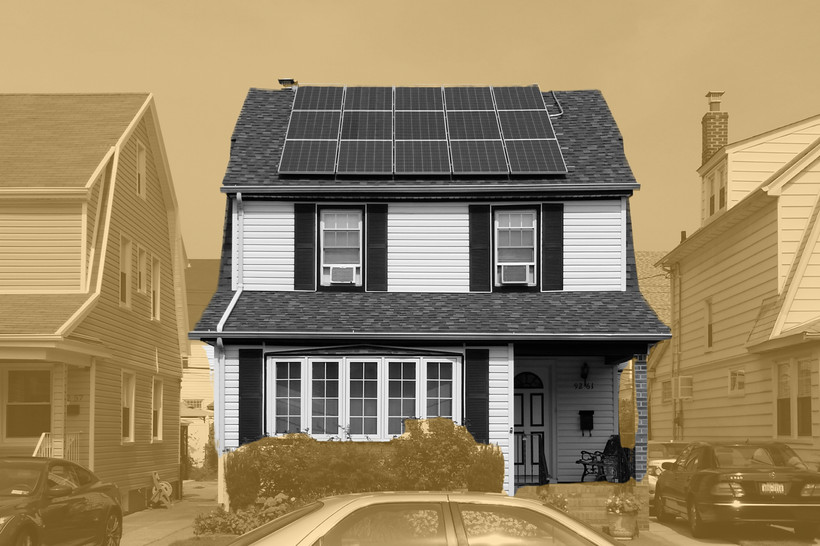
A residential home with rooftop solar panels in Queens Village, NY. | Photo: Matt Green/Flickr | Illustration: Leor Stylar

Sign up for Staying Focused, our newsletter keeping readers up to speed on New York politics.

A rooftop solar company with a vexed history could soon be out of business in New York.

On Tuesday, utility regulators moved to strip Attyx, formerly known as SUNco, of its license to operate in the state unless it can prove within 30 days why it should be allowed to stay in business.

Regulators accused the company of “misleading or deceptive” marketing that led homeowners to sign up for solar under the false pretext that they would get their roofs replaced for free, thanks to generous government incentives.

Tuesday’s order from the Public Service Commission, the seven-member panel that regulates New York energy companies, said the state had received numerous customer complaints about Attyx’s practices.

Some complaints echoed the story of Claver Campbell, a Queens homeowner and retiree who sued the company and its partners last fall. As New York Focus reported at the time, Campbell found herself on the hook for a $160,000 loan — with monthly payments three times higher than she’d been led to believe — after she responded to an enticing Facebook ad and a SUNco salesperson came twice to her home to close the deal. Her lawsuit accused the company of “fraudulent, deceptive, and abusive business practices,” as well as discrimination by age and race.

Attyx is one of seven energy companies set to lose their license to operate under a string of rulings announced last Thursday by the PSC. Most of the companies had simply failed to file required paperwork, according to the rulings. But regulators singled out Attyx for its years-long pattern of bad behavior.

A February letter to the company from the Department of Public Service, the state agency that works alongside the PSC, cited three formal complaints it received from customers, all of which involved the company and its affiliates offering a “no cost” roof and using “high-pressure” sales pitches to enroll customers. At least one of the deals resulted in an unfavorable loan agreement to pay for the rooftop solar installation, the letter said, much like Campbell’s.

Since September, more than 25 readers have contacted New York Focus alleging negative experiences with solar companies; at least a dozen of the complaints involved SUNco or Attyx. (New York Focus has not yet verified the allegations.) The Legal Aid Society, which is representing Campbell in court, has also received numerous additional complaints since filing her case, according to its attorneys.

The PSC’s move is not definitive. Attyx still has 30 days to rebut the state’s allegations, and even if the commission upholds Tuesday’s findings, it could take months to revoke the company’s license. The company is, however, prohibited from signing up new customers in the meantime.

The ruling notes that Attyx had faced scrutiny from state authorities since as early as 2021, when it was still called SUNco.

In June 2021, less than a year after approving the company for state subsidies, New York’s energy research and development arm, NYSERDA, put it on probation over inadequate disclosures to customers. That November, NYSERDA barred SUNco from the subsidy program altogether — but the company continued to use a state logo in its sales agreements, until NYSERDA finally sent it a cease and desist letter almost a year later, according to the PSC. Documents that Legal Aid obtained through a public records request show that NYSERDA received close to 50 customer complaints about Attyx between 2020 and 2024.

Attyx’s general counsel, Kyle Reeder, said the company was still reviewing the PSC’s ruling. “We remain committed to working constructively with the Department of Public Service to address any concerns,” he told New York Focus in an email.

The New York enforcement action comes at a frantic time for the solar industry. Under President Donald Trump’s “Big Beautiful Bill,” signed on July 4, homeowners have only until the end of this year to take advantage of the 30 percent federal tax credit that has for decades fueled adoption of rooftop solar. The industry has relied heavily on door-to-door sales and other marketing tactics, and the bill’s passage has led some companies to step up their sales pitches in the hopes of installing as many panels as they can before the deadline.

Chris Fasano, Legal Aid’s lead attorney in Campbell’s case, worries this could encourage bad actors.

“There’s gonna be this pressure, I think, from the scammers to try to squeeze the last juice out of this scam that they can,” he said.

Fasano said that the Trump administration’s efforts to dismantle the Consumer Financial Protection Bureau, which had been monitoring complaints of “predatory solar lending” around the country, could compound the problem.

Noah Ginsburg, executive director of the New York Solar Energy Industries Association, a trade group for residential and community solar companies, said that the state has strong protections against unscrupulous behavior.

“Ethical business practices are foundational to our industry’s long-term success,” he said in a text message. “New York continues to set a high bar, and there are myriad reputable local solar + storage companies ready to continue clearing the bar and delivering value to New York families and businesses who demand lower cost clean energy.” (Attyx is not a member of Ginsburg’s trade group.)

Campbell, for her part, remains in limbo more than 10 months after filing her case. The parties had been working toward a settlement, Fasano said, but progress has stalled since one of the defendants — the national lending company Mosaic — filed for bankruptcy in June.

I hope this article helped you better answer the question that guides all of our journalism: Who runs New York? Before you click away, please consider supporting our work and making more stories like this one possible.

New York state is standing at a crossroads for climate action. After passing one of the nation’s most ambitious climate laws in 2019, the state is lagging far behind on its targets, struggling to meet deadlines to build renewable energy and clean up its buildings and roads. Other states are closely watching our progress, making decisions about their own climate plans based on New York’s ability to implement this legislation.

As New York’s only statewide nonprofit news publication, we’ve been scrutinizing the state’s climate progress. Our journalism exists to unpack how power works in New York, analyze who’s really calling the shots, and reveal how obscure decisions shape ordinary New Yorkers’ lives.

But we can't do this work without your help. We rely on reader donations to help sustain our outlet, and every gift directly allows us to publish more pieces like this.

Our work has already shown what can happen when those with power know that someone is watching, with my reporting prompting a state investigation and fine for a major corporation. I have more story ideas than I can count, but only limited resources to pursue all the leads that come across my desk.

If you’re able, please consider supporting our journalism with a one-time or monthly gift. Even small donations make a big difference.

Thank you for reading.

Colin Kinniburgh
Climate and Environmental Politics Reporter
A photo of Colin Kinniburgh.
Colin Kinniburgh is a reporter at New York Focus, covering the state’s climate and environmental politics. He has worked in media for more than a decade, across print, television, audio, and online news, and participated in fellowship programs at CUNY’s Graduate School of Journalism… more
Also filed in New York State

A lobbyist who has been romantically linked to Assembly Speaker Carl Heastie led a rally opposing the legislation a week before the speaker declined to bring it to a vote.

In May, state lawmakers passed a $269 billion budget after haggling for months over thousands of line items and policies affecting New Yorkers.

Millions in outside spending was a boon to Gov. Kathy Hochul’s 2022 opponent, Lee Zeldin, and influenced down-ballot races.

Also filed in New York City

The citizens assembly model, used for public decision-making around the world, is gaining traction in New York.

Resorts World is floating legislation to avert more than $500 million in payments to the horseracing industry.

Some of the city’s new aid will be canceled out by pension boosts.

Also filed in Climate and Environment

Governor Kathy Hochul was successful in her bid to upend the Climate Leadership and Community Protection Act after legislators caved to finalize an overall budget deal.

The leader of Reinvent Albany discusses a data center subsidy in Rockland County that flew under the radar for years.

No other project in the country has gotten such a large subsidy to create so few jobs, according to watchdogs.