Advocates Float Contempt Ruling for New York Prison Agency

The Legal Aid Society alleges that DOCCS declared an overbroad emergency to keep incarcerated people locked in their cells for upward of 20 hours a day.

Chris Gelardi   ·   August 20, 2025
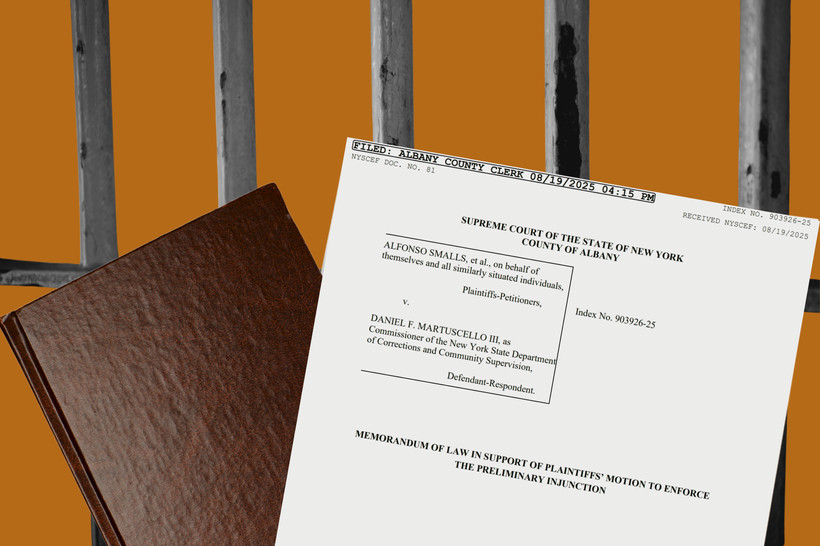
“Martuscello's filings in the case thus far suggest that he would rather have this law be at his discretion,” said Riley Evans of the Legal Aid Society. | Illustration: New York Focus

Sign up for Staying Focused, our newsletter keeping readers up to speed on New York politics.

The Reporters’ Notebook features bite-sized stories and updates from New York Focus reporters on the topics they cover.

On Tuesday, the Legal Aid Society asked a judge for a second time to compel the state prison agency to curtail its practice of keeping incarcerated people confined to their cells and dorms for upward of 20 hours a day — or else this time take the extraordinary step of holding the prison agency in contempt. New York state prisons have subjected thousands to such conditions for six months, including during extreme summer heat; the motion alleges that the prison agency hasn’t fulfilled the legal requirements to justify it.

The filing is part of an ongoing lawsuit accusing the Department of Corrections and Community Supervision, or DOCCS, of declaring an overbroad emergency to suspend the requirements of a 2021 solitary confinement reform law across the entire prison system. The law mandates that prisons and jails offer incarcerated people a minimum number of hours outside their cell each day, but allows DOCCS to pause compliance on a facility-by-facility basis during an emergency, which it declared after a prison guard strike in February.

Last month, a judge ordered DOCCS to limit its suspension of the reform law, called HALT, to temporary pauses at individual prisons and offer “detailed facts” about why those facilities warranted the emergency orders. DOCCS then filed a declaration offering extensive data on staffing and conditions in each prison, but didn’t explicitly state which facilities were under states of emergency or when it planned to lift all the suspensions.

With the available information, “it’s not really possible to tell with certainty whether DOCCS is complying with HALT in a given prison,” said Riley Evans, staff attorney with the Legal Aid Society’s Prisoners’ Rights Project.

The filing asks the court to order DOCCS to submit a new, compliant emergency declaration. The court can also hold the agency and Commissioner Daniel Martuscello in civil contempt, the filing argues, which would allow the judge to impose fines or other measures to enforce compliance.

DOCCS, which said it does not comment on pending litigation, has claimed that it has been doing its best to improve conditions given what it describes as a staffing crisis. Facilities adhere to the law when they can, Martuscello has said. He’s said he anticipates reintroducing HALT’s programming requirements by early fall, but has offered little indication of when all facilities will be able to let incarcerated people out of their cells for the law’s baseline of at least seven hours a day (or four for those in solitary confinement).

The filing is the latest development in a years-long dispute between advocates and the prison system over prisons’ implementation of HALT. Since the law went into effect in 2022, DOCCS has attempted to suspend or regulate around HALT’s requirements, including by pushing the limits of its emergency carveouts, as New York Focus has reported.

Tuesday’s motion is also the latest in an ongoing power struggle that has seen DOCCS battling advocates, the state legislature, the courts, and its own staff over the treatment of the more than 30,000 people it incarcerates.

That struggle came to head this winter, as the prison system faced nearly unprecedented scrutiny after corrections officers were caught on video killing an incarcerated man at Marcy Correctional Facility. In February, officers walked off the job, countering the narrative of guard brutality by highlighting what they describe as dangerous working conditions. One of the striking guards’ top demands was the repeal or rollback of HALT.

The strike lasted three weeks and ended with DOCCS firing roughly 2,000 guards, creating the staffing shortage. The prison system remains on pseudo-lockdown, with facilities canceling or severely shortening classes, recreation, therapeutic programming, and work release and limiting out-of-cell time to a precious few hours a day — all HALT violations absent an emergency.

“Martuscello’s filings in the case thus far suggest that he would rather have this law be at his discretion,” said Evans of the Legal Aid Society. “Thousands of New Yorkers are spending weeks and months locked in their cells without meaningful interaction with other people. The stakes here are nothing short of human dignity and torture.”

BEFORE YOU GO, consider: If not for the article you just read, would the information in it be public?

Or would it remain hidden — buried within the confines of New York’s sprawling criminal-legal apparatus?

I started working at New York Focus in 2022, not long after the outlet launched. Since that time, our reporters and editors have been vigorously scrutinizing every facet of the Empire State’s criminal justice institutions, investigating power players and the impact of policy on state prisons, county jails, and local police and courts — always with an eye toward what it means for people involved in the system.

That system works hard to make those people invisible, and it shields those at the top from scrutiny. And without rigorous, resource-intensive journalism, it would all operate with significantly more impunity.

Only a handful of journalists do this type of work in New York. In the last decades, the number of local news outlets in the state has nearly halved, making our coverage all the more critical. Our criminal justice reporting has been cited in lawsuits, spurred legislation, and led to the rescission of statewide policies. With your help, we can continue to do this work, and go even deeper: We have endless ideas for more ambitious projects and harder hitting investigations. But we need your help.

As a small, nonprofit outlet, we rely on our readers to support our journalism. If you’re able, please consider supporting us with a one-time or monthly gift. We so appreciate your help.

Here’s to a more just, more transparent New York.

Chris Gelardi
Justice Bureau Chief
A photo of Chris Gelardi
As New York Focus’s justice bureau chief, Chris Gelardi reports and edits work on the state’s criminal-legal and immigration systems. His writing on cops, jails, ICE, and the US military has appeared in more than a dozen other outlets, most frequently The Intercept… more
Also filed in Criminal Justice

A bill awaiting the governor’s signature would relax restrictions on who can qualify for victim compensation.

In May, state lawmakers passed a $269 billion budget after haggling for months over thousands of line items and policies affecting New Yorkers.

The legislation would make it easier for currently and formerly incarcerated people and child victims to sue the state over allegations of past abuse.

Also filed in New York State

City budget gaps and an ambitious affordability agenda may require pressing Albany again for taxes and aid.

We’ve compiled information for the 450,000 New Yorkers who will lose health care coverage on July 1.

A lobbyist who has been romantically linked to Assembly Speaker Carl Heastie led a rally opposing the legislation a week before the speaker declined to bring it to a vote.