Trump-Targeted Sheriff Did Not Rely on Sanctuary Law in High-Profile Case, Emails Show

GOP Ohio Rep. Jim Jordan blasted New York sanctuary policies during a June congressional hearing. Newly obtained emails tell a different story.

Julia Rock   ·   September 9, 2025
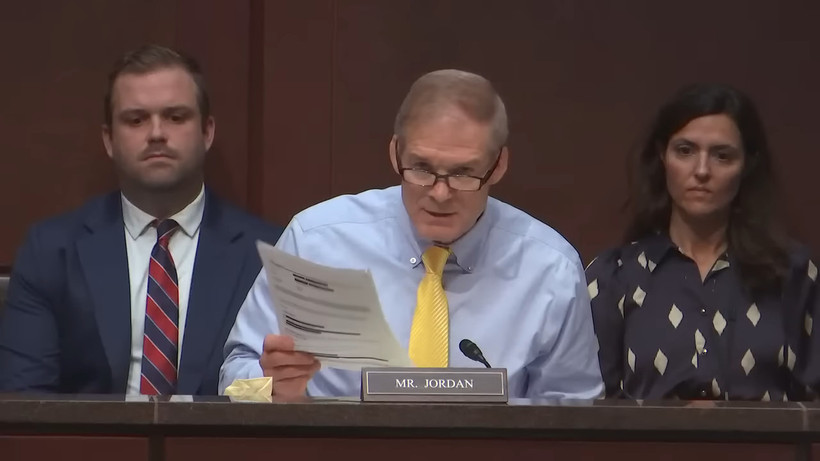
US Representative Jim Jordan held up a printout of an email exchange between Sheriff Derek Osborne — who was targeted by the Trump administration — and an ICE officer at a congressional hearing on June 12. | Screenshot: GOP Oversight/YouTube

Sign up for Staying Focused, our newsletter keeping readers up to speed on New York politics.

When Republicans dragged Democratic governors before Congress in June to testify about sanctuary policies, Governor Kathy Hochul was pressed on one case in particular: a central New York sheriff who had refused Immigration and Customs Enforcement’s request to hold a man in county jail past his release date.

The case had drawn national attention in January, when the Trump administration announced it was investigating Tompkins County Sheriff Derek Osborne for allegedly obstructing ICE in its efforts to arrest the man.

During the hearing, US Representative Jim Jordan, of Ohio, held up a printout of an email exchange between the sheriff and an ICE officer about the man’s release. The jail’s decision, Jordan said, “is what is so wrong and why the American people voted to restore law and order” — “sanctuary policy in a nutshell,” he said.

New York Focus obtained the emails that Jordan read from. The testy exchange between Osborne, other Tompkins County officials, and an ICE deportation officer leading up to the man’s release clarifies the circumstances surrounding the case. They also contradict Jordan’s characterization.

According to the emails Jordan referenced during his testimony, sanctuary policies did not play a role in the jail’s decision to release the man. Instead, that decision hinged on a state court ruling that dealt with the obscure intersection of federal civil law and local law enforcement.

The email exchange began back in November 2023, when ICE sent a letter to Tompkins County Jail, in Ithaca, asking to be notified before a specific individual was released. He was in jail after being charged with assault. A couple of months later, ICE again emailed the jail, this time with a federal criminal arrest warrant attached.

A year later, in the days after President Donald Trump’s inauguration, the man’s sentence was coming to an end. Lauran Harrison, “captain” of the Tompkins County Jail, wrote to ICE saying the jail could not hold the man past his release date.

Source: Tompkins County

“Per the attached case brief regarding the honoring of ICE detainers” — a 2018 New York Supreme Court ruling prohibiting local law enforcement from honoring such requests on civil immigration charges alone — “we cannot and will not hold him,” Harrison wrote to ICE deportation officer James W. O’Rawe. “We do not have the legal authority to hold him or make an arrest regarding immigration.”

O’Rawe pointed out that he had a criminal warrant, and said ICE agents would be at the jail later that night to take custody, but jail officials held firm.

In a final email, Osborne wrote, “I would suggest you read the cited case….We are correct in our understanding of it. There’s no need to communicate further.”

Jordan’s office did not respond to a request for comment.

When New York Focus first covered the case in February, it was not clear whether Osborne even had the authority to hold the man for ICE. The email exchange confirms that the agency presented Tompkins County with a criminal arrest warrant, which gave the county a legal basis to detain the man.

Hochul said during the hearing that “the person should have been held. In the state of New York, we would have turned him over.”

But Osborne was not obliged to help ICE.

While New York state law does not prohibit local law enforcement from helping ICE, it also does not require local law enforcement to cooperate. Tompkins County and Ithaca have sanctuary policies that allow the sheriff to hold people for a couple days past the end of their sentence if there is a criminal arrest warrant. Legal experts and the attorney general’s office have advised, however, that local sheriffs are under no obligation to do so.

That leaves Osborne and other sheriffs with a considerable amount of discretion in how they handle some requests from ICE. The email exchange shows that sanctuary policies did not seem to play a role in Tompkins County Jail officials’ decision.

Osborne was wrong that state case law prevented him from holding the man. The Tompkins County attorney later said publicly that if the jail is presented with a federal criminal arrest warrant, “it is optional but not obligatory” for local officials to detain someone.

Osborne did not respond to requests for comment from New York Focus.

Legal experts told New York Focus in February that Osborne did not break any law, and that when the Trump Department of Justice announced it would investigate him, it seemed aimed at scaring other local officials into aiding the president’s mass deportation agenda. DOJ attorneys have not brought charges against the sheriff, and did not respond to a question about whether the agency is still weighing prosecution.

Jordan said during the testimony that ICE showed up at the jail at 10:45 pm. that same evening of the email exchange to arrest the man, but he had been released about an hour before. It is not clear why ICE did not show up in time to arrest him, and the agency did not respond to questions.

ICE arrested him two days later in front of a local social services office. He pleaded guilty and was sentenced to seven months in federal prison for reentry after deportation.

At New York Focus, our central mission is to help readers better understand how New York really works. If you think this article succeeded, please consider supporting our mission and making more stories like this one possible.

New York is an incongruous state. We’re home to fabulous wealth — if the state were a country, it would have the tenth largest economy in the world — but also the highest rate of wealth inequality. We’re among the most diverse – but also the most segregated. We passed the nation’s most ambitious climate law — but haven’t been meeting its deadlines and continue to subsidize industries hastening the climate crisis.

As New York’s only statewide nonprofit news publication, our journalism exists to help you make sense of these contradictions. Our work scrutinizes how power works in the state, unpacks who’s really calling the shots, and reveals how obscure decisions shape ordinary New Yorkers’ lives.

In the last two decades, the number of local news outlets in New York has been nearly slashed in half, allowing elected officials and powerful individuals to increasingly operate in the dark — with the average New Yorker none the wiser.

We’re on a mission to change that. Our work has already shown what can happen when those with power know that someone is watching, with stories that have prompted policy changes and spurred legislation. We have ambitious plans for the rest of the year and beyond, including tackling new beats and more hard-hitting stories — but we need your help to make them a reality.

If you’re able, please consider supporting our journalism with a one-time gift or a monthly gift. We can't do this work without you.

Thank you,

Akash Mehta
Editor-in-Chief
A photo of Akash Mehta.
Julia Rock is a reporter for the Financial Times. She was previously an investigative reporter at New York Focus and The Lever.
Also filed in New York State

A lobbyist who has been romantically linked to Assembly Speaker Carl Heastie led a rally opposing the legislation a week before the speaker declined to bring it to a vote.

In May, state lawmakers passed a $269 billion budget after haggling for months over thousands of line items and policies affecting New Yorkers.

Millions in outside spending was a boon to Gov. Kathy Hochul’s 2022 opponent, Lee Zeldin, and influenced down-ballot races.

Also filed in Immigration

The Department of Justice has terminated more than 100 immigration judges since last year as it has pressured courts to order more deportations.

The legislation comes after months of haggling over how best to protect New Yorkers from President Trump’s immigration crackdown.

Footage published by New York Focus sparked a debate over deputies’ practice of calling Border Patrol on Spanish-speaking drivers.