Trump’s China Tariffs Hit New York’s Clean Heat Experiment

The country’s biggest public housing authority is counting on a Chinese company to supply thousands of new energy-saving window heat pumps.
Colin Kinniburgh   ·   April 15, 2025
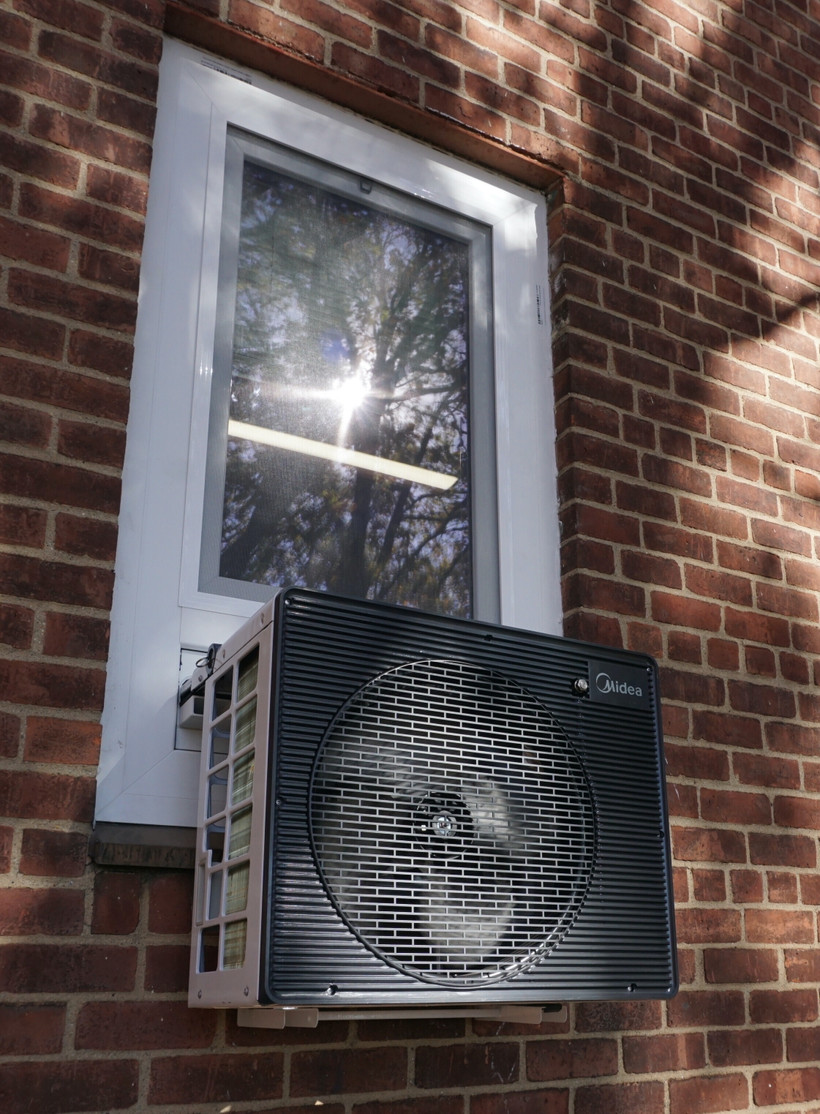
Window heat pump units made by the Chinese company Midea have roughly halved energy costs for the homes where NYCHA has installed test units, according to the housing authority. | Colin Kinniburgh

Sign up for Staying Focused, our newsletter keeping readers up to speed on New York politics.

President Donald Trump may have retreated from a full-blown trade war with most of the world, but his fight with China is still raging — and it could stymie New York City’s plans to decarbonize its public housing.

As of Monday afternoon, US tariffs on Chinese imports stood at 145 percent, with China charging 125 percent duties on US goods in response. That could throw a wrench in US climate efforts. China remains by far the world’s largest producer of green technologies and dominates the underlying supply chains. While the United States has already largely shut out some Chinese products, like solar panels, it still imports others, like grid-scale batteries. New York City is counting on one Chinese product in particular to help green its public housing: innovative window heat pump units made by the Guangdong-based company Midea.

Heat pumps allow homes to rely on electricity rather than gas for heating and cooling. They typically include both indoor and outdoor components, and often require electrical upgrades, which makes them difficult and expensive to install in large, old apartment buildings like those run by the New York City Housing Authority.

Three years ago, the agency set about using its massive buying power to create a solution — for its own buildings, which house over half a million people, and ultimately for the rest of the market. It launched a contest for companies to develop a version of the appliances that could just plug into a regular electrical socket, like an air conditioner, and wouldn’t require any additional outdoor components. That would allow apartments to go electric much more easily than with standard heat pumps. Midea developed its units for the contest.

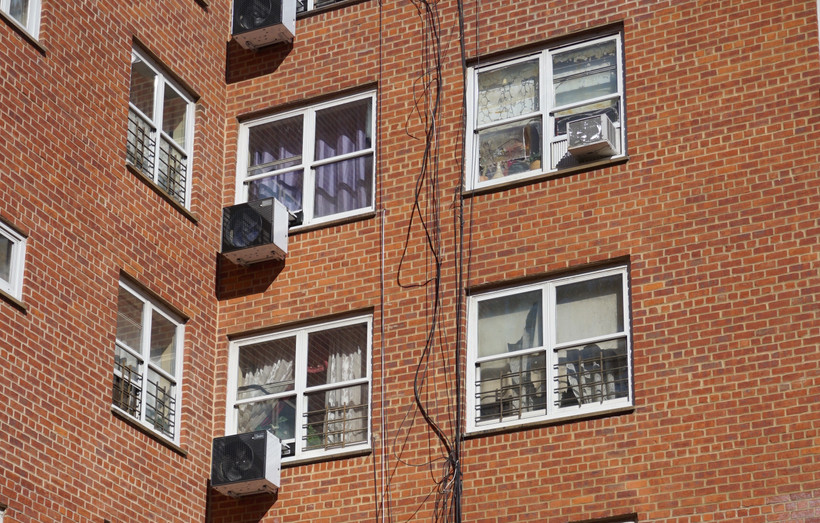
Prohibitive tariffs on Chinese imports could cause a major headache for the cash-strapped housing authority’s efforts to decarbonize. | Colin Kinniburgh

NYCHA selected Midea and another manufacturer called Gradient in 2022 and installed an initial 72 heat pumps the following year. By most accounts, the test round has been a smashing success. Residents at a Queens development are now coming out of a second winter heating their apartments with the test units and have rated them a major improvement over the old radiators. The heat pumps have yielded close to 90 percent energy savings and roughly halved energy costs for those homes, according to a NYCHA analysis.

But the rollout has been slow. NYCHA hasn’t installed any new heat pumps since the test round, even though the agency originally announced that it would install more than 20,000 heat pumps over five years. A spokesperson told New York Focus that the authority received another 150 units from Midea in January, which it plans to install across about 50 apartments over the coming months. And it still plans in the next two years to begin a wider rollout, which would see about 15,000 of the heat pumps installed.

Trump’s prohibitive tariffs on Chinese imports could complicate that plan. NYCHA has committed to buying 20,000 of the Midea units over the next seven years, and another 10,000 from the US-based Gradient. If Midea’s prices were to more than double, in line with current tariffs, it could cause a major headache for the cash-strapped housing authority’s efforts to decarbonize. An agency spokesperson declined to specify whether the prices for those units could still change, saying only that NYCHA is evaluating potential tariff impacts. Midea did not respond to requests for comment.

High and lasting tariffs would also impede a broader goal of the NYCHA program, called the Clean Heat for All challenge: to pioneer easy-to-install heat pumps for multifamily buildings beyond public housing. Buildings remain New York’s largest source of emissions, by the state’s accounting, and decarbonizing old apartment buildings is one of the thorniest challenges of the energy transition as a whole. Efficient, mass-market window heat pumps could be a game changer.

Both Gradient and Midea have started promoting their window heat pumps to customers beyond NYCHA, putting that goal within reach. But Midea has yet to announce a market price, and it’s hard to imagine its units would be cost-competitive in the US with a 145 percent markup. That could give its competitor Gradient a leg up, assuming Trump doesn’t restore major tariffs on other countries. (Gradient spokesperson Rebecca Silliman told New York Focus that the company’s heat pumps are made in India, with some components coming from Japan.) It’s not clear that Gradient’s nearly $4,000-apiece heat pumps will spur mass adoption of the technology on their own.

The impact of Trump’s tariffs on wider heat pump adoption also remains unclear. According to a recent report from New York’s major utilities, installations have crept up in recent years, with some 33,000 households embracing heat pumps in 2024 — a new high. But that growth falls short of what officials envisioned in the state’s climate plan, which assumed heat pump sales would rapidly accelerate throughout this decade, to eclipse gas furnaces altogether by around the mid-2030s. So far, growth has been more tortoise- than hare-like.

It’s hard to say whether tariffs will slow it down further. Many heat pumps sold in the US are made abroad — but so are gas appliances. China remains a minority player in heat pump manufacturing, unlike with most other clean tech; as of 2023, according to the International Energy Agency, almost a quarter of all heat pumps sold around the world were made in the United States. And for typical heat pump installations, labor costs as much or more than the equipment itself, making tariffs less salient.

Asked last week about how new levies might impact building electrification, a spokesperson for the state’s energy research and development arm, NYSERDA, said it was too soon to say.

John Mandyck, CEO of the nonprofit Urban Green Council, echoed the sentiment.

“This is no different than what every other industry is facing right now,” he said. “It’s impossible to predict impacts with whack-a-mole tariffs, so the prudent path is to stay the course.”

I hope this article helped you better answer the question that guides all of our journalism: Who runs New York? Before you click away, please consider supporting our work and making more stories like this one possible.

New York state is standing at a crossroads for climate action. After passing one of the nation’s most ambitious climate laws in 2019, the state is lagging far behind on its targets, struggling to meet deadlines to build renewable energy and clean up its buildings and roads. Other states are closely watching our progress, making decisions about their own climate plans based on New York’s ability to implement this legislation.

As New York’s only statewide nonprofit news publication, we’ve been scrutinizing the state’s climate progress. Our journalism exists to unpack how power works in New York, analyze who’s really calling the shots, and reveal how obscure decisions shape ordinary New Yorkers’ lives.

But we can't do this work without your help. We rely on reader donations to help sustain our outlet, and every gift directly allows us to publish more pieces like this.

Our work has already shown what can happen when those with power know that someone is watching, with my reporting prompting a state investigation and fine for a major corporation. I have more story ideas than I can count, but only limited resources to pursue all the leads that come across my desk.

If you’re able, please consider supporting our journalism with a one-time or monthly gift. Even small donations make a big difference.

Thank you for reading.

Colin Kinniburgh
Climate and Environmental Politics Reporter
A photo of Colin Kinniburgh.
Colin Kinniburgh is a reporter at New York Focus, covering the state’s climate and environmental politics. He has worked in media for more than a decade, across print, television, audio, and online news, and participated in fellowship programs at CUNY’s Graduate School of Journalism… more
Also filed in New York State

A lobbyist who has been romantically linked to Assembly Speaker Carl Heastie led a rally opposing the legislation a week before the speaker declined to bring it to a vote.
In May, state lawmakers passed a $269 billion budget after haggling for months over thousands of line items and policies affecting New Yorkers.

Millions in outside spending was a boon to Gov. Kathy Hochul’s 2022 opponent, Lee Zeldin, and influenced down-ballot races.

Also filed in New York City

The citizens assembly model, used for public decision-making around the world, is gaining traction in New York.

Resorts World is floating legislation to avert more than $500 million in payments to the horseracing industry.

Some of the city’s new aid will be canceled out by pension boosts.

Also filed in Climate and Environment

Governor Kathy Hochul was successful in her bid to upend the Climate Leadership and Community Protection Act after legislators caved to finalize an overall budget deal.

The leader of Reinvent Albany discusses a data center subsidy in Rockland County that flew under the radar for years.

No other project in the country has gotten such a large subsidy to create so few jobs, according to watchdogs.