Albany’s Blueprint for Schools: Cell‑Free Halls, Looser Yeshiva Rules, New Aid Math

Hochul’s budget includes $37 billion for education, but the state Education Department is slamming one policy change as “educational malpractice” and a political retreat.

Bianca Fortis   ·   May 9, 2025
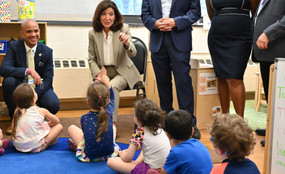
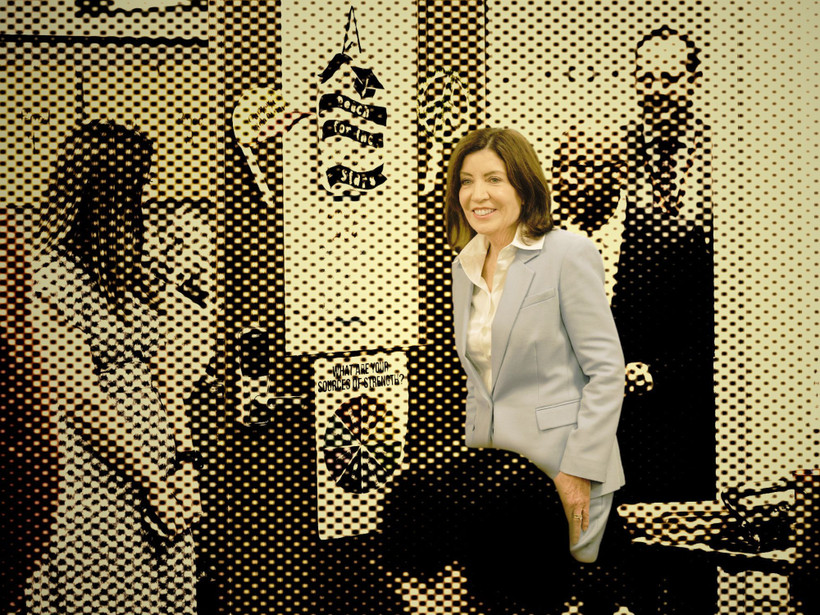
Hochul’s policy win makes New York the largest state to enforce a cellphone ban in schools. It’s one of several major changes to education wrapped up in the state budget. | Flickr: Governor Kathy Hochul / Illustration: New York Focus

Sign up for Staying Focused, our newsletter keeping readers up to speed on New York politics.

At Medina Junior-Senior High School, where Joe Byrne teaches 8th grade social studies, cellphones had become a problem: Kids came to school anxious, depressed, and altogether distracted by the devices, Byrne said.

The school implemented a cellphone ban in January following a teacher-led effort to curb the nonstop use of the devices, and the change in student behavior over the past few months has been noticeable, Byrne said.

It reminds him of when he started teaching 24 years ago, long before smartphones had become ubiquitous.

“They do not have them in study halls, they do not have them in the cafeteria, they do not have them in the hallways,” said Byrne, who is also the president of the Medina Teachers Association. “And it’s changed the dynamics of the kids interacting again and the kids talking. And when I say there’s noise in the hallway, it’s good noise.”

While Medina took the initiative to rein in cellphone use, all school districts will implement similar restrictions starting in September under a statewide “bell to bell” ban that was negotiated as part of the state budget.

Hochul began pushing the proposal last year with the support of the New York State United Teachers union.

“Our kids are overwhelmed by the addiction, the addictive algorithms and endless distractions,” Hochul said in a press conference. “Ninety-five percent of teenagers have smartphones. They receive 250 notifications a day on average. They can’t possibly focus on anything else. They’re so afraid of missing something.”

It’s up to school districts to figure out how to implement the ban, but the budget does include $13.5 million to assist districts in purchasing supplies that can help.

Some schools have turned to small, lockable pouches designed to create distraction-free spaces. But the pouches are costly, and kids may be able to outsmart them.

Byrne’s school, which has about 600 students, was able to find a simple solution: Students are directed to leave their phones in their lockers. If they’re caught with them during school hours, the phones are held at the assistant principal’s office for the rest of the day.

“It has been a game-changer to see these kids really come out of their shell and not be in the hallway with these cellphones 24/7,” Byrne said.

Hochul’s policy win makes New York the largest state to enforce such a ban. It’s one of several major changes to education wrapped up in the state budget — which includes $37 billion overall for education.

Substantial Equivalency Rules Rolled Back

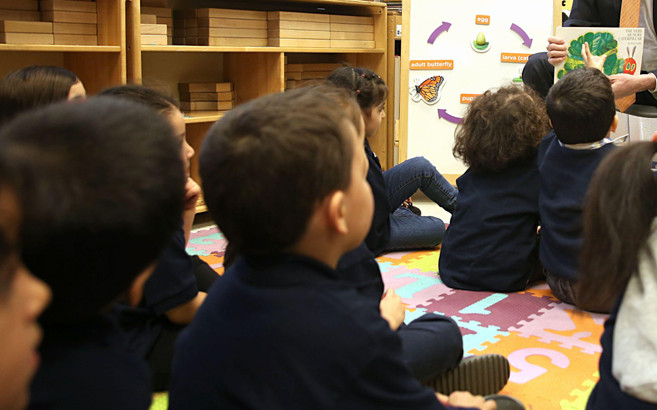
In a controversial move, the governor and the legislature agreed to roll back rules meant to ensure that nonpublic school students receive the same basic education in core subjects like English and math – despite pushback from the state Education Department.

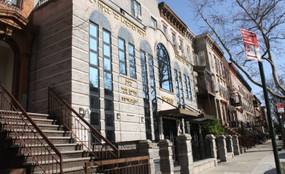
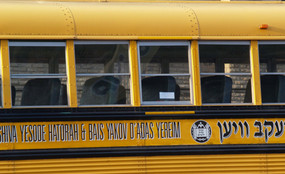
Thanks to a deal made during state budget negotiations, some members of the Ultra Orthodox community — and their lobbyists — succeeded in their bid to fight requirements that yeshivas and other religious schools provide a “substantially equivalent” education to public schools.

Despite receiving more than $1 billion in taxpayer funding over a recent four-year period, a New York Times investigation in 2022 found that many of the state’s yeshivas offered students little-to-no education in basic subjects and generated some of the lowest standardized test scores in the state. Prompted by the Times investigation, the state education department began cracking down on these schools, and this year pulled funding for six Brooklyn yeshivas that had failed to cooperate with the substantial equivalency requirement.

Although the education department has vehemently opposed weakening its regulations, the new state budget contains language that loosens restrictions for these schools and delays implementation for one of the pathways to compliance until the 2032-33 school year.

Young Advocates for Fair Education (YAFFED), an advocacy group that seeks to improve secular education within Haredi schools, blasted the budget deal.

“This is not a minor reform that will allow schools operating in good faith to come into compliance,” said Adina Mermelstein Konikoff, the organization’s executive director. “The bill being considered eviscerates the safeguards that ensure all children in New York, regardless of what school they attend, receive a sound basic education — a right protected by our state constitution.”

In a statement, state Education Department spokesperson JP O’Hare said the change in regulations was politically motivated and a deliberate retreat from educational responsibility.

“This is not responsible policymaking,” he said. “It’s educational malpractice and an abandonment of New York’s obligation to every child.”

In a statement made during a state Board of Regents meeting days before the final budget vote, Chancellor Frances Wills said the negotiations over the substantial equivalency regulations had impacted the educational mission and moral obligations of the board, as well as the education department.

“We are astonished that … the governor and legislature have indicated that there may be a halt to the progress that has been made and a postponement of freedom of life choices for thousands of children,” she said.

The Foundation Aid Formula Finally Gets an Update

For the first time since its implementation in 2007, the complicated formula the state uses to distribute most education funding — Foundation Aid — is getting an update.

The new formula will update how poverty is measured and include additional funding for districts with English Language Learners. The total cost: $26 billion.

Education stakeholders, who have long advocated for a total overhaul of the formula to more equitably fund schools, had asked for additional changes, like updating regional costs. The data currently used to calculate those costs is from 2006.

In the final budget, only districts in Westchester will see a regional cost update.

Under the revised formula, some districts may ultimately receive less funding than what they previously anticipated. Among those districts is New York City, which will see about $314 million less than what had been projected in prior calculations.

“We began the year hopeful that the State would make changes to the Foundation Aid formula that would help schools better support students, especially those with the greatest needs,” said Randi Levine, the policy director of Advocates for Children of New York. “Instead, the changes in the budget bill released today would cause NYC schools to miss out on hundreds of millions of dollars intended to serve low-income students in a city where more than 146,000 students experienced homelessness last year.”

At New York Focus, our central mission is to help readers better understand how New York really works. If you think this article succeeded, please consider supporting our mission and making more stories like this one possible.

New York is an incongruous state. We’re home to fabulous wealth — if the state were a country, it would have the tenth largest economy in the world — but also the highest rate of wealth inequality. We’re among the most diverse – but also the most segregated. We passed the nation’s most ambitious climate law — but haven’t been meeting its deadlines and continue to subsidize industries hastening the climate crisis.

As New York’s only statewide nonprofit news publication, our journalism exists to help you make sense of these contradictions. Our work scrutinizes how power works in the state, unpacks who’s really calling the shots, and reveals how obscure decisions shape ordinary New Yorkers’ lives.

In the last two decades, the number of local news outlets in New York has been nearly slashed in half, allowing elected officials and powerful individuals to increasingly operate in the dark — with the average New Yorker none the wiser.

We’re on a mission to change that. Our work has already shown what can happen when those with power know that someone is watching, with stories that have prompted policy changes and spurred legislation. We have ambitious plans for the rest of the year and beyond, including tackling new beats and more hard-hitting stories — but we need your help to make them a reality.

If you’re able, please consider supporting our journalism with a one-time gift or a monthly gift. We can't do this work without you.

Thank you,

Akash Mehta
Editor-in-Chief
A photo of Akash Mehta.
Bianca Fortis was the education reporter at New York Focus. She was previously an Abrams reporting fellow at ProPublica, where she spent 18 months investigating how Columbia University protected a predatory doctor who had sexually abused hundreds of patients for more than 20 years… more
Also filed in New York State

A bill awaiting the governor’s signature would relax restrictions on who can qualify for victim compensation.

We’ve compiled information for the 450,000 New Yorkers who will lose health care coverage on July 1.

A lobbyist who has been romantically linked to Assembly Speaker Carl Heastie led a rally opposing the legislation a week before the speaker declined to bring it to a vote.

Also filed in Budget

In May, state lawmakers passed a $269 billion budget after haggling for months over thousands of line items and policies affecting New Yorkers.

State leaders are expected to pass a bill that avoids resolving how much Resorts World New York City needs to pay.

Resorts World is floating legislation to avert more than $500 million in payments to the horseracing industry.

Also filed in Education

Advocates welcomed the additional funding but said it falls short of need and doesn’t do enough to support workers.

Some of the city’s new aid will be canceled out by pension boosts.

The Hochul administration now has a chance to relax New York’s child care staffing ratios — among the country’s strictest — after 26 years. But will it?