How the Clock Ran Out on One of Albany’s Biggest Environmental Bills

Wrangling over a major bill to cut packaging waste continued until the final hours of the legislative session, assemblymembers said.

Colin Kinniburgh   ·   June 19, 2025
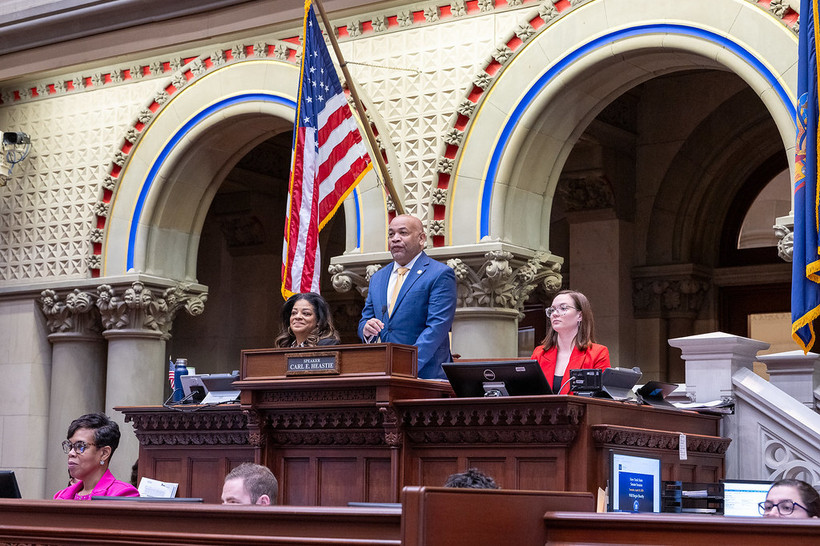
Assembly Speaker Carl Heastie in early June. | New York state Assembly Majority

Sign up for Staying Focused, our newsletter keeping readers up to speed on New York politics.

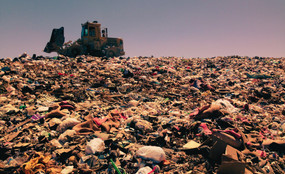
The New York Assembly closed the legislative session late Tuesday night without passing the year’s most closely watched environmental bill: a measure to reduce plastic pollution by holding companies responsible for the packaging waste they generate.

The fight over the packaging reduction bill continued until the final hours of the session, assemblymembers told New York Focus, but Speaker Carl Heastie ultimately declined to bring it to the floor for a vote — despite saying he supports it himself. A spokesperson for the speaker suggested that the bill did not have the votes to pass, though a majority of lawmakers in the chamber had signed onto it.

In the end, it may have come down to a cluster of reticent lawmakers who indicated that they were prepared to vote for the bill if it came to the floor — but hoped it wouldn’t. “There was resistance to the bill, and it was just pushing, pushing, pushing back until the clock ran out,” said Assemblymember Phara Souffrant Forrest, who backed the legislation.

She and Assemblymember Sarahana Shrestha, a fellow supporter of the measure, said that the wrangling over the bill continued until around 10pm Tuesday night, when it became clear that there was no longer time for an expected hours-long debate on the legislation before members were sent home.

Judith Enck, president of the advocacy group Beyond Plastics and the packaging bill’s most outspoken advocate, held Heastie responsible.

“He should have let the bill come up and if some people wanted to vote no, they’re free to vote no,” she said. “I think this puts a spotlight on how undemocratic the State Assembly is.”

Heastie’s spokesperson Michael Whyland rejected the characterization.

“The speaker was a ‘yes’ on the bill,” he wrote in an email. “What should be gone are the days of lazy advocacy that expects a top down approach. Instead of spending time attacking the Speaker, advocates should put in the work to gain the necessary support for their bills.”

“Contrary to popular belief, the Speaker is the most accurate vote counter in the Assembly,” Whyland added.

Shrestha acknowledged that many of her colleagues remained reluctant to approve the bill, as lobbyists successfully drove home the message — disputed by environmentalists — that the packaging reduction measure could drive grocery prices up and products off shelves.

“We knew that there was a slice that was a hard ‘no,’ and a slice that would vote with the team, but not enthusiastically,” Shrestha said. “And then, there was the bigger slice who really wanted to vote ‘yes’ on this bill — this was clearly the biggest slice.”

The bill, sponsored by Assemblymember Deborah Glick and Senator Pete Harckham, was co-sponsored by 76 assemblymembers, a slim majority of the chamber and a supermajority of Democrats.

In the end, it was hesitation that won out.

“If the vote is close, you don’t want to take a chance,” Glick said of Heastie’s reasoning, adding that some of the bill’s supporters were not available on the final days that the Assembly added to its calendar. Glick said she continued to push for the bill until late into Tuesday, but acknowledged that it faced tough odds by that point.

“We should not be voting on a bill of this magnitude at the eleventh hour in session,” she said.

It didn’t help that this year’s budget was New York’s latest in years, leaving the legislature — which only meets for half the year — just weeks to consider thousands of pending bills. Particularly in the final days, Shrestha said, getting bills to the floor becomes a zero-sum game: “​​If somebody is going to get to debate their bill, it probably means somebody else is not going to because of the time constraint.”

Business interests had mounted a massive campaign against the bill, which as of April was this year’s most-lobbied on outside the budget. Industry pressure only intensified after the bill passed the Senate in late May, and particularly over the past week; about 20 lobbyists were camped outside the Assembly chamber, according to Enck, Souffrant-Forrest, and Shrestha.

Opponents ranged from household brand names L’Oréal and Kraft Heinz to oil giants ExxonMobil and Shell. But the most dogged was the American Chemistry Council, the top trade group for the US chemical industry, which has spent hundreds of thousands of dollars on lobbyists and ads against the legislation.

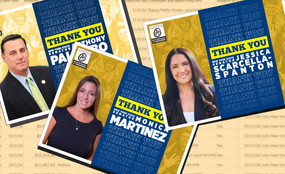
Last fall, the trade group teamed up with the Business Council, Albany’s leading business lobby group, to mount a $250,000 election mailer campaign backing incumbent candidates who were sympathetic to its position on recycling. In the last few months, the two groups threw their weight behind a less stringent rival bill that they said offered a “reasonable” alternative to the environmentalist-backed measure.

Forrest said the competing bill fueled divisions in the Black, Puerto Rican, Hispanic & Asian Legislative Caucus, which she had sought to rally around the environmentalist-backed measure.

The Chemistry Council’s lobbying campaign went down to the buzzer. The group took out ads in Politico’s widely read Playbook newsletter on Monday and Tuesday, the final days of the Assembly session, blasting Glick and Harckham’s bill as “even more extreme” than a similar measure in California.

Other opponents also emerged as the debate came down to the wire, including labor unions — even though lawmakers added labor-friendly provisions to the bill last year in a bid to gain union support. In recent days, the AFL-CIO, United Steelworkers, and two Teamsters locals joined the American Beverage Association — a trade group for major drink brands like Coca Cola — in condemning the bill. (The AFL-CIO and the Steelworkers, which represents some workers in the paper industry, had quietly opposed the bill as early as 2023.)

The opposition campaign paid off, and business groups cheered the final outcome.

“We are thankful leadership and members of the assembly listened to the concerns of businesses,” said Business Council spokesperson Patrick Bailey.

A spokesperson for the Chemistry Council said the group “look[s] forward to continuing to work with legislators across the state toward a solution that reduces plastic waste without over burdening working families and small businesses.”

Harckham, the bill’s Senate sponsor, said it was time for his side to regroup.

“This is a victory for the corporate polluters and the millions of dollars they spent to oppose the bill,” Harckham said on Wednesday.

Asked whether he planned to push the legislation again next year, he said, “Let’s let everybody sleep. … Let’s let the dust settle and then we’ll come up with a plan.”

Enck remained determined, noting that the bill came much closer to passing this year than last. “Plastic pollution isn’t going away, and neither are we,” she said.

Update: June 20, 2025 — This article was updated with comment provided by Assemblymember Deborah Glick, the bill's sponsor, after publication.

I hope this article helped you better answer the question that guides all of our journalism: Who runs New York? Before you click away, please consider supporting our work and making more stories like this one possible.

New York state is standing at a crossroads for climate action. After passing one of the nation’s most ambitious climate laws in 2019, the state is lagging far behind on its targets, struggling to meet deadlines to build renewable energy and clean up its buildings and roads. Other states are closely watching our progress, making decisions about their own climate plans based on New York’s ability to implement this legislation.

As New York’s only statewide nonprofit news publication, we’ve been scrutinizing the state’s climate progress. Our journalism exists to unpack how power works in New York, analyze who’s really calling the shots, and reveal how obscure decisions shape ordinary New Yorkers’ lives.

But we can't do this work without your help. We rely on reader donations to help sustain our outlet, and every gift directly allows us to publish more pieces like this.

Our work has already shown what can happen when those with power know that someone is watching, with my reporting prompting a state investigation and fine for a major corporation. I have more story ideas than I can count, but only limited resources to pursue all the leads that come across my desk.

If you’re able, please consider supporting our journalism with a one-time or monthly gift. Even small donations make a big difference.

Thank you for reading.

Colin Kinniburgh
Climate and Environmental Politics Reporter
A photo of Colin Kinniburgh.
Colin Kinniburgh is a reporter at New York Focus, covering the state’s climate and environmental politics. He has worked in media for more than a decade, across print, television, audio, and online news, and participated in fellowship programs at CUNY’s Graduate School of Journalism… more
Also filed in New York State

A bill awaiting the governor’s signature would relax restrictions on who can qualify for victim compensation.

We’ve compiled information for the 450,000 New Yorkers who will lose health care coverage on July 1.

A lobbyist who has been romantically linked to Assembly Speaker Carl Heastie led a rally opposing the legislation a week before the speaker declined to bring it to a vote.

Also filed in Climate and Environment

The citizens assembly model, used for public decision-making around the world, is gaining traction in New York.

In May, state lawmakers passed a $269 billion budget after haggling for months over thousands of line items and policies affecting New Yorkers.

Governor Kathy Hochul was successful in her bid to upend the Climate Leadership and Community Protection Act after legislators caved to finalize an overall budget deal.

Also filed in Affordability

We’ve compiled information for SNAP recipients in New York on the changing work requirements.

Despite last-ditch efforts by a coalition of lawmakers, the state failed to avert a health coverage cliff coming this summer.

The Hochul administration now has a chance to relax New York’s child care staffing ratios — among the country’s strictest — after 26 years. But will it?