‘Worse Than I’ve Ever Seen’: New York Among Slowest States to Pay Unemployment Benefits

And the delays have gotten worse in recent months.
Julia Rock   ·   July 25, 2025
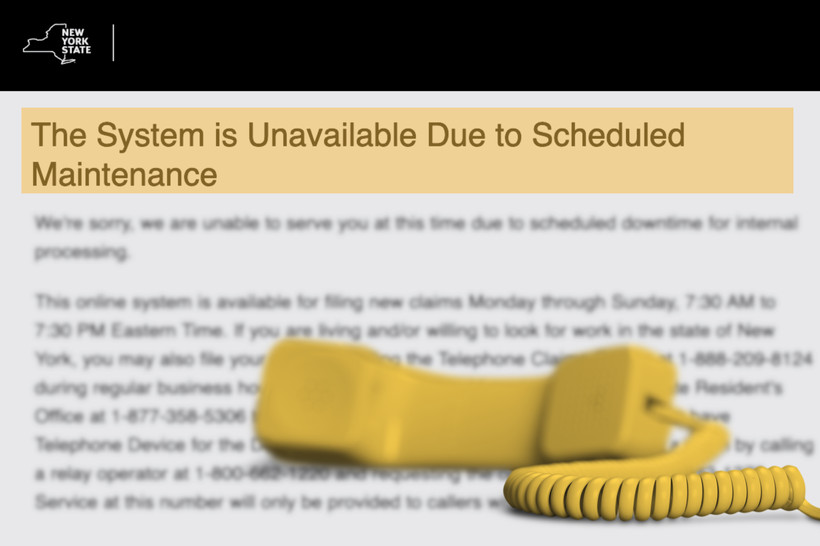
New York Focus reported earlier this month that it can feel nearly impossible for New Yorkers applying for unemployment to get someone on the phone. | Screenshot: New York state Department of Labor; Photo: Billion Photos/Canva | Illustration: Leor Stylar

Sign up for Staying Focused, our newsletter keeping readers up to speed on New York politics.

New York has become one of the slowest states in the country to pay unemployment benefits.

Only six states have been slower to start sending unemployment checks this year, according to federal Labor Department data. The agency considers a payment timely if someone receives it within 21 days of filing a claim.

New York paid 64 percent of eligible people within that time frame in the first half of this year — far below the 87 percent benchmark that the federal government considers “acceptable.”

The delays have gotten worse in recent months. In April, the state Department of Labor, which administers the unemployment system, paid 58 percent of claimants in the timely window; by May, the number had fallen to 55 percent, and in June, it was 58 percent.

Several unemployed New Yorkers who spoke to New York Focus described having to rely on savings or family members to pay bills while they waited weeks or months for their benefit.

“Workers have bills to pay,” said Amy Traub, a senior researcher with the National Employment Law Project who focuses on unemployment insurance. “Their landlord isn’t interested in a story about how their unemployment check is late.”

She said the federal government is supposed to help states meet the 87 percent performance benchmark, but that it rarely imposes consequences when states fail to do so.

“The New York State Department of Labor remains committed to delivering benefits as efficiently as possible while also protecting this essential safety net for New Yorkers,” an agency spokesperson said in a statement.

The state’s processing times slowed down drastically at the start of the Covid-19 pandemic, when unemployment spiked and the state system was overwhelmed. In the years leading up to the pandemic, New York consistently hit or exceeded the federal benchmark. Then, its payment speed sharply declined.

While the unemployment rate has returned to pre-pandemic levels, the state’s payment speed has not.

“The delay is worse than I’ve ever seen, and I’ve been doing this for 35 years,” said Jon Bloom, executive director of the Workers Defense League, a nonprofit that helps people navigate unemployment benefits. “It used to be … a much shorter process.”

The New York Department of Labor did not directly answer a question about why payments are delayed.

A spokesperson noted that the agency’s ability to process claims on time is impacted by staffing levels, and there are fewer people processing unemployment claims in the department than before the pandemic, according to staffing data. Those roles are entirely funded by the federal government, and funding levels are determined by the volume of unemployment claims.

The agency said its processing speed also depends on other factors, like how quickly applicants and their employers respond to requests for additional information or complete an anti-fraud identity verification process. But the agency doesn’t make it easy for applicants to speed up those parts of the process, according to legislators, advocates, and several people who’ve applied for unemployment.

The online application portal prompts some people to call the state hotline to complete their claim, but New York Focus reported earlier this month that people often can’t reach a human agent. One week last month, only a third of callers reached a human, the department said.

“These wait times of months and months are egregious.”

—Assemblymember Grace Lee

Brooklyn resident Paige Johnson said she got locked out of the portal while trying to apply last November and had to call the hotline every day when it opened at 8 am. It took her nine days to get someone on the phone to fix the issue with her account.

People also said that documents they upload to the portal or fax to the state upon request seem to disappear. Another Brooklyn resident, who asked to remain anonymous to protect his privacy, told New York Focus that he gave up on applying earlier this year because he never got a response after mailing requested documents to the state Labor Department. On top of that, the department’s anti-fraud tool is difficult to navigate.

“It seems like the entire system is designed to make you not want to go through the process of applying,” said Johnson.

Applicants experience payment delays even when they don’t have issues with the application or their employer doesn’t contest their claim, according to advocates who help people access the benefit.

“Most of the calls we get are people saying, ‘I applied months ago, and I haven’t gotten payments, and I haven’t gotten a denial,’” said Bloom from the Workers Defense League. “Some of these are straightforward cases where the person was laid off” and there’s no dispute over their eligibility, he said. “The delays are just built in.”

Several state lawmakers told New York Focus that constituents frequently call their offices because they need help with their claim or to complain about delays.

“These wait times of months and months are egregious,” said state Assemblymember Grace Lee of Manhattan. “My office has been happy to help our constituents, but if we can address the systemic issues driving the delays, it would be incredibly beneficial to New Yorkers.”

Others, including Assemblymembers Claire Valdez and Phara Souffrant Forrest, have echoed Lee’s concerns. But legislators and advocates who work on unemployment could not pinpoint exactly what issues are driving the delays or how to address them.

The state legislature could pressure the Labor Department to fix the issues with unemployment, or put in a funding request, said Assemblymember Jessica González-Rojas. But first, she said, “We need to get to the bottom of the problem and what’s happening with staffing.”

State Senator Jessica Ramos, who chairs her chamber’s labor committee, said the legislature can press the Labor Department for information about staffing during the budget hearing process, which takes place each winter, “but they’re never straightforward about numbers.”

The Labor Department provided New York Focus with staffing numbers upon request. They show that the department has 75 fewer employees processing claims than it did eight years ago.

Unemployment delays aren’t unique to New York. Many states are still slower at paying claims than they were before the pandemic, said Michele Evermore, an unemployment insurance expert who worked for the US Labor Department during the Covid-19 pandemic.

Some states are adjudicating appeals from the high volume of pandemic claims, fending off organized crime rings that began targeting unemployment systems in 2020, and struggling with attrition of experienced staff who were burnt out from around-the-clock work during that time, she said.

But the change has been more dramatic in New York than elsewhere, and the problem is not abating.

“We’ve seen other states continuing to improve since the pandemic,” said Traub. “New York has been getting worse.”

At New York Focus, our central mission is to help readers better understand how New York really works. If you think this article succeeded, please consider supporting our mission and making more stories like this one possible.

New York is an incongruous state. We’re home to fabulous wealth — if the state were a country, it would have the tenth largest economy in the world — but also the highest rate of wealth inequality. We’re among the most diverse – but also the most segregated. We passed the nation’s most ambitious climate law — but haven’t been meeting its deadlines and continue to subsidize industries hastening the climate crisis.

As New York’s only statewide nonprofit news publication, our journalism exists to help you make sense of these contradictions. Our work scrutinizes how power works in the state, unpacks who’s really calling the shots, and reveals how obscure decisions shape ordinary New Yorkers’ lives.

In the last two decades, the number of local news outlets in New York has been nearly slashed in half, allowing elected officials and powerful individuals to increasingly operate in the dark — with the average New Yorker none the wiser.

We’re on a mission to change that. Our work has already shown what can happen when those with power know that someone is watching, with stories that have prompted policy changes and spurred legislation. We have ambitious plans for the rest of the year and beyond, including tackling new beats and more hard-hitting stories — but we need your help to make them a reality.

If you’re able, please consider supporting our journalism with a one-time gift or a monthly gift. We can't do this work without you.

Thank you,

Akash Mehta
Editor-in-Chief
A photo of Akash Mehta.
Julia Rock is a reporter for the Financial Times. She was previously an investigative reporter at New York Focus and The Lever.
Also filed in New York State

State leaders are expected to pass a bill that avoids resolving how much Resorts World New York City needs to pay.

New York state has pumped millions of taxpayer dollars into an online portal that vowed to make life easier for Rochester’s neediest, but critics say it’s fallen short.

Resorts World is floating legislation to avert more than $500 million in payments to the horseracing industry.

Also filed in Labor

160,000 injured New Yorkers seek workers’ compensation each year — but in recent years, regulators have tilted the scales towards employers and insurers.

The leader of Reinvent Albany discusses a data center subsidy in Rockland County that flew under the radar for years.

The Bronx Democratic Party is gaining power. So is a consulting firm tied to its chair.

Also filed in Social Services

We’ve compiled information for SNAP recipients in New York on the changing work requirements.

Despite last-ditch efforts by a coalition of lawmakers, the state failed to avert a health coverage cliff coming this summer.

The Hochul administration now has a chance to relax New York’s child care staffing ratios — among the country’s strictest — after 26 years. But will it?

Also filed in Affordability

Governor Kathy Hochul was successful in her bid to upend the Climate Leadership and Community Protection Act after legislators caved to finalize an overall budget deal.

New rules could result in thousands of New Yorkers losing their food benefits this summer.