Renewable Developers Press Hochul to Settle Tax Dispute Before Key Deadline

New Yorkers will pay more for wind and solar if Hochul doesn’t sign property tax legislation in the coming days, the industry says.

Colin Kinniburgh   ·   December 1, 2025
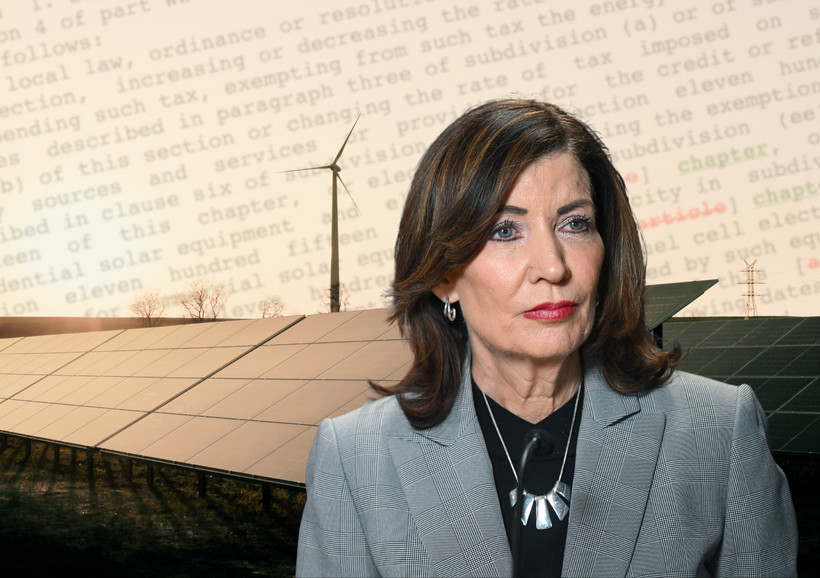
Wind and solar developers have until Thursday, December 4, to bid for state contracts under an expedited timeline Hochul announced in September. | Photos: Office of Governor Kathy Hochul; Text: New York state Senate | Illustraton: New York Focus

Sign up for Staying Focused, our newsletter keeping readers up to speed on New York politics.

Update: December 3, 2025 — Governor Kathy Hochul signed the bill on December 3.

A bill pending with Governor Kathy Hochul could shape how much New Yorkers pay for renewable energy for years to come — but she only has a few days left to sign it and deliver the full savings promised, the bill’s supporters say.

Wind and solar developers have until Thursday, December 4, to bid for state contracts under an expedited timeline Hochul announced in September. It may be the last chance for the companies to secure contracts in time to build projects with federal tax credits, which they’ve relied on for decades and which are set to expire next year under legislation signed by President Donald Trump.

When developers submit a bid, they have to include an estimate of how much a project will cost to build and operate over the long term, including land, materials, financing, and property taxes. The lower the cost, the more likely it is that the state will approve the bid — and the less it will cost New Yorkers whose energy bills pay for the project.

But property taxes are hard to predict, as state and local officials remain locked in a yearslong tug-of-war over who has the right to set tax rates for wind and solar.

The pending bill would settle the dispute, standardizing how renewables are taxed across the state and, developers argue, saving residents millions in the process.

For the law to achieve maximum effect, Hochul would need to sign it before Thursday, since the prices that developers bid this week are the ones New York electricity customers will pay for 20 years or more after the projects are built.

“If [developers] don’t know how much they’ll be taxed, they have to put a high number in there to cover their bases,” said Marguerite Wells, executive director of the renewable energy lobbying group Alliance for Clean Energy New York. If the state shores up its accounting method, Wells said, developers will be able to shave a few dollars off the price of their bids, out of $100 or so per unit of energy. That adds up to many millions of dollars over the life of the projects.

Even developers who have nearly finalized their bids will likely jump at the opportunity to lower them, as late as the day of the auction deadline, said Wells.

The bill’s proponents say it could have a larger effect, too, countering municipalities’ ability to block renewable projects by overtaxing them. (For the largest projects, permitting decisions rest with the state, but Wells said some towns have tried to use taxes as a “back door veto.”)

“While this is a fairly technical bill, it goes to the much bigger ideological battle that is being waged over renewable energy,” said Assemblymember Micah Lasher, who sponsored the bill. “I think it will make a big difference in ensuring that New York remains a place where renewable energy can continue to flourish in spite of everything that Donald Trump and his minions are doing to kill it.”

Christopher Koetzle, executive director of the Association of Towns of the State of New York, denied that localities were using their tax powers to kill projects. He calls the pending measure a violation of local authority, and said his group only wants to ensure that communities are being compensated fairly for hosting renewable projects.

“When you undervalue one project in the community, it ends up shifting the [tax] burden on to everybody else unfairly,” Koetzle said. “We generally are supportive of trying to get the projects done while the federal credits are still available, but not at the expense of local government control or local taxpayers.”

Hochul’s office declined to answer questions about the bill, as is standard with bills pending before her. Spokesperson Ken Lovett said only that the governor “will review the legislation.”

A Long Legal Battle

The bill stems from a yearslong legal dispute between the industry and municipalities, involving multiple lawsuits and revised legislation.

Currently, the way renewable projects are taxed is largely up to localities. A longstanding state law allows wind and solar developers to apply for a 15-year exemption from property taxes, but localities can opt out, and many do: nearly two-dozen counties, at last count, and hundreds of towns and school districts. Instead, developers have typically negotiated alternative agreements with local authorities.

These agreements vary widely, and the industry has long complained about the unpredictability. State lawmakers sought to address the issue in 2021, requiring wind and solar projects to be assessed using a “discounted cash flow” method. It’s a way of calculating a property’s value based on the income it’s expected to generate — one of the three common methods used to assess property taxes.

The approach is favored by the industry, and for good reason, said Daniel Spitzer, a tax lawyer at the firm Hodgson Russ: Wind and solar farms bring in steady income, just like rental and other properties typically assessed using this method. But towns have generally preferred a different method that results in higher taxes, he said. (Spitzer is not a party to the ongoing lawsuit; he generally represents developers, he said, but his firm represents municipalities as well.)

Some local officials feel the decision should be left to local assessors. They have twice sued the state over the law, charging that it would deprive them of millions of dollars of much-needed revenue.

In both cases, courts have sided with the towns. In 2022, a judge suspended the law on procedural grounds. Legislators passed an updated law the following year to address the issue, but the towns sued again. They argued, crucially, that the state Department of Tax and Finance had overstepped when it decided key details of the tax formula.

An Albany judge agreed in March, finding that lawmakers had granted agency officials too much leeway in deciding whether or not to count certain kinds of subsidies.

The state appealed the ruling, and the appeals court has allowed tax officials to continue using its formula until at least February, when a judge is due to hear the case.

If Hochul signs the pending bill, it will clear the “stumbling blocks” raised in litigation and finally allow the 2021 law to have its intended effect, Lasher said.

Opponents would rather keep the issue in the courts. They say renewables are being singled out for special treatment, allowing large corporate developers to profit at small towns’ expense.

Every taxpayer thinks they are being overcharged, Koeztle said. “Why does solar and wind get something that nobody else gets?” (The state already has tax formulas for oil and gas, among other energy infrastructure.)

“Essentially, they’re taking it from the local taxpayers as a subsidy,” he said of developers. “At some point, we have to look at it and say, this [renewable energy] isn’t economically sustainable, as badly as we want it.”

The bill’s proponents insist that electric customers, not developers, will pay the difference if Hochul doesn’t sign.

“The whole point of the law was to create certainty for municipalities and developers,” said Spitzer. “And when you don’t have that, costs are higher.”

As of Monday morning, the bill’s sponsors said they had no word on it from the governor’s office.

ACE NY has been prodding Hochul’s staff about it weekly since the legislature passed it in June, Wells said, and she is still hopeful that the governor could sign it in time for the current round of project bids.

I hope this article helped you better answer the question that guides all of our journalism: Who runs New York? Before you click away, please consider supporting our work and making more stories like this one possible.

New York state is standing at a crossroads for climate action. After passing one of the nation’s most ambitious climate laws in 2019, the state is lagging far behind on its targets, struggling to meet deadlines to build renewable energy and clean up its buildings and roads. Other states are closely watching our progress, making decisions about their own climate plans based on New York’s ability to implement this legislation.

As New York’s only statewide nonprofit news publication, we’ve been scrutinizing the state’s climate progress. Our journalism exists to unpack how power works in New York, analyze who’s really calling the shots, and reveal how obscure decisions shape ordinary New Yorkers’ lives.

But we can't do this work without your help. We rely on reader donations to help sustain our outlet, and every gift directly allows us to publish more pieces like this.

Our work has already shown what can happen when those with power know that someone is watching, with my reporting prompting a state investigation and fine for a major corporation. I have more story ideas than I can count, but only limited resources to pursue all the leads that come across my desk.

If you’re able, please consider supporting our journalism with a one-time or monthly gift. Even small donations make a big difference.

Thank you for reading.

Colin Kinniburgh
Climate and Environmental Politics Reporter
A photo of Colin Kinniburgh.
Colin Kinniburgh is a reporter at New York Focus, covering the state’s climate and environmental politics. He has worked in media for more than a decade, across print, television, audio, and online news, and participated in fellowship programs at CUNY’s Graduate School of Journalism… more
Also filed in New York State

Millions in outside spending was a boon to Gov. Kathy Hochul’s 2022 opponent, Lee Zeldin, and influenced down-ballot races.

The legislation would make it easier for currently and formerly incarcerated people and child victims to sue the state over allegations of past abuse.

State leaders are expected to pass a bill that avoids resolving how much Resorts World New York City needs to pay.

Also filed in Climate and Environment

Governor Kathy Hochul was successful in her bid to upend the Climate Leadership and Community Protection Act after legislators caved to finalize an overall budget deal.

The leader of Reinvent Albany discusses a data center subsidy in Rockland County that flew under the radar for years.

No other project in the country has gotten such a large subsidy to create so few jobs, according to watchdogs.

Also filed in Affordability

We’ve compiled information for SNAP recipients in New York on the changing work requirements.

Despite last-ditch efforts by a coalition of lawmakers, the state failed to avert a health coverage cliff coming this summer.

The Hochul administration now has a chance to relax New York’s child care staffing ratios — among the country’s strictest — after 26 years. But will it?