‘What Stood Out Was What Wasn’t Said’: Antonio Delgado on Hochul’s Speech

New York Focus interviewed Lieutenant Governor Antonio Delgado as he challenges his boss for the Democratic nomination for governor.

Sam Mellins   ·   January 16, 2026
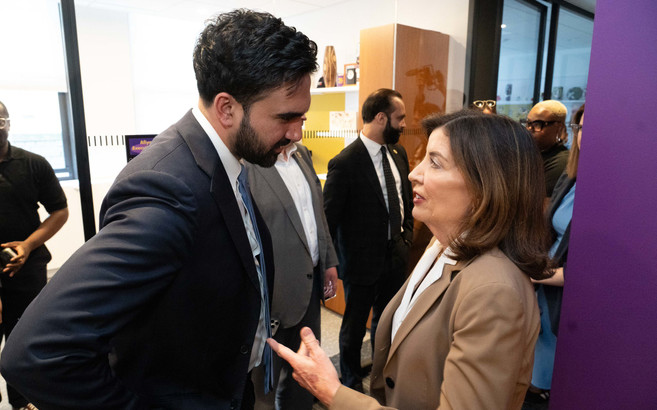
"The governor seems to have lost or forgotten the fact that she is the governor of the state and not just the city," Delgado said. | Office of Governor Kathy Hochul

Sign up for Staying Focused, our newsletter keeping readers up to speed on New York politics.

This week, Governor Kathy Hochul gave her annual State of the State speech, in which she touted her accomplishments and laid out her priorities as she seeks reelection to a second full term this November.

The first hurdle to clear is winning the Democratic primary on June 23. She’s facing a challenge from her own lieutenant governor, Antonio Delgado, who is mounting an underdog campaign, attacking his boss from her political left.

On Thursday, senior reporter Sam Mellins spoke with Lieutenant Governor Delgado about how Hochul’s agenda this year compares to the platform he’s running on. This transcript of their conversation has been edited for length and clarity.

New York Focus: So first of all, I wanted to ask about what stood out to you from the Governor’s State of the State speech this week. Did anything surprise you?

Lieutenant Governor Antonio Delgado: What stood out was what wasn’t said. She didn’t call for taxing the rich. She didn’t back [immigrant protection bill] New York for All. There was no bold measure to address housing or the fact that Trump has gutted our health care system. That, to me, is what stood out.

NYF: Governor Hochul has always been a proud moderate. When you accepted the invitation to be her lieutenant governor, did you think she would govern differently?

AD: I did. When I decided to run for lieutenant governor … we had very, very open, frank conversations about the nature of my role, and being a partner, and being able to bring a perspective to bear, and helping to shape how to govern things differently. The governor acknowledged that she had lacked that kind of partnership with the previous governor, and had understood and appreciated that it was important to try to do things differently and to govern in a way that was more transparent, accountable, collaborative, and certainly more connected.

NYF: Can you be specific about how you thought she would govern differently?

AD: I thought she would be more collaborative, not just with me, but more collaborative with the folks that are impacted by her decisions. So it was clear to me that when you’re talking about housing, for example, the partnerships that she makes in housing have more to do with developers than they do with fighting for folks who are impacted by the affordability crisis, or, if we’re talking about health care, it became clear to me that a lot of the folks that she was more interested in engaging with were the hospital conglomerates and the insurance companies.

A lot of it was window dressing. And I didn’t believe that was the appropriate way to serve the people of New York.

NYF: Governor Hochul’s headline policy this year is a major boost to child care funding. She pledged billions of dollars towards programs for pre-school-age children, especially in New York City, but also elsewhere in the state. What did you think of this, and what would you do differently on child care?

AD: One, I want to applaud the mayor for pushing the governor to do something in this space. The governor has had a good while to do something, and only chose to step up and meaningfully pursue any remote attempt at universal childcare on the heels of his efforts. He has certainly been able to secure a meaningful investment in New York City.

I’ll point out, though, that there remain significant challenges when it comes to this entirety of the state, and the governor seems to have lost or forgotten the fact that she is the governor of the state and not just the city.

It also should be noted that nowhere in her platform does she suggest that we should pay childcare workers an actual living wage, despite the fact that one in 10 are in poverty. How do you expect to get universal childcare statewide if you can’t pay childcare workers a living wage?

NYF: Mayor Mamdani is obviously very happy with the governor’s investment in child care in New York City, and he’s been pretty friendly with her, in general, even though he was one of her most frequent critics before he ran for mayor. What do you make of their relationship?

AD: I think it’s always healthy to try to figure out, particularly in his position, how to build relationships that could benefit the folks who you’re fighting for, right? He’s doing what he needs to do to ensure that the people of New York City are served under his leadership.

NYF: You’re running a come-from-behind campaign from the left, just like he did, but both Hochul and Mamdani have indicated that he’s likely to endorse her campaign. What do you think of that? And have you met with him during your campaign?

AD: My focus is actually on connecting with the people on the ground, and I’ve been able to do so in a real, meaningful way. This week alone I’ve been in Rochester, Syracuse, Buffalo, and Brooklyn. People, ultimately, are the ones who decide whether they want certain kinds of leaders.

I’m very proud of the fact that I’m the first statewide candidate to ever qualify for public matching funds, which I think is also reflective of the ability to really connect with people in a grassroots fashion.

NYF: You’ve criticized the governor for not supporting the New York for All Act, which would ban local police departments from collaborating with ICE. Beyond that legislation, what else would you do differently to protect immigrants?

AD: I would do two other things that the governor has not acknowledged. One is to ban ICE from wearing masks. If you’re enforcing the law, you shouldn’t have to wear a mask.

Two, I think we should provide [legal] representation to our immigrant community statewide that is facing deportation proceedings. So those are two things that the governor has not backed, as well as Dignity not Detention legislation [which would ban New Yorkers, including local governments and corporations, from owning or operating immigrant detention facilities].

NYF: You’ve also criticized the governor for not doing enough to help the hundreds of thousands of New Yorkers who will lose Medicaid coverage due to cuts by the Trump administration. What in particular would you do to protect them?

AD: The Medicaid cuts have been devastating, and the governor has done nothing. In fact, she’s just essentially letting folks who were on the [federally-funded] Essential Plan and otherwise would have been subsidized by the federal government, lose their health care. And as I did last year, I would have called for a special session, and I would have raised revenue. I would have increased taxes, either on our most profitable corporations or on the ultra-wealthy to attempt to fill in part the gap that is a result of these cuts, so that the state itself could figure out a way to provide meaningful care.

NYF: Do you have a sense of how much that would cost?

AD: I would have sat down with the legislative body to figure that out. I mean, we know we’re going to be in the deficit of $10 billion, not this cycle, but the next fiscal year. I think this fiscal year it’s more like $3 billion. So it’s about trying to figure out how much of that is wrapped up in the Medicaid portion — that would have had to be calculated. But I do believe that we could have the money.

NYF: Governor Hochul embraced nuclear energy in her speech, announcing plans to build more nuclear energy infrastructure in New York than the entire country has built in the last three decades. You called this a waste of money and time. Can you say more about that criticism?

AD: We don’t need nuclear. It’s incredibly cost-burdensome, it’s labor-intensive, time-intensive. In some cases, it can take up to a decade to build. And there’s also the challenge of waste and nuclear waste.

We have some of the strongest climate laws in the country, and we’re not leveraging those laws to the fullest extent. We’re not leveraging the public renewables act to double down aggressively on investing in public renewables and green energy. We’re canceling green energy projects that would otherwise allow us to meet our [emission reduction] goals. The governor has not released the cap and invest rules and regulations, and instead, she’s fast-tracking water quality permits for Trump’s fracked gas pipeline, and reversing course on air quality permits on data mining facilities on Seneca Lake.

So it’s just a complete reverse course on her part, at a time where not only do we need to have urgency behind climate action, but also at a time where people’s energy bills are going up considerably. And we can create good-paying jobs and drive down the cost of energy with real investment in green energy.

NYF: On another topic, it’s been a year of crisis for New York’s prison system, which didn’t come up in Hochul’s speech. What steps would you take on prison reform?

AD: I think it’s also notable that it didn’t come up in Hochul’s speech given the tragedy of [Robert] Brooks and so many other untold stories. There was a real effort to push prison reform, on the heels of that tragedy, and we certainly were able to make some progress, but not enough, not nearly enough.

I think that there was a lot of watering down to the proposed legislation, particularly around the special investigation unit.

I also believe in ensuring that the folks who are inside have a chance at rehabilitation in a real way. I think there’s been some really good advocacy around parole reform and legislation like the Second Look Act that are important to elevate and to push forward as we think about criminal justice a lot more holistically, and not just through the lens of punishment.

NYF: Okay, last one. You’ve traveled all around the state as lieutenant governor and now on the campaign trail. What’s a place in New York that more New Yorkers should visit?

AD: I’m very biased, to be honest. I live in Hudson Valley, Dutchess County, the Catskills. If you talk to folks who come from the city and they drive through the Hudson Valley and the Catskills — there’s just something very majestic, particularly during the fall, about that area.

You think about New York, and especially for those who are outside the state, you think of the city, the boroughs. But if you really want to get a feel for how impressive the state actually is, drive to the lower mid-Hudson Valley and out into the Catskills. That drive, it’s just spectacular.

At New York Focus, our central mission is to help readers better understand how New York really works. If you think this article succeeded, please consider supporting our mission and making more stories like this one possible.

New York is an incongruous state. We’re home to fabulous wealth — if the state were a country, it would have the tenth largest economy in the world — but also the highest rate of wealth inequality. We’re among the most diverse – but also the most segregated. We passed the nation’s most ambitious climate law — but haven’t been meeting its deadlines and continue to subsidize industries hastening the climate crisis.

As New York’s only statewide nonprofit news publication, our journalism exists to help you make sense of these contradictions. Our work scrutinizes how power works in the state, unpacks who’s really calling the shots, and reveals how obscure decisions shape ordinary New Yorkers’ lives.

In the last two decades, the number of local news outlets in New York has been nearly slashed in half, allowing elected officials and powerful individuals to increasingly operate in the dark — with the average New Yorker none the wiser.

We’re on a mission to change that. Our work has already shown what can happen when those with power know that someone is watching, with stories that have prompted policy changes and spurred legislation. We have ambitious plans for the rest of the year and beyond, including tackling new beats and more hard-hitting stories — but we need your help to make them a reality.

If you’re able, please consider supporting our journalism with a one-time gift or a monthly gift. We can't do this work without you.

Thank you,

Akash Mehta
Editor-in-Chief
A photo of Akash Mehta.
A photo of Sam Mellins.
Sam Mellins is senior reporter at New York Focus, which he has been a part of since launch day. His reporting has also appeared in The San Francisco Chronicle, The Intercept, THE CITY, and The Nation. Reach him on Signal: mellins.613
Also filed in Elections

The last-minute influx, the biggest ever for a legislative primary, is boosting her opponent, Jessica González-Rojas.

Millions in outside spending was a boon to Gov. Kathy Hochul’s 2022 opponent, Lee Zeldin, and influenced down-ballot races.

Hakeem Jeffries urged Albany to avoid maps that aggressively boosted Democrats, sources told New York Focus.

Also filed in New York State

At a Board of Regents meeting Monday, state officials proposed eliminating credit-based diploma requirements.

City budget gaps and an ambitious affordability agenda may require pressing Albany again for taxes and aid.

A bill awaiting the governor’s signature would relax restrictions on who can qualify for victim compensation.