How to Push Utilities Toward a Cheaper, Cleaner Future: A Q&A With Jigar Shah

The energy expert discusses his vision for a more flexible grid — and what’s standing in the way.

Colin Kinniburgh and Jack Carroll   ·   February 28, 2026
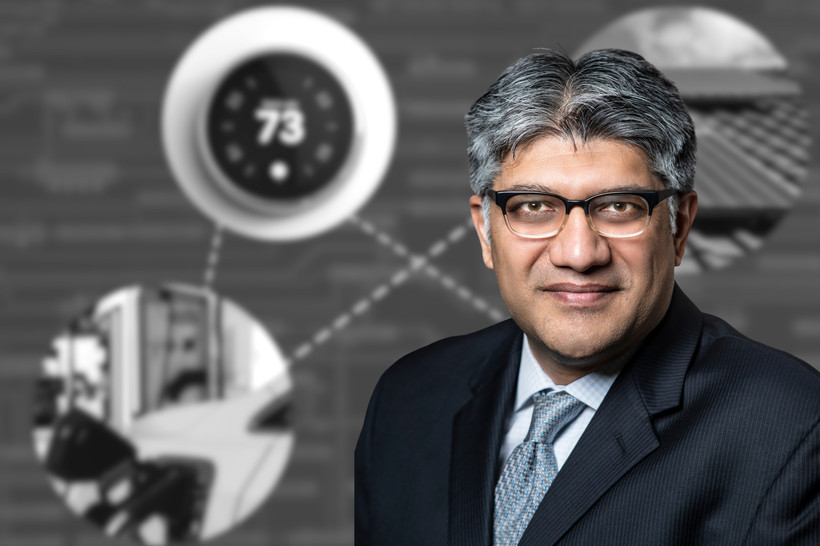
Clean energy expert Jigar Shah explains why New York has been slow to change. | Jigar Shah photo: US Govt/Wikimedia Commons; Background photos: andiiwan, anuka5296, Jirasukhanont, Jordi Calvera/Canva | Illustration: New York Focus

Sign up for Staying Focused, our newsletter keeping readers up to speed on New York politics.

Over his more than two decades as a clean energy entrepreneur and commentator, Jigar Shah has established himself as one of the most prominent voices calling for a more decentralized, flexible grid. From founding the company SunEdison in 2003 to heading up the US Department of Energy’s Loan Programs Office under former President Joe Biden, Shah has helped finance a generation of clean energy projects. He also had a hand in shaping New York’s energy policies as a board member of the state energy authority NYSERDA from 2014 to 2017, when the agency was building up its rooftop solar program and pursuing a deeper electric grid overhaul known as “Reforming the Energy Vision.” (That effort remains unfinished, as New York Focus recently reported.)

Throughout, Shah has hammered home the message that a cheaper, cleaner grid is within reach — if only utilities would allow it. Home devices ranging from water heaters to batteries can be networked into “virtual power plants” that help the grid stay in balance at a fraction of the cost of dirty power plants, he says. (In video episodes of his new podcast, the phrase hovers just above Shah’s head, in a poster on the wall behind him.) But utilities have long resisted efforts to bring this approach into the mainstream.

New York Focus spoke with Shah in December as part of a broader look at virtual power plants. He discussed his vision for a more flexible grid and why New York’s efforts to achieve one have been slow to take off. (The interview predated Governor Kathy Hochul’s announcement that she is seeking to expand those efforts through a program called Excelsior Power, which would provide $33 million in incentives for New Yorkers to enroll smart thermostats with their utilities. The initiative does not include batteries, which Shah says are a priority.)

A transcript of the conversation follows. It has been edited for length and clarity.

Jack Carroll: You hear about virtual power plants, demand response, demand flexibility, all these different terms. For you, what’s the top reason to pursue these things?

Jigar Shah: The utility is in charge of making sure that you have a worry-free experience. If you want to buy an espresso machine, do it. If you want to convert your gas dryer to an electric dryer, do it. If you want to put an EV in your garage, they’ll take care of it. The whole point of the electric utility company is to make your consumer purchases easy to do.

In order for the utility to make that work, they supply you power in a real-time basis. They spin up a generator, they transmit that power via transmission lines, and then distribute it by distribution lines to your home. That’s a one-directional system. If your home requires more power than that, then you need to upgrade the service of your home. If the neighborhood needs more power, well, then you’ve got to upgrade the entire distribution system.

That has turned out to be the most expensive way to solve the problem. And that is now leading to people feeling powerless over their bills. So that’s one big theme.

The second theme is that you’ve got 30-plus years of electricity innovation that’s occurred here in the United States, and a lot of that technology is now really cheap and affordable. And we don’t really have an ability to deploy that technology at scale.

The last time we had this issue was in the 1990s. We had the 1996 Telecom Act, which basically was saying, ‘Why don't people have access to cell phones?’ It was because the utility company, in that case AT&T, wouldn’t allow the implementation of innovation. It was always, ‘Well, it’s not safe. It’s somebody’s fault. We’re doing a transition as fast as we can.’ But as a result, we were not deploying innovation that we had invented here in the United States. And they ended up having to break up the utility. 

Now, I don't know what the answer is here, but both things are true. One is that the utility business-as-usual model is too expensive. And two is that we have a crapload of innovations. And the utilities are saying, ‘We're doing that as fast as we can, but you guys don't understand physics.’ That, I think, is the foundation of the problem that we're in.

Colin Kinniburgh: You brought up the cost aspect. Something we also hear about constantly these days is reliability. Grid operators are putting out these reports saying there will be shortfalls in supply with all these new loads coming onto the grid. They talk about keeping peaker plants open for longer. To what extent do you think these kinds of solutions can address reliability?

Shah: It’s the same exact argument. On the one hand, you have the business-as-usual way of doing reliability. And then you’ve got 30 years of innovation — ways that can provide reliability that’s 90 percent cheaper than that. Every new water heater that people install now has an app that goes with it. So you can control people’s water heaters and, if you need to spin up a natural gas peaker plant because you need extra power, well, the alternative is you can reduce load. That’s what Rocky Mountain Power has been doing for five years in Salt Lake City. They pay to help you put a battery in your home, and then they run that battery twice a day, and they run it instead of running a peaker plant.

“Reforming the Energy Vision” is an initiative launched under then-Governor Andrew Cuomo in 2014 that sought to reduce utilities’ incentive to build traditional infrastructure and instead promote more “distributed” resources like rooftop solar and batteries. The effort is ongoing but largely dormant.

Under Governor Kathy Hochul, the state has ramped up its efforts to develop battery storage of all sizes, including through a competitive bidding process for larger projects (5 megawatts and up) that could serve a wider area. All projects bidding for state contracts also need approval from their local utilities to plug into the grid.

In August, Con Edison froze applications from battery storage developers following a surge of project proposals in New York City’s outer boroughs. The utility is now seeking approval from state regulators to charge developers more for plugging in new battery projects, in ways it says will better reflect their impact on the grid.


Kinniburgh: Why do you think this hasn’t taken off more? What is the biggest barrier? And specifically in New York?

Shah: We in New York invented the whole REV — Reforming the Energy Vision. And even now, when you look at the five-megawatt battery storage pilot in ConEd territory, ConEd is saying, ‘Oh, too much success. We’ve had too many batteries bid into this program. Now we’re worried about shifting the entire peak. I think we’re going to have to slow this down and reevaluate all of it.’

You go to the governor, and you say, ‘Hey, Governor, you have this problem. Utilities want business as usual. The innovators want to deploy their innovations. What is your opinion on how we get through this?’ And she’s like, ‘I don’t have any expertise in this area. Don’t make me make the decision.’ And you’re like, ‘Great, you’ve got Doreen Harris that runs NYSERDA. Why don’t you outsource it to her? She’s super smart.’ And Doreen is like, ‘We do research and development. We don’t want to make those decisions at NYSERDA.’ And then you’ve got Rory Christian running the Public Service Commission. And Rory is like, ‘I don’t want to make that decision either. I’m going to relegate it to the staff of the New York Public Service Commission. New York Public Service Commission’s like, ‘Well, we think everything should go much more slowly.’

And so there’s no architect for change in New York state. I don’t think any of them are villains. I don’t think the people who run the Public Service Commission or NYSERDA or the governor’s office are bad people, but they certainly don’t trust their own instincts. And so the question is, who should they trust? Because that answer is nobody, they trust the electric utility. Because [the utilities] have been around for a long time, and they’re the ones who are in charge of making sure the lights go on, and they’re the ones that people blame when there’s a power outage or whatever it is. So if they are saying, ‘We think there’s going to be increased power outages because of decisions you’re making, Governor,’ then the governor’s like, ‘Wow, then we should slow this down.’ And as a result, they continue to get the ability to raise rates.

[Asked about this characterization, NYSERDA President Doreen Harris said, “NYSERDA is helping New Yorkers access clean, affordable electricity by researching, commercializing, and deploying innovative technologies that address barriers to renewable energy,” citing the authority’s $65 million Grid Modernization Program.

Public Service Commission chair Rory Christian said, “The Commission has long served as an agent of change for NYS. New York includes some of the oldest and most complicated energy networks in the world, and integrating new technologies while prioritizing safety, reliability, and affordability takes time and responsible coordination.” He cited longstanding programs to rein in energy use from large industrial customers, which open up some 1.4 gigawatts on the grid at peak times.]

Kinniburgh: Is there a role for the legislature here to step in?

Shah: Yeah. Because what the utilities are saying is, ‘We’ll follow the law.’ So if the legislature passes a law that says, ‘We need to make sure we get more out of the stuff we’ve already paid for,’ then there’s two components to that. One component is we have to measure how well we’re using the stuff we’ve already paid for. That data needs to be open sourced, or at least partially open sourced. Maybe you don’t give it to the public, but you give it to the Public Service Commission, or you give it to somebody.

Then, the Public Service Commission has to approve projects based on that number. So if the utility says, ‘Well, this distribution circuit’s used 12 percent of the time,’ they’re like, ‘Great. That number needs to be 14. It needs to go up. And then 16, then 18, then 20, 22.’ And you’re like, ‘How do we do that?’ It might be natural gas. I’m not trying to be specific on the technologies. But most likely it’s going to be batteries or demand flexibility, or virtual power plants or all this other stuff.

But now you actually have a framework. And so I think you’re putting your finger on it. The only way to break this logjam is through the legislature.

What's Happening in Other Places?


Virginia: Passed a law last May requiring the state’s largest utility to create a 450-megawatt virtual power plant pilot, comparable to the size of a major conventional power plant. The state legislature is now weighing another bill that would require utilities to measure grid utilization (“how well we’re using the stuff we’ve already paid for,” in Shah’s words) with the goal of improving it.


California: Assembled more than 700 megawatts’ worth of home batteries in less than three years, but funding issues have left the program in limbo.


Puerto Rico: The utility LUMA pays owners of rooftop solar and batteries to use some of their power when supply falls short. As of October, more than 81,000 customers were enrolled, adding up to 500 megawatts of capacity.


Utah: The utility Rocky Mountain Power offers a program similar to LUMA’s, with about 6,000 batteries enrolled as of 2024.


Minnesota: Regulators are reviewing a proposal by the utility Xcel Energy to create utility-owned virtual power plants — an approach that Shah supports, but other flexible grid proponents oppose out of concern that it could be more expensive than a consumer-led model.


Australia: The country’s largest power company has some 400,000 devices — including water heaters, batteries, solar panels, and electric vehicles — connected into a massive 1.5-gigawatt network.

Carroll: I’ve heard you say we can cut rates 20 percent by 2030. Do you think that statement applies to New York as well?

Shah: Yeah. There’s two pieces to the equation. One piece is the numerator — expenditure by the utility. And then the second piece is the denominator [electricity demand]. The reason you couldn’t do it five years ago is the denominator wasn’t going up. Today, the denominator is going up. Kilowatt-hour sales are going up. That’s in New York state — that’s everywhere. And then [with] the numerator, the question is, how does that number become more stable? That doesn’t mean that we’re spending less money, to be clear — we’re just spending less money [on our utility bills]. Because consumers are spending lots of money. They’re buying solar panels with battery storage. They’re buying electric vehicles. They’re buying smart water heaters. They’re buying smart thermostats. They’re buying lots of stuff. But none of those features are being paid for by the utility. Consumers continue to pay more and more money for stuff that they believe protects their family. And now those things can do double duty to reduce rates.

Kinniburgh: These technologies often demand consumers to be very active. If you want solar on your roof, you have to go through everything to install that. Maybe you have to subscribe to a demand response program. You’re getting texts [asking you to reduce usage]. There’s just a lot of hoops to jump through. What is the best way to do this so that people aren’t bombarded with decisions about their energy?

Shah: I think that there’s a level of interest that consumers have. And I think the vast majority of this can be done in a consultative fashion with the customer, where you say to the customer, ‘Has something broken?’ ‘Yes, my water heater. I’d like to replace it with something that could give me the lowest possible lifetime cost.’

‘Great. That’s this model.’ And you don’t need to research Wirecutter, and you don’t need to research all the utility rebate programs, and you don’t have to research Consumer Reports. ‘We’ll make sure we give you the best recommendation, and here’s the contractor that we’ve pre-vetted that doesn’t screw people in the Syracuse area, and we’ve got this financing, and it’s all seamless to you.’

I think that’s possible. I think this stuff can be fairly painless.

I hope this article helped you better answer the question that guides all of our journalism: Who runs New York? Before you click away, please consider supporting our work and making more stories like this one possible.

New York state is standing at a crossroads for climate action. After passing one of the nation’s most ambitious climate laws in 2019, the state is lagging far behind on its targets, struggling to meet deadlines to build renewable energy and clean up its buildings and roads. Other states are closely watching our progress, making decisions about their own climate plans based on New York’s ability to implement this legislation.

As New York’s only statewide nonprofit news publication, we’ve been scrutinizing the state’s climate progress. Our journalism exists to unpack how power works in New York, analyze who’s really calling the shots, and reveal how obscure decisions shape ordinary New Yorkers’ lives.

But we can't do this work without your help. We rely on reader donations to help sustain our outlet, and every gift directly allows us to publish more pieces like this.

Our work has already shown what can happen when those with power know that someone is watching, with my reporting prompting a state investigation and fine for a major corporation. I have more story ideas than I can count, but only limited resources to pursue all the leads that come across my desk.

If you’re able, please consider supporting our journalism with a one-time or monthly gift. Even small donations make a big difference.

Thank you for reading.

Colin Kinniburgh
Climate and Environmental Politics Reporter
A photo of Colin Kinniburgh.
Colin Kinniburgh is a reporter at New York Focus, covering the state’s climate and environmental politics. He has worked in media for more than a decade, across print, television, audio, and online news, and participated in fellowship programs at CUNY’s Graduate School of Journalism… more
Jack Carroll is a journalist in New York. His work has also appeared in Wired, City & State and The Daily Gazette.
Also filed in New York State

At a Board of Regents meeting Monday, state officials proposed eliminating credit-based diploma requirements.

The last-minute influx, the biggest ever for a legislative primary, is boosting her opponent, Jessica González-Rojas.

City budget gaps and an ambitious affordability agenda may require pressing Albany again for taxes and aid.

Also filed in Climate and Environment

The citizens assembly model, used for public decision-making around the world, is gaining traction in New York.

A lobbyist who has been romantically linked to Assembly Speaker Carl Heastie led a rally opposing the legislation a week before the speaker declined to bring it to a vote.

In May, state lawmakers passed a $269 billion budget after haggling for months over thousands of line items and policies affecting New Yorkers.

Also filed in Affordability

We’ve compiled information for the 450,000 New Yorkers who will lose health care coverage on July 1.

We’ve compiled information for SNAP recipients in New York on the changing work requirements.

Despite last-ditch efforts by a coalition of lawmakers, the state failed to avert a health coverage cliff coming this summer.