Mamdani Wants to Fix Property Taxes. Eric Adams’s Failure Is a Warning Sign.

As Zohran Mamdani prepares to unveil property tax reforms, he must weigh a plan he inherited from his predecessor.

Nick Garber   ·   March 2, 2026
Eric Adams's failed attempt to fix New York City's broken property tax system shows why it won’t be easy for Mamdani to do so either.
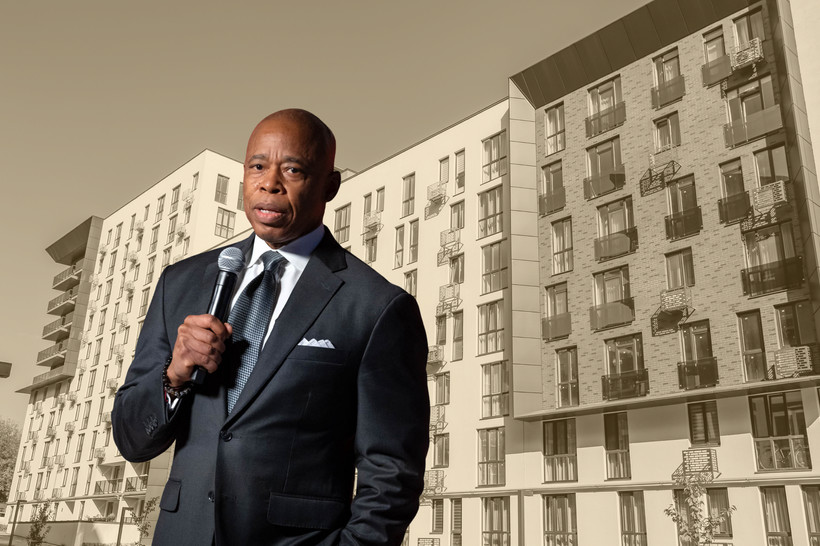
Eric Adams's proposed a fix to New York City's property tax system — but couldn't get Albany lawmakers to introduce it. | Eric Adams photo: Ed Reed/Mayoral Photography Office; Building photo: Olha Tsiplyar/Canva | Illustration: New York Focus

Sign up for Staying Focused, our newsletter keeping readers up to speed on New York politics.

New York City Mayor Zohran Mamdani made a bold pledge last month: Within weeks, he would send state lawmakers a plan to fix the city’s broken property tax system.

A failed attempt by his predecessor, Eric Adams, shows why that won’t be easy.

The city’s property tax system is widely considered to be unfair because it taxes lower-income neighborhoods at higher rates than wealthy ones, and taxes big apartment buildings, where tenants tend to live, at higher rates than expensive co-ops and condos. Last spring, the Adams administration pitched state lawmakers on a set of reforms, but the effort died after the mayor was unable to find any legislators willing to even sponsor the bill.

New York Focus obtained the proposal, details of which have not previously been reported. The plan dealt with one side of the system, by gradually shrinking the tax disparity between small homes in different neighborhoods. It would not have addressed the problems affecting rental housing, condos, and co-ops. Still, it would have lowered tax bills for nearly 300,000 homeowners, while raising taxes on fewer than 200,000.

The bill’s failure to advance is a warning sign for Mamdani, who campaigned on fixing the system that has been enshrined in state law since 1981.

Most mayors since David Dinkins have made similar promises, but few, if any, have gotten as far as Adams did by proposing an actual bill in Albany. Others have been confronted by the political reality that comprehensive reform would entail raising some homeowners’ tax bills by thousands of dollars — a nonstarter for some of the state legislators who would need to approve the reforms.

But Mamdani has given the issue more urgency: Even as he pushes to make the system more fair, the mayor has also proposed a last-resort budget that would raise property taxes citywide under the current, inequitable rules, unless Albany approves tax hikes on the wealthy and corporations.

Mamdani’s budget director, Sherif Soliman, and his corporation counsel, Steven Banks, were made aware of the Adams plan by City Hall officials shortly before the ex-mayor left office at the end of last year, according to an Adams official who requested anonymity to discuss the unpublished plan.

“Is he going to have them start all over again, or is he going to pick up the bill that is sitting in his Albany office and introduce it?” the official said.

It appears that Mamdani wants to start over: A city official told New York Focus that the Adams plan falls short of the wide-reaching reforms that Mamdani envisions.

A key part of the Adams plan would have loosened the longstanding caps on how much the assessed value of a one- to three-family home can rise each year, a major source of the system’s inequities. The current caps — 6 percent per year and 20 percent over five years — have slowed tax increases in neighborhoods like Park Slope and the East Village, where values have skyrocketed in recent decades. Meanwhile, homeowners pay far higher tax rates relative to their homes’ value in lower-income parts of southern Brooklyn, the east Bronx, and eastern Queens.

The Adams plan would have raised those caps to 8 percent per year and 35 percent over five years, creating a “gradual transition toward more equitable taxation,” according to a slideshow his administration showed lawmakers last year. It would also reset a home’s assessed value to a standard level — 6 percent of market value — when the home is sold, although that would not apply when homes are transferred between family members.

That’s less ambitious than what Mamdani hopes to do. Soliman has said publicly that the administration’s plan will be modeled on the recommendations of a 2021 commission on property tax reform convened by then-Mayor Bill de Blasio — which called for fully eliminating the caps.

The Adams plan also gave tax relief to some lower-income homeowners — offering a tax break worth up to 25 percent of a home’s assessed value for households earning below about $107,000. A similar exemption was also recommended by the de Blasio commission.

The Adams plan would have reduced tax rates for about 275,000 households, with a median savings of about $960 a year, according to the city’s estimates. Another 168,000 households would have seen a median tax increase of $711.

Property tax bills would have risen in nearly all of Manhattan, parts of north and central Brooklyn, and Riverdale in the Bronx, according to the documents, while the biggest decreases would happen in the east Bronx, eastern Queens and southern Brooklyn.

Bronx state Senator Luis Sepúlveda is among the lawmakers who were briefed on Adams’s plan last year. He said it was a decent start.

“We were making some progress, and then session ended, and we couldn’t get to the finish line,” he said. “I thought de Blasio’s plan was better.”

‘A Waste of Effort’

Absent from the Adams plan are fixes for other huge flaws in the current system: the over-taxation of multifamily buildings compared to standalone homes, and the under-taxation of luxury apartments. Under the current system, a 43-unit building in West Harlem with rent-stabilized units pays $71,500 a year in property taxes — or 1.6 percent of its total value — while a single-family home next door worth $4.2 million owes just $12,200, or 0.3 percent of its value, according to a 2025 report by the antipoverty nonprofit Community Service Society.

Meanwhile, expensive units often pay relatively little, thanks largely to a state law that requires condos and co-ops to be valued as if they were rentals. That means luxury homes are compared to a broad category of apartments that includes rent-stabilized units worth much less — resulting in artificially low tax bills for the expensive homes. That shifts more of the tax burden onto rental buildings, whose owners often pass those costs to tenants through higher rents.

Ana Champeny, vice president for research at the fiscally conservative Citizens Budget Commission, called the Adams plan “a limited proposal” that mainly addresses inequities among one- to three-family homes, “rather than a comprehensive property tax reform package that the city truly needs.” It’s unclear whether the Adams plan would have been revenue neutral, meaning it would not cause the city to lose money compared to the current system.

Champeny said the Adams plan could have even raised the effective tax rate on apartment buildings since it lowers taxes on some smaller homeowners.

That could be a non-starter for Mamdani, who has said he wants to lower property taxes on rental buildings to help landlords afford the cost of his proposed rent freeze on stabilized units.

Kenny Burgos, who represents rent-stabilized landlords as CEO of the New York Apartment Association, had harsh words for the Adams plan after New York Focus provided a copy.

“Any property tax reform plan that doesn’t reduce taxes on rent regulated buildings providing deeply affordable housing is a waste of effort,” Burgos said in a statement. “This proposal did nothing to end the most egregious inequity in the current property tax system.”

The mayor’s office did not respond to questions about whether Adams’ plan will influence Mamdani’s forthcoming proposal, but said Mamdani believes the current system is “fundamentally broken and deeply inequitable.”

“For too long, it has shifted the burden onto working families and tenants while protecting entrenched interests,” City Hall spokesperson Matt Rauschenbach said. “That’s why our administration is working closely with our allies to advance a comprehensive package of reforms that will finally deliver a fair, transparent system — one that treats tenants and property owners with the dignity and equity they deserve.”

Could a Lawsuit Force Action?

After promising to take quick action on property taxes, Adams showed little movement on the issue until last year. That sudden activity was sparked in part by a 2024 court ruling that revived a lawsuit brought by a coalition of renters, homeowners, and landlords called Tax Equity Now New York, which wants to force the city to take action.

Adams officials had little hope of passing any reforms last year. But they told lawmakers that even showing some interest could protect the city “from the consequences of an unfavorable ruling” in the suit, according to the presentation.

“All we wanted them to do was introduce the bill,” the former Adams official said, referring to lawmakers. “We wanted to be able to show the court that we are in fact working on an equitable property tax system — here’s the bill.”

The suit’s plaintiffs are unconvinced. Martha E. Stark, a former city finance commissioner who is policy director for Tax Equity Now, argues that the city could fix some problems on its own, by changing its method for assessing condos and co-ops to compare them only to market-rate rentals, rather than rent-stabilized units. As a candidate, Mamdani criticized Adams for fighting the lawsuit in court, but city lawyers have not given any public sign that they are shifting their position since he took office.

A ruling in that case has been pending for months. In the meantime, Stark said it would be a mistake for Mamdani to run with his predecessor’s plan, which she said did too little to address the needs of tenants in particular.

“If the mayor wants to forfeit his opportunity to fix those things, then I am concerned about his affordability agenda,” she said.

At New York Focus, our central mission is to help readers better understand how New York really works. If you think this article succeeded, please consider supporting our mission and making more stories like this one possible.

New York is an incongruous state. We’re home to fabulous wealth — if the state were a country, it would have the tenth largest economy in the world — but also the highest rate of wealth inequality. We’re among the most diverse – but also the most segregated. We passed the nation’s most ambitious climate law — but haven’t been meeting its deadlines and continue to subsidize industries hastening the climate crisis.

As New York’s only statewide nonprofit news publication, our journalism exists to help you make sense of these contradictions. Our work scrutinizes how power works in the state, unpacks who’s really calling the shots, and reveals how obscure decisions shape ordinary New Yorkers’ lives.

In the last two decades, the number of local news outlets in New York has been nearly slashed in half, allowing elected officials and powerful individuals to increasingly operate in the dark — with the average New Yorker none the wiser.

We’re on a mission to change that. Our work has already shown what can happen when those with power know that someone is watching, with stories that have prompted policy changes and spurred legislation. We have ambitious plans for the rest of the year and beyond, including tackling new beats and more hard-hitting stories — but we need your help to make them a reality.

If you’re able, please consider supporting our journalism with a one-time gift or a monthly gift. We can't do this work without you.

Thank you,

Akash Mehta
Editor-in-Chief
A photo of Akash Mehta.
A photo of Nick Garber.
Nick Garber covers politics for New York Focus. He previously worked for Crain’s New York Business, where he covered city and state government, housing and real estate, and money in politics. He also covered neighborhood news in Manhattan and Queens for Patch, and got… more
Also filed in New York State

A lobbyist who has been romantically linked to Assembly Speaker Carl Heastie led a rally opposing the legislation a week before the speaker declined to bring it to a vote.

In May, state lawmakers passed a $269 billion budget after haggling for months over thousands of line items and policies affecting New Yorkers.

Millions in outside spending was a boon to Gov. Kathy Hochul’s 2022 opponent, Lee Zeldin, and influenced down-ballot races.

Also filed in New York City

The citizens assembly model, used for public decision-making around the world, is gaining traction in New York.

Resorts World is floating legislation to avert more than $500 million in payments to the horseracing industry.

Some of the city’s new aid will be canceled out by pension boosts.

Also filed in Housing

A law designed to protect the environment will be partially rolled back to pave the way for much-needed homes.

After a New York Focus investigation, a Bronx charity distributed nearly $400,000 to survivors of a deadly 2022 fire.

Senate Majority Leader Andrea Stewart-Cousins says she sees “no reason” to remove Senator Luis Sepúlveda as judiciary chair.