Mamdani’s Albany Agenda Narrows as Tax Fight Crowds Out Other Issues

The mayor campaigned on more than a dozen state-level policy demands, but some are taking a backseat.

Nick Garber   ·   February 12, 2026
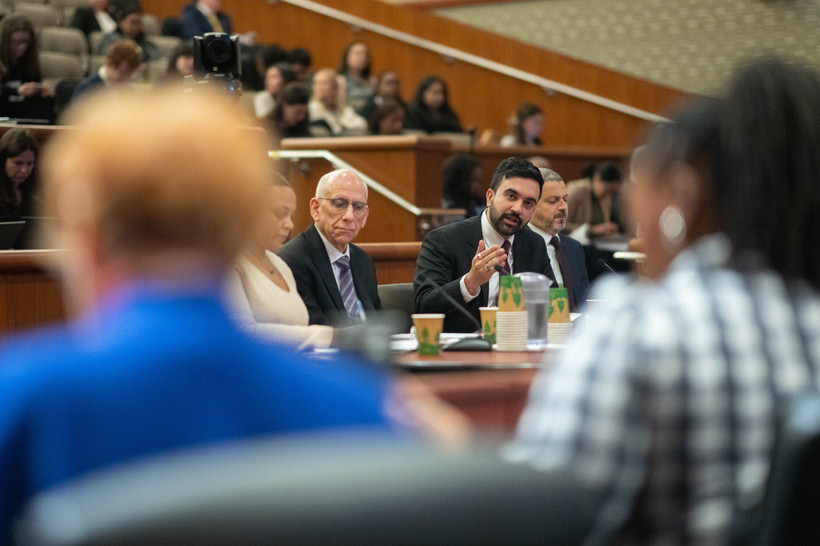
Mayor Zohran Mamdani testifies at the 2026 Joint Legislative Budget Hearing in Albany.
Mayor Zohran Mamdani testifies at the 2026 Joint Legislative Budget Hearing in Albany. | Michael Appleton/Office of Mayor Zohran Mamdani

Sign up for Staying Focused, our newsletter keeping readers up to speed on New York politics.

Mayor Zohran Mamdani’s “Tin Cup Day” in Albany was dominated by talk of two big-ticket policy proposals: making buses fare-free and raising taxes on millionaires and corporations. But New York City’s mayor has made a multitude of other promises that also hinge on state approval, which now appear to be on the back burner.

Mamdani’s campaign platform included more than a dozen distinct policies that require signoff from Albany, many of which have gotten relatively little attention. Mamdani said he wanted to nearly double the city’s debt limit in order to borrow another $70 billion to build housing; vowed to champion state bills banning non-disclosure agreements and junk fees; and promised to push for more state funding for the city’s beleaguered public housing system.

None of those figured into his four-hour hearing on Wednesday. And the mayor seemed to acknowledge that he is putting those lower-profile asks on hold for now, as he pushes lawmakers and Governor Kathy Hochul for permission to raise taxes to help close the city’s budget gap for the coming year.

“The focus at this moment, given the scale of this financial deficit, is addressing the deficit,” Mamdani told New York Focus after his testimony. But, he added: “We’re having a number of conversations all at once about issues of a scale large and small.”

Although Mamdani’s team contacted lawmakers before the hearing to ask what issues they planned to raise, several legislators told New York Focus in recent days that they have not received any specific policy requests from City Hall. The new mayor’s Albany operation is in its infancy, consisting of a small group of holdovers from Eric Adams’ administration as well as First Deputy Mayor Dean Fuleihan and senior advisor Simonia Brown — both Albany veterans. (Fuleihan approached several of those aides to introduce himself at Wednesday’s hearing, a sign of how recently the team came together.)

The city is making unexpectedly quick progress on at least one big Albany issue: a proposal to reform the city’s broken property tax system. Sherif Soliman, Mamdani’s budget director, said Wednesday that the city plans to release bills “in a matter of weeks” that would reform the system along the lines recommended by a 2021 commission formed by then-Mayor Bill de Blasio. It’s far from certain, however, whether any lawmakers will be willing to support the politically fraught reforms, which would leave some homeowners with far higher tax bills.

And Mamdani is getting a helping hand on some of his other campaign pledges. Hochul’s executive budget proposes extending and expanding J-51, a tax break that encourages renovations in apartment buildings, matching a call Mamdani made while running. Mamdani is supporting Hochul’s proposal, the mayor’s office said.

Biggest of all, Hochul has handed Mamdani a huge victory by helping to fund an expansion of child care in the city, one of his biggest campaign pledges. Although the program itself does not require state approval, it would have been exceedingly difficult to implement without the $1.7 billion that Hochul is committing next year.

But other pledges are getting pushed aside, at least for now. Most notable among them may be Mamdani’s call to borrow an additional $70 billion over the next decade to build 200,000 affordable homes, on top of the roughly $25 billion the city has already allocated for that purpose — which would require raising the city’s legal debt limit from its current ceiling of about $44 billion per year. Some Albany lawmakers may balk at the idea, since the city would need to eventually repay that debt with interest, further straining its already shaky finances.

Mamdani also campaigned on pushing Albany to expand rent stabilization to more new housing, likely by making changes to the 485-x tax break. The mayor has given no indication that he is sticking with that promise. Leila Bozorg, Mamdani’s deputy mayor for housing and planning, told THE CITY this month that she does not see any need to change 485-x.

And Mamdani made no mention of several state bills that he had pledged to support as mayor. They included the Tenant Opportunity to Purchase Act, a statewide version of the city-level measure that Eric Adams vetoed late last year; the Twenty-First Century Anti-Trust Act, a bill by Senate Deputy Majority Leader Michael Gianaris that would let the state more easily break up big companies; and a number of other bills that would reform the clemency process, guarantee a right to counsel in immigration court, and bar local governments from entering into immigration detention contracts with the federal government.

Mamdani did express support Wednesday for the New York for All Act, which would prohibit local law enforcement from collaborating with Immigration and Customs Enforcement. Although Hochul is backing a plan that would stop cities and counties from entering into contracts with ICE or renting out jail space to the feds, New York for All would go further by also prohibiting informal collaboration between local agencies and federal authorities.

Under questioning by Assemblywoman Sarahana Shrestha, a New York for All supporter, Mamdani — who has forged a delicate alliance with the moderate governor — said he supports both proposals.

“I think the governor has taken an important step in what she has announced. I think that this is also incredibly important legislation,” Mamdani said.

Matt Rauschenbach, a spokesperson for City Hall, said the mayor is still committed to issues beyond the ones he raised. “Mayor Mamdani has an ambitious agenda to move New York City forward, and he plans to work collaboratively with the governor and elected leaders in Albany to get it done,” he said. “He will continue working to build more housing, stand up for tenants, and support policy that makes the most expensive city in the country more affordable for working people.”

Lawmakers mostly used Wednesday’s hearing to grill Mamdani on his proposed 2 percent tax on city residents earning over $1 million per year, and four percentage-point tax hike on corporations that do business in the city. Legislators pressed the mayor about whether the measures would drive people and companies out of the city — and some took issue with his argument that the city deserves more because of its disproportionate contributions to the state’s tax base.

“I think you’re much better saying, ‘These are unique challenges that the City of New York faces that no one else faces,’” Assemblymember Pat Burke of Buffalo told Mamdani. “Not, ‘We make more, we have more, so we should get more.’”

Evan Stavisky, a longtime Albany lobbyist, said it makes sense that Mamdani is focusing his first Albany session on his proposed tax hikes, since the mayor wants to use that money to fund many of the city-level programs at the heart of his agenda.

“It doesn’t make it any easier to convince the governor or legislators to raise taxes,” Stavisky said, “but it’s obviously central to his economic worldview to ask companies and successful individuals to pay more in taxes to support programs for New Yorkers.”

At New York Focus, our central mission is to help readers better understand how New York really works. If you think this article succeeded, please consider supporting our mission and making more stories like this one possible.

New York is an incongruous state. We’re home to fabulous wealth — if the state were a country, it would have the tenth largest economy in the world — but also the highest rate of wealth inequality. We’re among the most diverse – but also the most segregated. We passed the nation’s most ambitious climate law — but haven’t been meeting its deadlines and continue to subsidize industries hastening the climate crisis.

As New York’s only statewide nonprofit news publication, our journalism exists to help you make sense of these contradictions. Our work scrutinizes how power works in the state, unpacks who’s really calling the shots, and reveals how obscure decisions shape ordinary New Yorkers’ lives.

In the last two decades, the number of local news outlets in New York has been nearly slashed in half, allowing elected officials and powerful individuals to increasingly operate in the dark — with the average New Yorker none the wiser.

We’re on a mission to change that. Our work has already shown what can happen when those with power know that someone is watching, with stories that have prompted policy changes and spurred legislation. We have ambitious plans for the rest of the year and beyond, including tackling new beats and more hard-hitting stories — but we need your help to make them a reality.

If you’re able, please consider supporting our journalism with a one-time gift or a monthly gift. We can't do this work without you.

Thank you,

Akash Mehta
Editor-in-Chief
A photo of Akash Mehta.
A photo of Nick Garber.
Nick Garber covers politics for New York Focus. He previously worked for Crain’s New York Business, where he covered city and state government, housing and real estate, and money in politics. He also covered neighborhood news in Manhattan and Queens for Patch, and got… more