Phantom Bill Targeting Education Rules Triggers Sharp Backlash in Statehouse

No lawmaker will take credit for the proposal, but its quiet circulation has sparked fierce debate over state control of religious education.
Bianca Fortis   ·   April 10, 2025
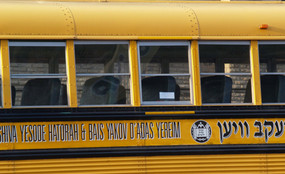
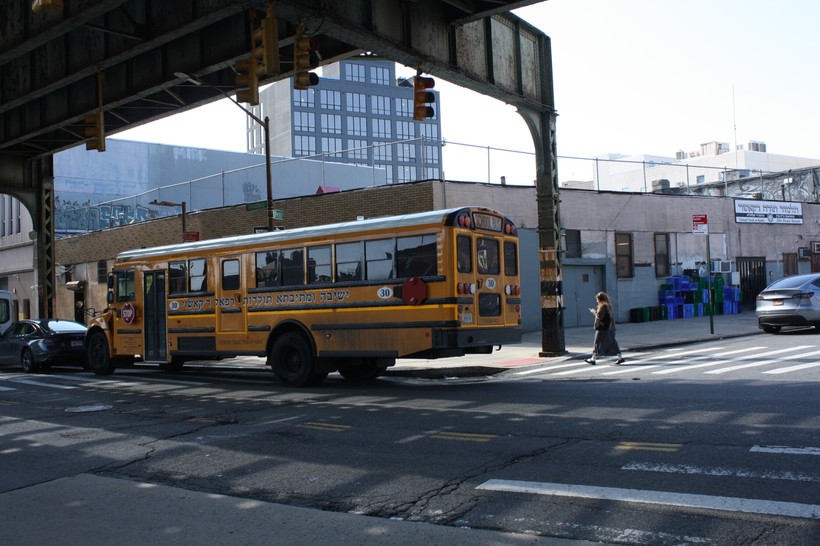
A school bus sits in front of Yeshiva Talmud Torah of Kasho in Williamsburg, Brooklyn. | Bianca Fortis

Sign up for Staying Focused, our newsletter keeping readers up to speed on New York politics.

A draft bill quietly circulating in the state legislature could significantly weaken oversight of nonpublic schools — including yeshivas — by loosening education standards and delaying enforcement deadlines. Few details about the bill have emerged, including who authored it, and multiple legislators say they haven’t seen the proposal.

New York Focus reached out to 24 members of the Assembly and Senate, including 19 on education committees. None could offer information about the bill’s origin or progress.

Governor Kathy Hochul said last week that she hadn’t seen the proposal and wouldn’t say whether she supported it — though she did back a similar effort last year.

The draft bill’s appearance so late during budget negotiations indicates that its sponsors are likely seeking to have the language inserted directly into a budget bill, as opposed to formally introducing it.

New York law requires nonpublic schools to provide a “substantially equivalent” education to that of public schools, and to teach core subjects like math, English, and science. If passed, the bill would weaken those regulations by making it easier for schools to meet the standard and by delaying the deadline — June 30 — for some schools to meet the requirements.

Some leaders of the Ultra-Orthodox community have fiercely opposed state oversight of yeshivas — which often prioritize teaching religious Jewish texts over core subjects — maintaining that they should retain full autonomy over their schools. A 2022 New York Times investigation found that many yeshivas, despite receiving $1 billion in public funds during the prior four years, had failed to teach students core subjects, left students unable to speak easily in English or find jobs post-graduation, and had some of the lowest standardized test scores in the state.

News of the proposal circulating in the Assembly elicited a sharp rebuke from the state Education Department. Spokesperson JP O’Hare said the agency “is concerned that access to a high-quality education for every child could be traded away as part of a political deal to pass a state budget.”

“This appears to be an attempt by some legislators to go around our state’s courts and dismantle a law that has been in place for over a century,” O’Hare said.

State Senator Liz Krueger backed the agency’s stance.

The education department’s “public opposition is crucially important — they worked hard and long to come up with a model of substantial equivalency that is supported by nearly every public, private, and religious school system in our State,” Krueger said in a statement. “The courts have also ruled in their favor. A handful of schools, and an even smaller number of legislators, should not be allowed to undermine New York children’s right to their education.”

State Senator John Liu, who sits on the Senate Education Committee and is the chair of the standing committee on New York City education, reaffirmed the agency’s viewpoint.

“Their statement is accurate,” Liu said. “And it’s pretty straightforward.”

Yet some saw the news as an opportunity to go even further.

Senate Minority Leader Robert Ortt issued a statement on Tuesday demanding the repeal of the substantial equivalency regulations in the state budget altogether.

“Our state’s woke, big-government education agenda has gone too far in targeting religious education,” Ortt said. “For too long, Albany bureaucrats and radical progressives have been waging war on parental rights in education and trampling on religious schools’ autonomy. We don’t need to just delay these attacks, we need to end them.”

The substantial equivalency regulations have been state law since 1895. The state Education Department issued new guidelines in 2022 to better enforce the rules.

Ortt’s office also did not provide details about the bill.

“This appears to be an attempt by some legislators to go around our state’s courts and dismantle a law that has been in place for over a century.”

—Education Dept. Spokesperson JP O’Hare

This latest effort to weaken the regulations is part of a years-long battle over whether the state should have oversight over Haredi and Hasidic yeshivas, of which there are more than 100 in New York, primarily in Brooklyn and Rockland and Orange counties.

The state Education Department has already pulled funding for six yeshivas in Brooklyn, well ahead of the upcoming deadline. The agency said those schools have failed to cooperate with both city and state education agencies, despite several deadlines and invitations to meet.

“The majority of nonpublic schools across the state are currently cooperating with the regulatory requirements,” O’Hare said in a statement. “We continue to stand ready to engage or re-engage with the small number of schools that have failed to demonstrate that they meet the minimum requirements of the law to date.”

In January, a coalition of yeshivas filed a complaint with the US Department of Education’s Office of Civil Rights, alleging discriminatory treatment by the state Education Department as well as the New York City Department of Education.

At New York Focus, our central mission is to help readers better understand how New York really works. If you think this article succeeded, please consider supporting our mission and making more stories like this one possible.

New York is an incongruous state. We’re home to fabulous wealth — if the state were a country, it would have the tenth largest economy in the world — but also the highest rate of wealth inequality. We’re among the most diverse – but also the most segregated. We passed the nation’s most ambitious climate law — but haven’t been meeting its deadlines and continue to subsidize industries hastening the climate crisis.

As New York’s only statewide nonprofit news publication, our journalism exists to help you make sense of these contradictions. Our work scrutinizes how power works in the state, unpacks who’s really calling the shots, and reveals how obscure decisions shape ordinary New Yorkers’ lives.

In the last two decades, the number of local news outlets in New York has been nearly slashed in half, allowing elected officials and powerful individuals to increasingly operate in the dark — with the average New Yorker none the wiser.

We’re on a mission to change that. Our work has already shown what can happen when those with power know that someone is watching, with stories that have prompted policy changes and spurred legislation. We have ambitious plans for the rest of the year and beyond, including tackling new beats and more hard-hitting stories — but we need your help to make them a reality.

If you’re able, please consider supporting our journalism with a one-time gift or a monthly gift. We can't do this work without you.

Thank you,


Bianca Fortis was the education reporter at New York Focus. She was previously an Abrams reporting fellow at ProPublica, where she spent 18 months investigating how Columbia University protected a predatory doctor who had sexually abused hundreds of patients for more than 20 years… more
Also filed in New York State

In May, state lawmakers passed a $269 billion budget after haggling for months over thousands of line items and policies affecting New Yorkers.

Millions in outside spending was a boon to Gov. Kathy Hochul’s 2022 opponent, Lee Zeldin, and influenced down-ballot races.

The legislation would make it easier for currently and formerly incarcerated people and child victims to sue the state over allegations of past abuse.

Also filed in Budget

State leaders are expected to pass a bill that avoids resolving how much Resorts World New York City needs to pay.

Resorts World is floating legislation to avert more than $500 million in payments to the horseracing industry.

Our searchable database breaks down the most consequential decisions Albany politicians made on climate, immigration, housing, schools, taxes, and more.

Also filed in Education

Advocates welcomed the additional funding but said it falls short of need and doesn’t do enough to support workers.

Some of the city’s new aid will be canceled out by pension boosts.

The Hochul administration now has a chance to relax New York’s child care staffing ratios — among the country’s strictest — after 26 years. But will it?